Loading page, please wait…
Vaidra Logo
Vaidra

Top 4 items + smart groups

UPSC GPT
New
Current Affairs
Daily Solutions
Daily Puzzle
Mains Evaluator

Version 2.0.0 • Built with ❤️ for UPSC aspirants

Loading...
Loading...
Loading...
Loading...
Loading...
Loading...
Loading...
Loading...
Loading...
Loading...
Loading...
Loading...
Loading...
Successful Launch of Ariane 6 Rocket - UPSC Science And Technology
Back
All Subjects

Topics

0 topics • 0 completed

Loading topics...
Loading...
Loading...
Loading...
Loading...
Loading...
Overall Progress0%

Successful Launch of Ariane 6 Rocket - UPSC Science And Technology

What is Successful Launch of Ariane 6 Rocket in UPSC Science And Technology?

Successful Launch of Ariane 6 Rocket is a key topic under Science And Technology for UPSC Civil Services Examination. Key points include: Ariane 6 is Europe's new heavy-lift launch vehicle, succeeding Ariane 5.. Its successful debut from French Guiana marks Europe's return to independent space access.. The Vinci engine in its upper stage allows for multiple restarts, enabling flexible payload deployment into various orbits.. Understanding this topic is essential for both UPSC Prelims and Mains preparation.

Why is Successful Launch of Ariane 6 Rocket important for UPSC exam?

Successful Launch of Ariane 6 Rocket is a Medium-level topic in UPSC Science And Technology. It is tested in both Prelims (factual MCQs) and Mains (analytical answer writing). Previous year UPSC questions have frequently covered aspects of Successful Launch of Ariane 6 Rocket, making it essential for comprehensive IAS preparation.

How to prepare Successful Launch of Ariane 6 Rocket for UPSC?

To prepare Successful Launch of Ariane 6 Rocket for UPSC: (1) Study the comprehensive notes covering all key concepts on Vaidra. (2) Practice previous year questions on this topic. (3) Connect it with current affairs using daily updates. (4) Revise using key takeaways and mind maps available for Science And Technology. (5) Write practice answers linking Successful Launch of Ariane 6 Rocket to related GS Paper topics.

Key takeaways of Successful Launch of Ariane 6 Rocket for UPSC

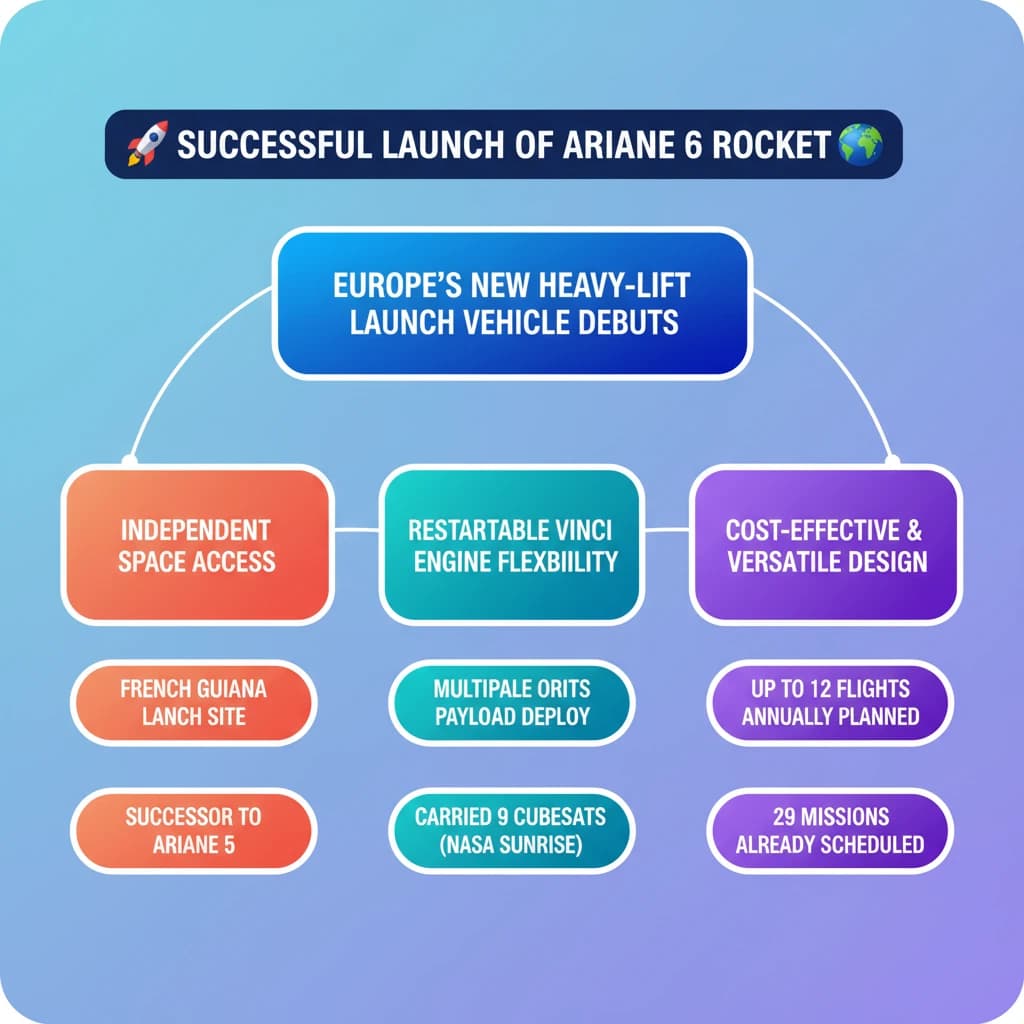
  • Ariane 6 is Europe's new heavy-lift launch vehicle, succeeding Ariane 5.
  • Its successful debut from French Guiana marks Europe's return to independent space access.
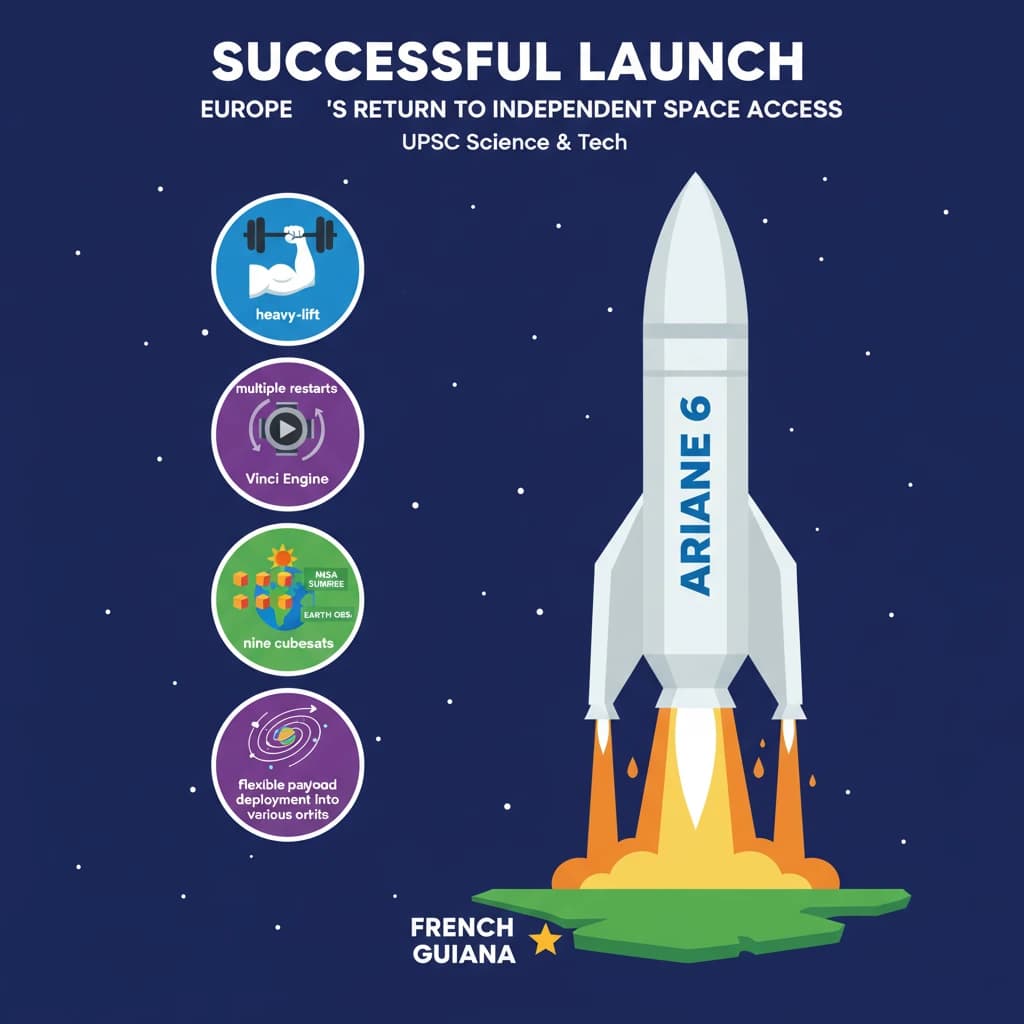
  • The Vinci engine in its upper stage allows for multiple restarts, enabling flexible payload deployment into various orbits.
  • The inaugural flight carried nine cubesats, including NASA's SUNRISE and Earth observation satellites.
  • Ariane 6 is designed for cost-effectiveness and versatility, with plans for up to 12 flights annually and 29 missions scheduled.
  • It is crucial for Europe's strategic autonomy and competitiveness in the global space market.
Successful Launch of Ariane 6 Rocket

Successful Launch of Ariane 6 Rocket

Medium⏱️ 7 min read✓ 95% Verified
science and technology

📖 Introduction

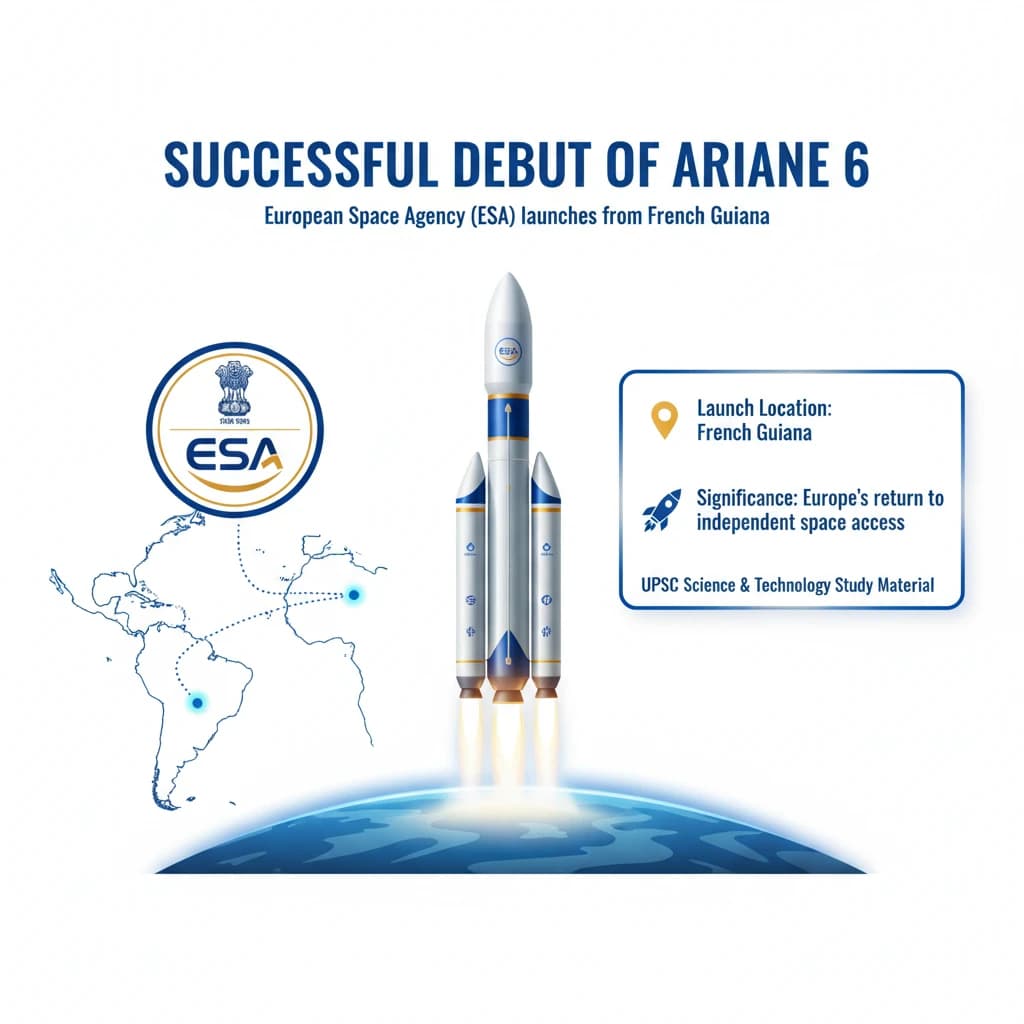
<h4>Successful Debut of Ariane 6</h4><p>The <strong>European Space Agency (ESA)</strong> has successfully launched the <strong>Ariane 6 rocket</strong> for the first time. This landmark event took place from <strong>French Guiana</strong>, signaling <strong>Europe’s return to independent space access</strong> after facing various delays and setbacks.</p><div class='info-box'><p>📍 <strong>Launch Location:</strong> French Guiana</p><p>🚀 <strong>Significance:</strong> Europe's return to independent space access</p></div><h4>Ariane Rocket Series: A New Era</h4><p>The <strong>Ariane 6</strong> is the latest and most advanced rocket in Europe’s distinguished <strong>Ariane rocket series</strong>. It is designed to take over from its highly successful predecessor, the <strong>Ariane 5</strong>.</p><div class='key-point-box'><p>The <strong>Ariane 6</strong> possesses versatile capabilities, enabling it to launch missions from <strong>low-Earth orbit</strong> and extend its reach further into <strong>deep space</strong>.</p></div><h4>Legacy of Ariane 5</h4><p>The <strong>Ariane 5 rocket</strong> has a remarkable track record, having been instrumental in launching numerous critical missions for various international space agencies.</p><ul><li>It launched <strong>NASA’s communication satellites</strong> such as <strong>GSAT-30</strong> and <strong>GSAT-31</strong>.</li><li>It was also used for <strong>ESA’s Juice mission</strong>, a significant deep-space probe.</li><li>Crucially, <strong>Ariane 5</strong> deployed <strong>NASA’s James Webb Space Telescope (JWST)</strong>, one of the most advanced space observatories.</li></ul><h4>Inaugural Flight Payloads</h4><p>The debut flight of <strong>Ariane 6</strong> successfully carried a diverse set of payloads into orbit, demonstrating its immediate operational capability.</p><div class='info-box'><p>The flight deployed <strong>nine cubesats</strong>, including:</p><ul><li><strong>NASA’s Subsolar Radiometer Interferometry Experiment (SUNRISE)</strong></li><li>Other satellites dedicated to studying <strong>Earth’s climate and weather</strong>.</li></ul></div><h4>Advanced Propulsion: The Vinci Engine</h4><p>A significant technological advancement integrated into the <strong>Ariane 6</strong> is its innovative upper stage engine.</p><div class='key-point-box'><p>The <strong>Vinci engine</strong>, utilized in the upper stage, is specifically designed to <strong>restart repeatedly</strong>. This crucial feature allows the operating agency to precisely place multiple payloads into <strong>several different orbits</strong> during a single mission, enhancing mission flexibility and efficiency.</p></div><h4>Future Outlook and Mission Goals</h4><p><strong>Ariane 6</strong> has an ambitious mission manifest planned for the coming years, solidifying Europe's long-term commitment to space exploration and commercial launches.</p><div class='info-box'><p>Over the next several years, <strong>29 missions</strong> are scheduled to be launched by <strong>Ariane 6</strong>. The program aims for a high operational tempo, targeting up to <strong>12 flights a year</strong>.</p></div><div class='exam-tip-box'><p>For <strong>UPSC Prelims</strong>, focus on the rocket's name, launch location, and key technical features like the <strong>Vinci engine's restart capability</strong>. For <strong>Mains GS-III</strong>, understand the strategic importance of <strong>independent space access</strong> and Europe's competitive position in the global space market.</p></div>
Concept Diagram

💡 Key Takeaways

  • •Ariane 6 is Europe's new heavy-lift launch vehicle, succeeding Ariane 5.
  • •Its successful debut from French Guiana marks Europe's return to independent space access.
  • •The Vinci engine in its upper stage allows for multiple restarts, enabling flexible payload deployment into various orbits.
  • •The inaugural flight carried nine cubesats, including NASA's SUNRISE and Earth observation satellites.
  • •Ariane 6 is designed for cost-effectiveness and versatility, with plans for up to 12 flights annually and 29 missions scheduled.
  • •It is crucial for Europe's strategic autonomy and competitiveness in the global space market.

🧠 Memory Techniques
Memory Aid
95% Verified Content

📚 Reference Sources

•European Space Agency (ESA) official website
•NASA official website (for JWST, SUNRISE details)
•Arianespace official website

Related Topics

Loading related topics...
Explore:Science And Technology Topics·All Subjects·Daily Current Affairs·Editorial Analysis·Previous Year Questions·UPSC GPT