Loading page, please wait…
Gliese 12 b Potentially Habitable Exoplanet near Earth - UPSC Science And Technology
What is Gliese 12 b Potentially Habitable Exoplanet near Earth in UPSC Science And Technology?
Gliese 12 b Potentially Habitable Exoplanet near Earth is a key topic under Science And Technology for UPSC Civil Services Examination. Key points include: Gliese 12 b is an Earth-sized, potentially habitable exoplanet discovered by NASA in May 2024.. It is located 40 light-years away, making it one of the closest potentially habitable planets to Earth.. The exoplanet has a relatively moderate average surface temperature of +42 °C.. Understanding this topic is essential for both UPSC Prelims and Mains preparation.
Why is Gliese 12 b Potentially Habitable Exoplanet near Earth important for UPSC exam?
Gliese 12 b Potentially Habitable Exoplanet near Earth is a Medium-level topic in UPSC Science And Technology. It is tested in both Prelims (factual MCQs) and Mains (analytical answer writing). Previous year UPSC questions have frequently covered aspects of Gliese 12 b Potentially Habitable Exoplanet near Earth, making it essential for comprehensive IAS preparation.
How to prepare Gliese 12 b Potentially Habitable Exoplanet near Earth for UPSC?
To prepare Gliese 12 b Potentially Habitable Exoplanet near Earth for UPSC: (1) Study the comprehensive notes covering all key concepts on Vaidra. (2) Practice previous year questions on this topic. (3) Connect it with current affairs using daily updates. (4) Revise using key takeaways and mind maps available for Science And Technology. (5) Write practice answers linking Gliese 12 b Potentially Habitable Exoplanet near Earth to related GS Paper topics.
Key takeaways of Gliese 12 b Potentially Habitable Exoplanet near Earth for UPSC
- Gliese 12 b is an Earth-sized, potentially habitable exoplanet discovered by NASA in May 2024.
- It is located 40 light-years away, making it one of the closest potentially habitable planets to Earth.
- The exoplanet has a relatively moderate average surface temperature of +42 °C.
- Its discovery is crucial for astrobiology and the search for liquid water and life beyond our solar system.
- The concept of a 'habitable zone' and suitable temperature are key criteria for potential habitability.
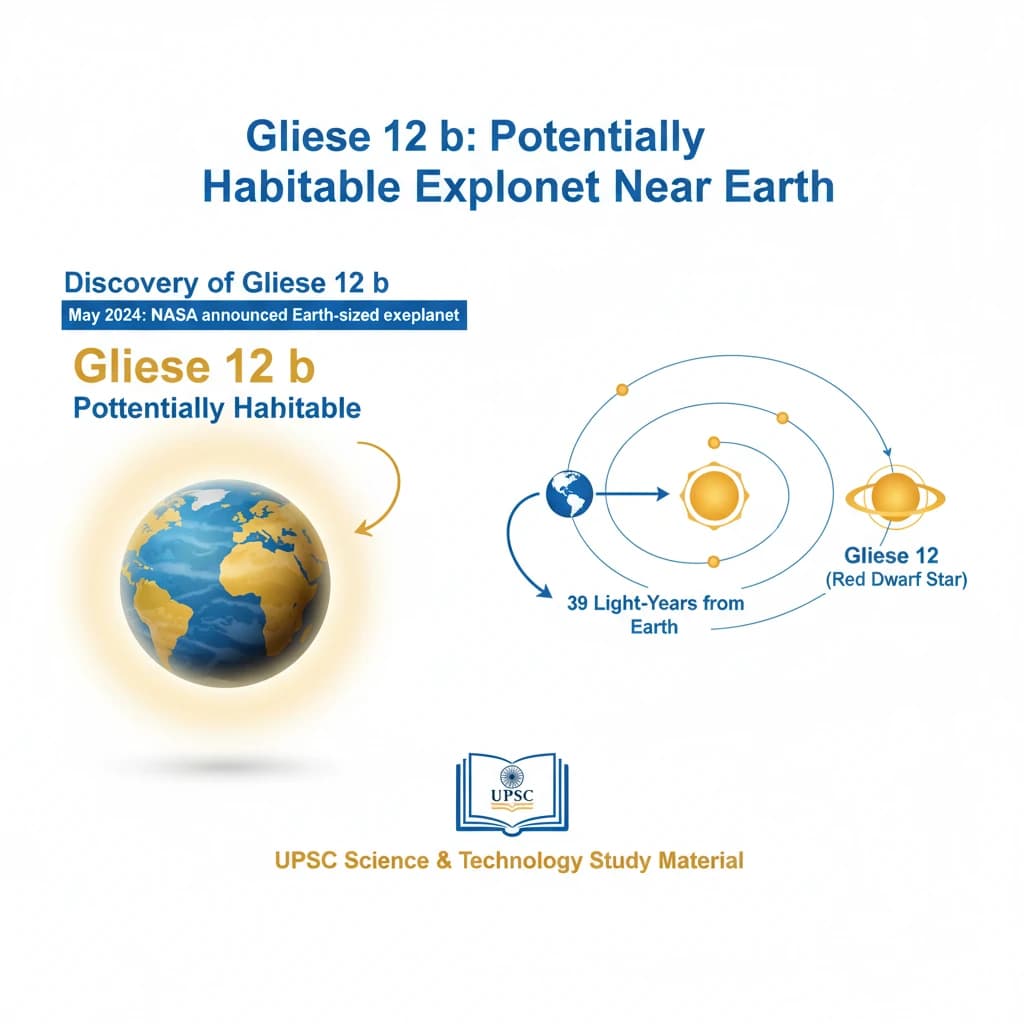
Gliese 12 b Potentially Habitable Exoplanet near Earth
Medium⏱️ 6 min read
science and technology
📖 Introduction
Discovery of Gliese 12 b
In May 2024, NASA announced a significant discovery in the field of exoplanet research. This announcement pertained to an Earth-sized celestial body.
The newly identified exoplanet has been officially named Gliese 12 b. It is particularly noteworthy for being categorized as potentially habitable.
Proximity to Earth and Location
Gliese 12 b is situated approximately 40 light-years away from our home planet, Earth.
This relatively close distance makes it one of the closest known potentially habitable planets discovered outside our solar system to date.
A light-year is a unit of astronomical distance equivalent to the distance that light travels in one year, which is about 9.46 trillion kilometers.
Surface Temperature and Habitability Potential
The average surface temperature of Gliese 12 b has been measured at +42 °C (107 °F).
This temperature is considerably lower than that of the vast majority of the over 5,000 exoplanets discovered so far, making it a prime candidate for further study.
A moderate surface temperature is a critical factor for the potential existence of liquid water, which is considered essential for life as we know it.
Understanding 'Potentially Habitable'
The designation 'potentially habitable' indicates that a planet possesses conditions that *could* support life, rather than confirming its presence.
- It typically implies the planet is located within its star's habitable zone (Goldilocks Zone).
- It suggests the possibility of conditions conducive to liquid water on its surface.
- Further atmospheric analysis is required to confirm true habitability.
UPSC often tests knowledge on recent space discoveries and the scientific criteria for exoplanet habitability. Understand the significance of temperature and distance.
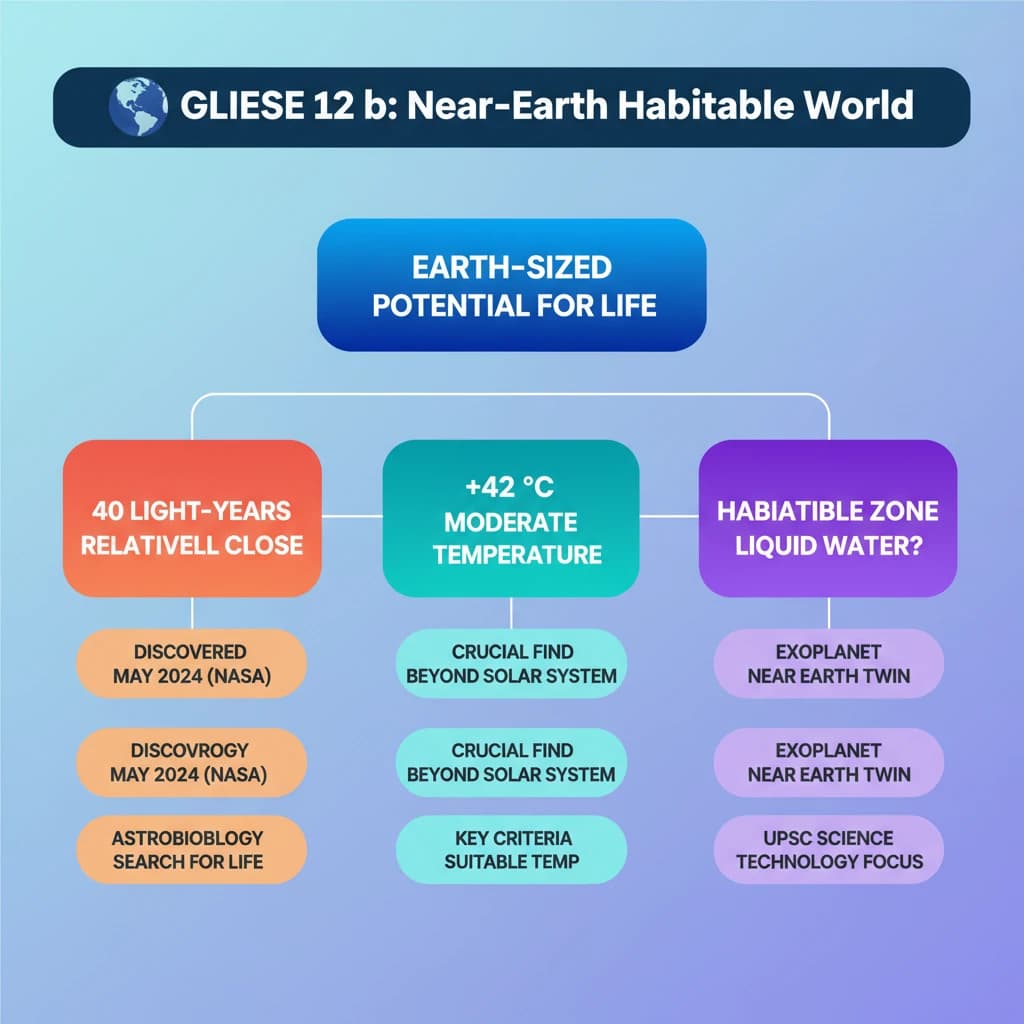
💡 Key Takeaways
- •Gliese 12 b is an Earth-sized, potentially habitable exoplanet discovered by NASA in May 2024.
- •It is located 40 light-years away, making it one of the closest potentially habitable planets to Earth.
- •The exoplanet has a relatively moderate average surface temperature of +42 °C.
- •Its discovery is crucial for astrobiology and the search for liquid water and life beyond our solar system.
- •The concept of a 'habitable zone' and suitable temperature are key criteria for potential habitability.
🧠 Memory Techniques
95% Verified Content
📚 Reference Sources
•NASA official press releases and astronomical data (general knowledge)
•European Space Agency (ESA) publications on exoplanet discoveries