Loading page, please wait…
Hayflick Limit: Cellular Senescence and its Role in Ageing - UPSC Science And Technology
What is Hayflick Limit: Cellular Senescence and its Role in Ageing in UPSC Science And Technology?
Hayflick Limit: Cellular Senescence and its Role in Ageing is a key topic under Science And Technology for UPSC Civil Services Examination. Key points include: The <strong>Hayflick Limit</strong> states that <strong>somatic cells</strong> can only divide a finite number of times (40-60) before stopping.. This cessation of division is called <strong>cellular senescence</strong>, and its accumulation contributes to aging.. The discovery challenged the belief that aging was solely due to external factors, introducing the concept of an <strong>inherent cellular clock</strong>.. Understanding this topic is essential for both UPSC Prelims and Mains preparation.
Why is Hayflick Limit: Cellular Senescence and its Role in Ageing important for UPSC exam?
Hayflick Limit: Cellular Senescence and its Role in Ageing is a Medium-level topic in UPSC Science And Technology. It is tested in both Prelims (factual MCQs) and Mains (analytical answer writing). Previous year UPSC questions have frequently covered aspects of Hayflick Limit: Cellular Senescence and its Role in Ageing, making it essential for comprehensive IAS preparation.
How to prepare Hayflick Limit: Cellular Senescence and its Role in Ageing for UPSC?
To prepare Hayflick Limit: Cellular Senescence and its Role in Ageing for UPSC: (1) Study the comprehensive notes covering all key concepts on Vaidra. (2) Practice previous year questions on this topic. (3) Connect it with current affairs using daily updates. (4) Revise using key takeaways and mind maps available for Science And Technology. (5) Write practice answers linking Hayflick Limit: Cellular Senescence and its Role in Ageing to related GS Paper topics.
Key takeaways of Hayflick Limit: Cellular Senescence and its Role in Ageing for UPSC
- The <strong>Hayflick Limit</strong> states that <strong>somatic cells</strong> can only divide a finite number of times (40-60) before stopping.
- This cessation of division is called <strong>cellular senescence</strong>, and its accumulation contributes to aging.
- The discovery challenged the belief that aging was solely due to external factors, introducing the concept of an <strong>inherent cellular clock</strong>.
- For humans, the maximum lifespan is estimated around <strong>125 years</strong>, beyond which this limit suggests life cannot be extended.
- Different species exhibit different <strong>Hayflick Limits</strong>, highlighting species-specific biological determinants of longevity.
Hayflick Limit: Cellular Senescence and its Role in Ageing
Medium⏱️ 6 min read
science and technology
📖 Introduction
Introduction: Renewed Attention to Hayflick Limit
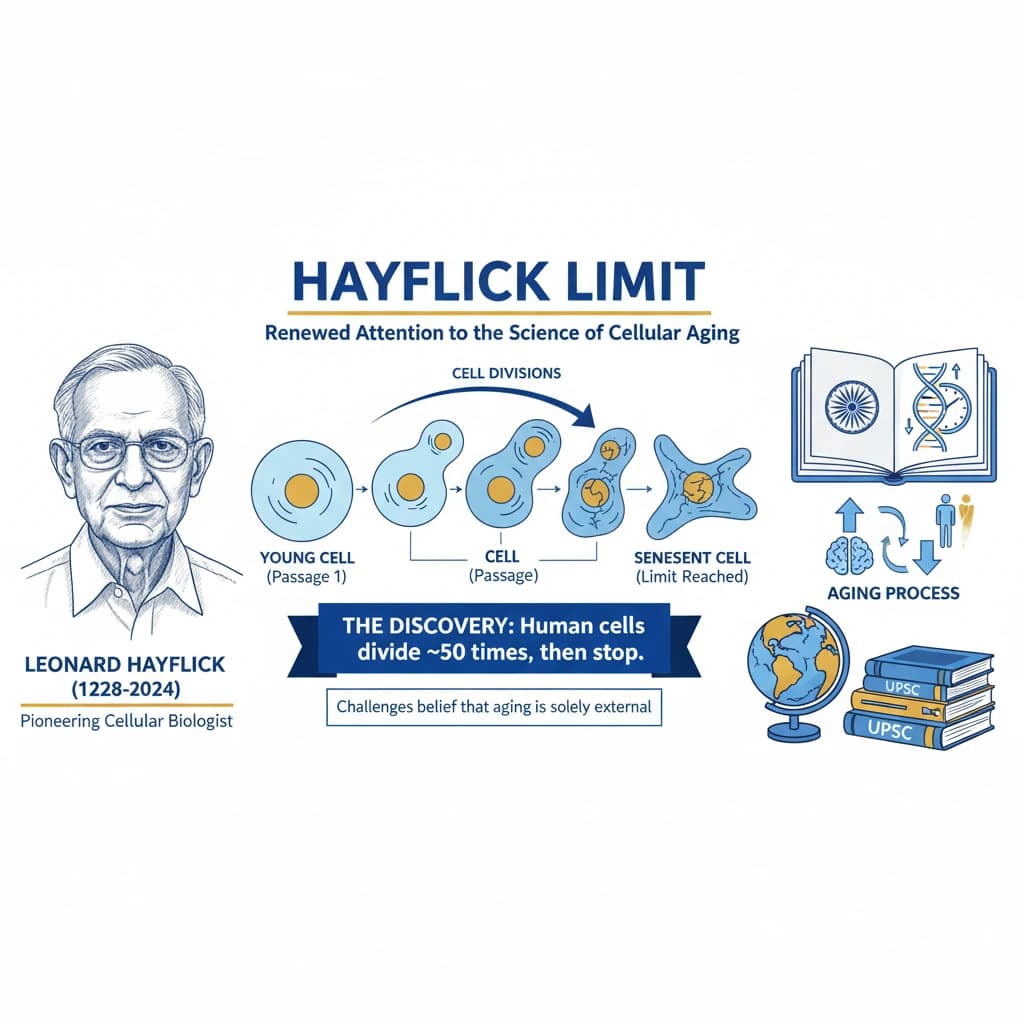
The recent passing of prominent biomedical researcher Leonard Hayflick has brought significant focus back to his pivotal discovery: the Hayflick Limit.
This concept fundamentally reshaped our understanding of the aging process, moving beyond the sole influence of external factors.
Challenging Previous Beliefs on Aging
Before Hayflick's work, aging was primarily attributed to external factors such as disease and adverse environmental conditions.
His discovery introduced the idea of an inherent cellular mechanism contributing to the decline associated with age.
Defining the Hayflick Limit
In the 1960s, Leonard Hayflick discovered that somatic cells (non-reproductive cells) possess a finite capacity for division.
These cells can only divide approximately 40 to 60 times before they permanently cease dividing, a phenomenon termed cellular senescence.
Cellular Senescence and Aging
The cessation of cell division leads to an accumulation of these senescent cells within the body.
This accumulation is now considered a crucial factor in the overall aging process and the associated physical decline.
The Inherent Cellular Clock
The Hayflick Limit proposes the existence of an inherent cellular clock within organisms, including humans.
This internal clock dictates the maximum potential lifespan for a species, setting a biological upper limit.
Human Lifespan and the Hayflick Limit
For humans, this biological limit is estimated to be around 125 years.
Beyond this estimated maximum, it is suggested that neither external factors nor genetic modifications can significantly extend life according to this principle.
Species-Specific Hayflick Limits
Hayflick and other researchers meticulously documented variations in the Hayflick limits across different animal species.
This comparative study underscored the species-specific nature of cellular division capacity and lifespan potential.
💡 Key Takeaways
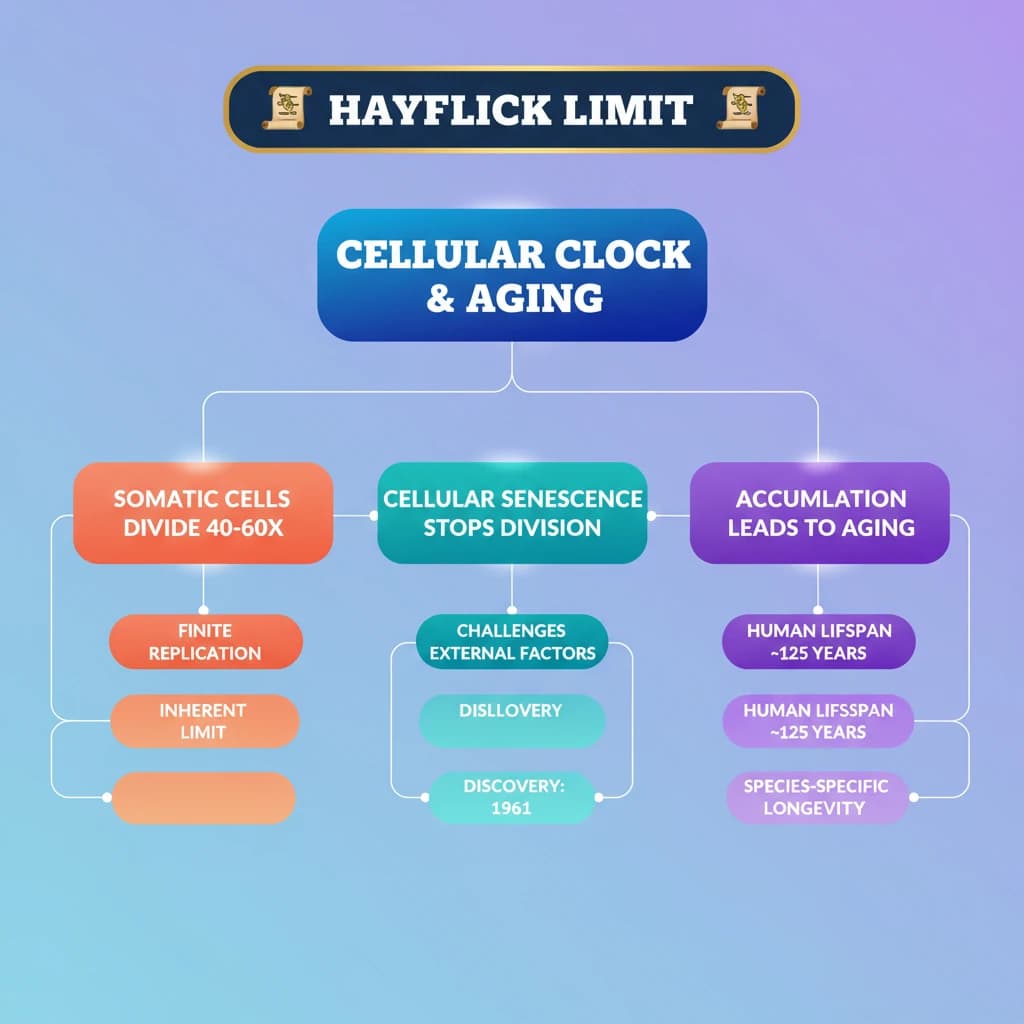
- •The <strong>Hayflick Limit</strong> states that <strong>somatic cells</strong> can only divide a finite number of times (40-60) before stopping.
- •This cessation of division is called <strong>cellular senescence</strong>, and its accumulation contributes to aging.
- •The discovery challenged the belief that aging was solely due to external factors, introducing the concept of an <strong>inherent cellular clock</strong>.
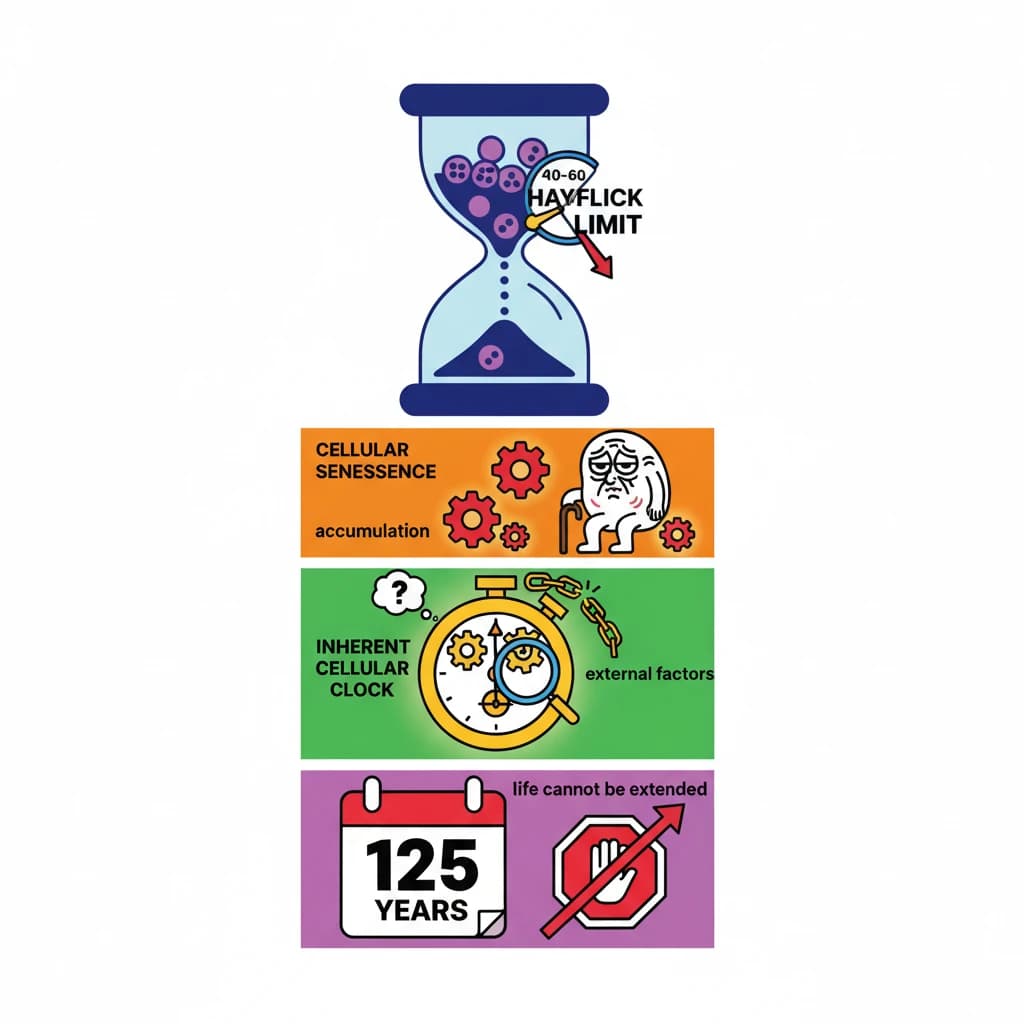
- •For humans, the maximum lifespan is estimated around <strong>125 years</strong>, beyond which this limit suggests life cannot be extended.
- •Different species exhibit different <strong>Hayflick Limits</strong>, highlighting species-specific biological determinants of longevity.
🧠 Memory Techniques
95% Verified Content