Loading page, please wait…
India to Join SKAO as a Full Member - UPSC Science And Technology
What is India to Join SKAO as a Full Member in UPSC Science And Technology?
India to Join SKAO as a Full Member is a key topic under Science And Technology for UPSC Civil Services Examination. Key points include: India is set to become a full member of the Square Kilometre Array Observatory (SKAO).. SKAO is the world's largest radio telescope project, with antennas in South Africa and Australia.. SKAO's objectives include studying celestial phenomena and gravitational waves.. Understanding this topic is essential for both UPSC Prelims and Mains preparation.
Why is India to Join SKAO as a Full Member important for UPSC exam?
India to Join SKAO as a Full Member is a Medium-level topic in UPSC Science And Technology. It is tested in both Prelims (factual MCQs) and Mains (analytical answer writing). Previous year UPSC questions have frequently covered aspects of India to Join SKAO as a Full Member, making it essential for comprehensive IAS preparation.
How to prepare India to Join SKAO as a Full Member for UPSC?
To prepare India to Join SKAO as a Full Member for UPSC: (1) Study the comprehensive notes covering all key concepts on Vaidra. (2) Practice previous year questions on this topic. (3) Connect it with current affairs using daily updates. (4) Revise using key takeaways and mind maps available for Science And Technology. (5) Write practice answers linking India to Join SKAO as a Full Member to related GS Paper topics.
Key takeaways of India to Join SKAO as a Full Member for UPSC
- India is set to become a full member of the Square Kilometre Array Observatory (SKAO).
- SKAO is the world's largest radio telescope project, with antennas in South Africa and Australia.
- SKAO's objectives include studying celestial phenomena and gravitational waves.
- India has approved Rs 1,250 crore for joining SKAO, initiating the ratification process.
- NewSpace India Limited (NSIL) is ISRO's commercial arm, responsible for commercial exploitation of India's space program.
- NSIL's business areas include manufacturing launch vehicles, providing space services, building satellites, and technology transfer.
India to Join SKAO as a Full Member
Medium⏱️ 10 min read
science and technology
📖 Introduction
India Joins SKAO: A Landmark Decision
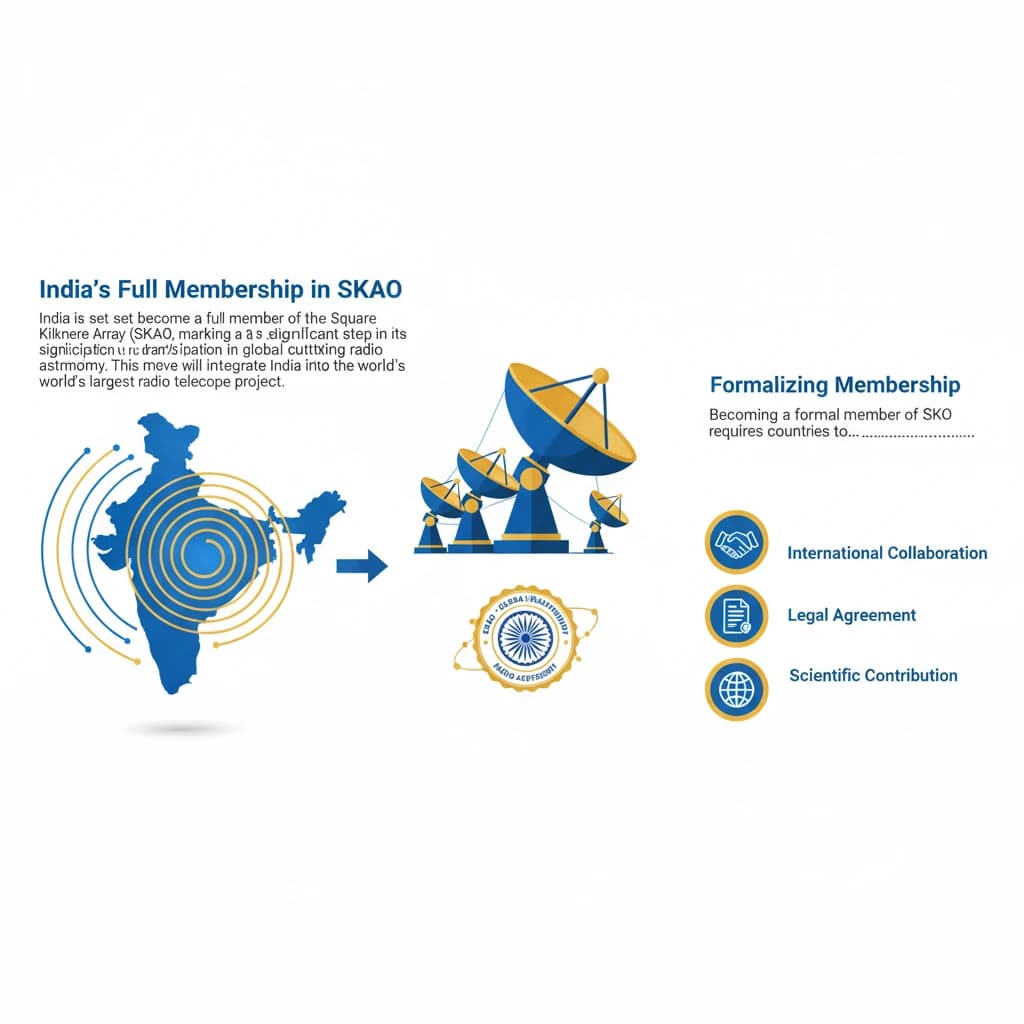
India is set to become a full member of the Square Kilometre Array Observatory (SKAO), marking a significant step in global radio astronomy. This decision involves a substantial financial commitment and signifies India's growing role in international scientific collaborations.
UPSC Relevance: This topic is crucial for GS Paper 3: Science and Technology, particularly under 'Space' and 'Developments in Science and Technology'. It also touches upon international relations in science.
Understanding the Square Kilometre Array Observatory (SKAO)
The SKAO is an intergovernmental organization dedicated to building and operating state-of-the-art radio telescopes. It represents the world's largest scientific endeavor in this field.
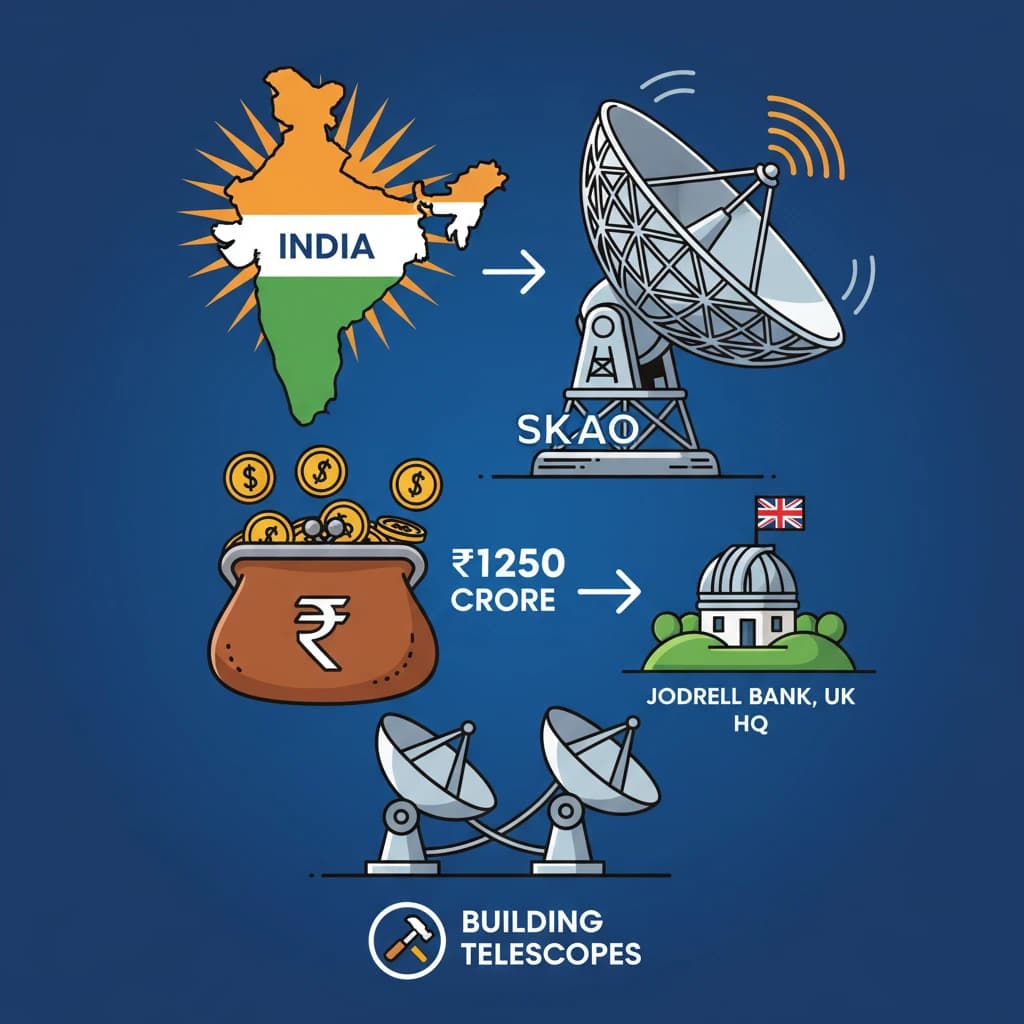
Global Headquarters: The SKAO's global headquarters is located at the Jodrell Bank Observatory in the United Kingdom.
The project does not feature a single telescope but rather an array of thousands of antennas. These antennas are strategically placed in remote, radio-quiet locations across South Africa and Australia, designed to function cohesively as one massive observational unit.
The primary goal of SKAO is to observe and study various celestial phenomena, providing unprecedented insights into the universe.
Key Objective: A significant objective of the SKAO project also includes the study of gravitational waves, which are ripples in spacetime.
Several countries are actively involved in the construction and operation of the SKA. These include the UK, Australia, South Africa, Canada, China, France, India, Italy, and Germany, showcasing a truly global scientific partnership.
India's Commitment and Ratification Process
To formally become a member of SKAO, countries are required to both sign and ratify the SKAO convention. India's journey towards full membership has begun with the Government of India's approval.
Financial Sanction: The Indian government has sanctioned Rs 1,250 crore for joining the project, which is the initial step towards the formal ratification process.
NewSpace India Limited (NSIL): India's Commercial Space Arm
While the source content initially describes NSIL, its relevance here is in enabling India's broader participation and commercial exploitation of space technologies, which indirectly supports such large-scale scientific endeavors.
Primary Mandate: NSIL's main responsibility is to empower Indian industries to engage in high-technology space-related activities. It also handles the production and commercialization of products and services from India's space program.
The major business areas of NSIL are diverse and comprehensive, covering various aspects of the space sector:
- Production of Launch Vehicles: This includes manufacturing the Polar Satellite Launch Vehicle (PSLV) and Small Satellite Launch Vehicle (SSLV) through industrial partners.
- Space-based Services: Production and marketing of services such as launch services, transponder leasing, remote sensing, and mission support services.
- Satellite Building: Constructing both communication and Earth observation satellites tailored to user requirements.
- Technology Transfer: Facilitating the transfer of technologies developed by ISRO centers/units and other constituent institutions of the Department of Space.
- Marketing Spin-off Technologies: Commercializing products and services that emerge as spin-offs from ISRO's activities.
- Consultancy Services: Providing expert advice and guidance in the space domain.
NSIL has demonstrated its capabilities through successful missions. In June 2022, it completed its first demand-driven satellite mission, the GSAT-24, which was entirely secured by Tata Play, a satellite television service.
Currently, NSIL actively manages and operates a fleet of 11 communication satellites in orbit, showcasing its operational expertise and commercial viability.
💡 Key Takeaways
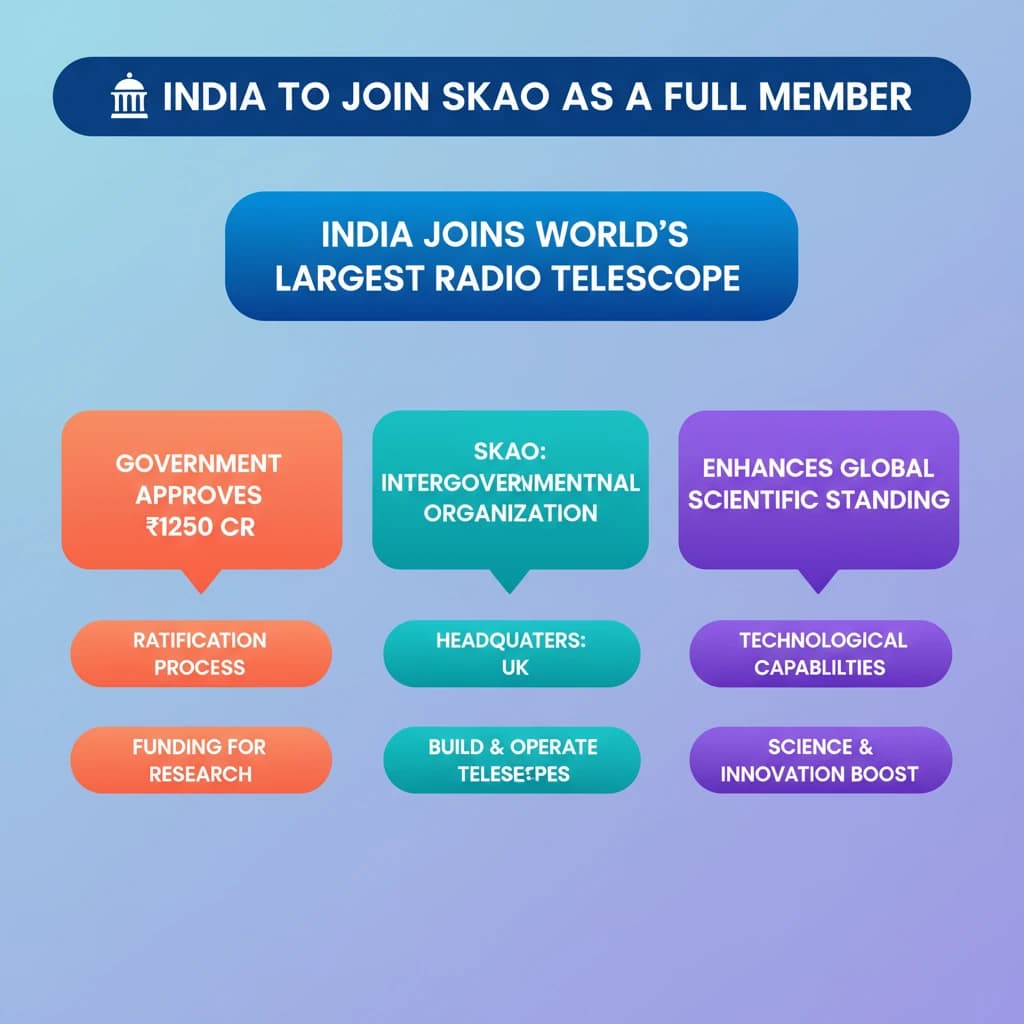
- •India is set to become a full member of the Square Kilometre Array Observatory (SKAO).
- •SKAO is the world's largest radio telescope project, with antennas in South Africa and Australia.
- •SKAO's objectives include studying celestial phenomena and gravitational waves.
- •India has approved Rs 1,250 crore for joining SKAO, initiating the ratification process.
- •NewSpace India Limited (NSIL) is ISRO's commercial arm, responsible for commercial exploitation of India's space program.
- •NSIL's business areas include manufacturing launch vehicles, providing space services, building satellites, and technology transfer.
🧠 Memory Techniques
95% Verified Content
📚 Reference Sources
•Official SKAO Website (www.skao.int)
•ISRO Website (www.isro.gov.in)
•NewSpace India Limited (NSIL) Website (www.nsilindia.co.in)