Loading page, please wait…
India's Contribution to the Square Kilometre Array (SKA) Project - UPSC Science And Technology
What is India's Contribution to the Square Kilometre Array (SKA) Project in UPSC Science And Technology?
India's Contribution to the Square Kilometre Array (SKA) Project is a key topic under Science And Technology for UPSC Civil Services Examination. Key points include: India, via NCRA, has been involved in SKAO since the 1990s.. India's primary contribution is the development and operation of the 'Telescope Manager'.. The Telescope Manager is the SKAO's central 'neural network' or control software.. Understanding this topic is essential for both UPSC Prelims and Mains preparation.
Why is India's Contribution to the Square Kilometre Array (SKA) Project important for UPSC exam?
India's Contribution to the Square Kilometre Array (SKA) Project is a Medium-level topic in UPSC Science And Technology. It is tested in both Prelims (factual MCQs) and Mains (analytical answer writing). Previous year UPSC questions have frequently covered aspects of India's Contribution to the Square Kilometre Array (SKA) Project, making it essential for comprehensive IAS preparation.
How to prepare India's Contribution to the Square Kilometre Array (SKA) Project for UPSC?
To prepare India's Contribution to the Square Kilometre Array (SKA) Project for UPSC: (1) Study the comprehensive notes covering all key concepts on Vaidra. (2) Practice previous year questions on this topic. (3) Connect it with current affairs using daily updates. (4) Revise using key takeaways and mind maps available for Science And Technology. (5) Write practice answers linking India's Contribution to the Square Kilometre Array (SKA) Project to related GS Paper topics.
Key takeaways of India's Contribution to the Square Kilometre Array (SKA) Project for UPSC
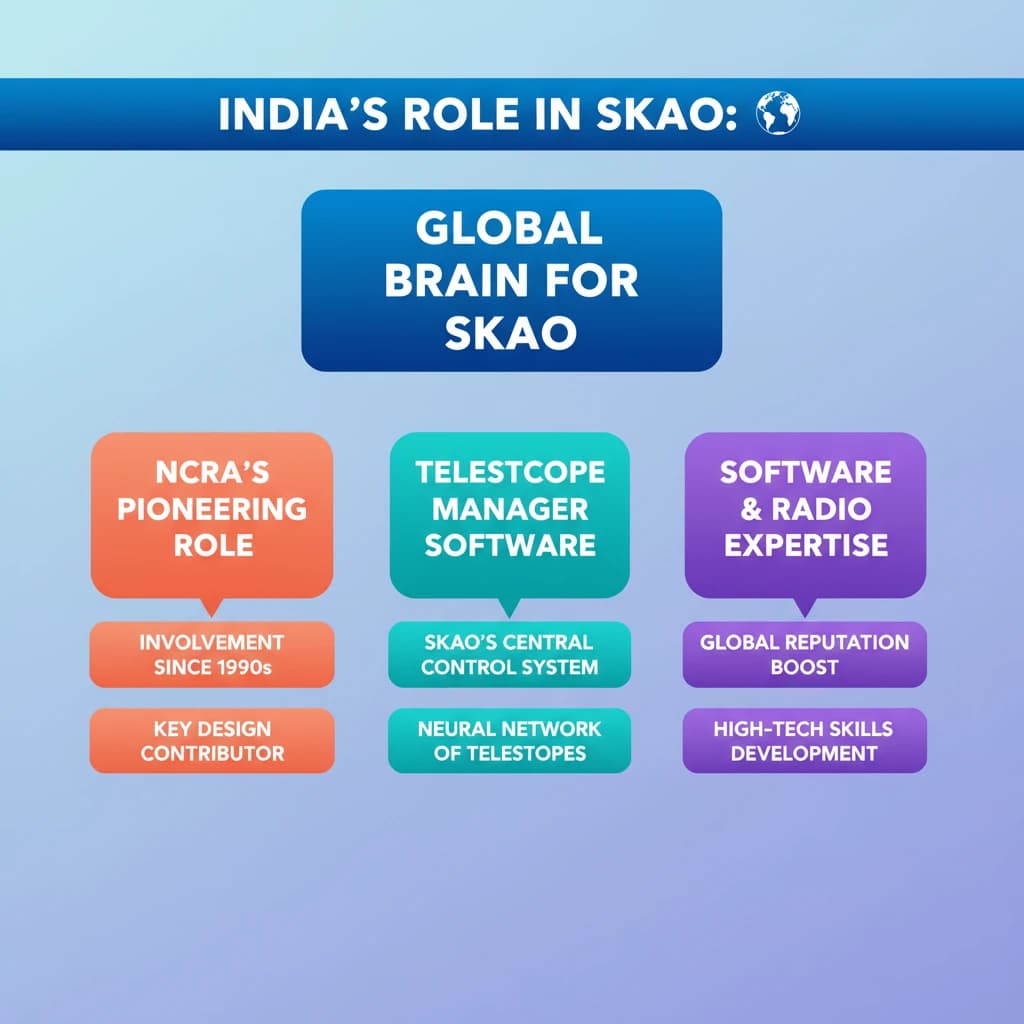
- India, via NCRA, has been involved in SKAO since the 1990s.
- India's primary contribution is the development and operation of the 'Telescope Manager'.
- The Telescope Manager is the SKAO's central 'neural network' or control software.
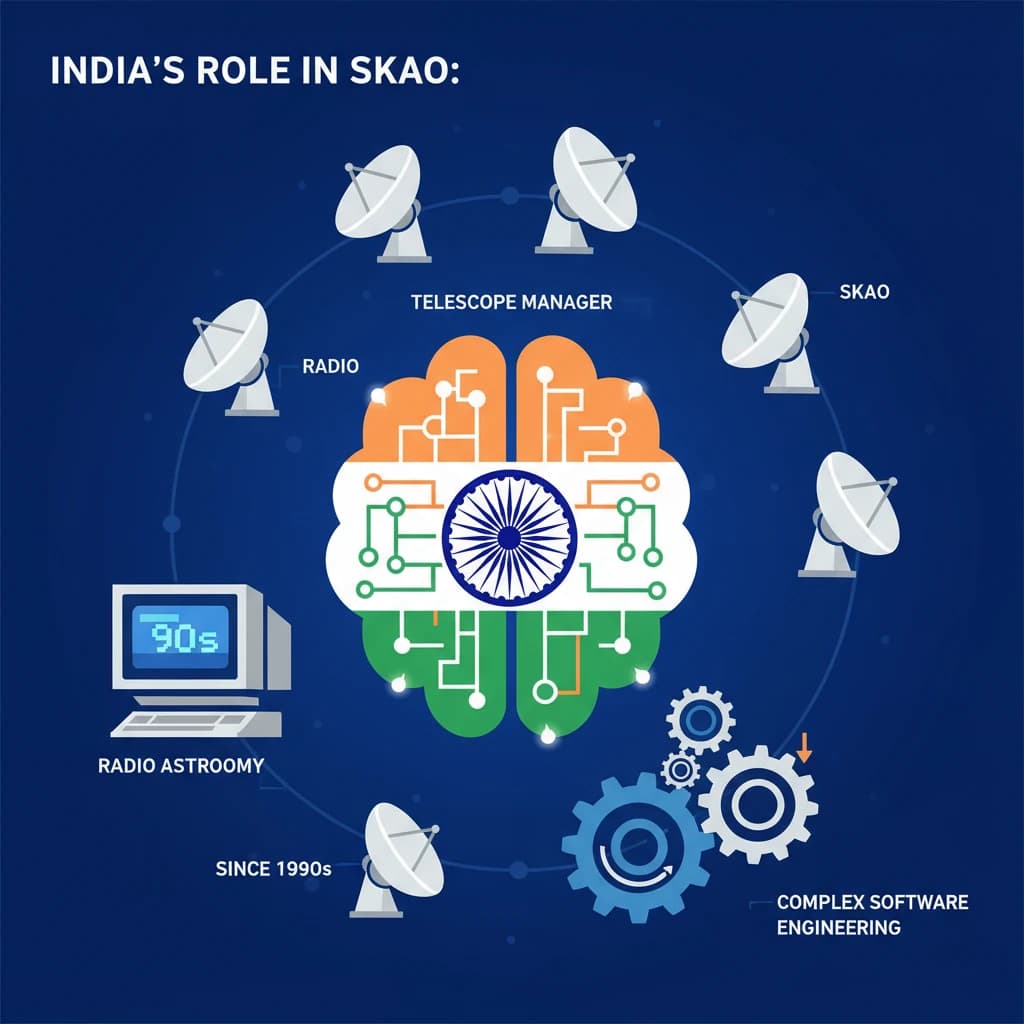
- This highlights India's expertise in complex software engineering and radio astronomy.
- SKAO involvement boosts India's scientific reputation and fosters high-tech skill development.

India's Contribution to the Square Kilometre Array (SKA) Project
Medium⏱️ 6 min read
science and technology
📖 Introduction
Introduction to the Square Kilometre Array Observatory (SKAO)
The Square Kilometre Array Observatory (SKAO) is an ambitious global initiative to build the world's largest radio telescope. This monumental project aims to push the boundaries of astronomical research, exploring fundamental questions about the universe.
It involves a vast network of thousands of radio antennas spread across sites in South Africa and Australia, designed to observe the universe with unprecedented sensitivity and resolution.
India's Foundational Role in SKAO Development
India has been a pivotal partner in the development of the SKAO project since its very inception. This involvement dates back to the 1990s, highlighting India's long-standing commitment to global scientific endeavors.
India's participation has been primarily channeled through the Pune-based National Centre for Radio Astrophysics (NCRA) and a consortium of other esteemed Indian institutions.
National Centre for Radio Astrophysics (NCRA): A premier research institution under the Tata Institute of Fundamental Research (TIFR), known for its expertise in radio astronomy and operating the Giant Metrewave Radio Telescope (GMRT).
India's Core Contribution: The Telescope Manager Element
A significant and central contribution from India to the SKAO project is the development and ongoing operation of the Telescope Manager element. This component is critical to the entire observatory's functionality.
The Telescope Manager is often described as the "neural network" or the central software brain that orchestrates the entire operation of the SKAO telescope. It manages data flow, coordinates observations, and ensures seamless functioning of the vast array.
This sophisticated software system is responsible for controlling all aspects of the telescope, from scheduling observations to managing the enormous data streams generated by the array.
UPSC Insight: India's contribution to the Telescope Manager showcases its advanced capabilities in software engineering and complex system integration for large-scale scientific projects. This is a crucial point for GS Paper 3 (Science & Technology), highlighting indigenous technological prowess and international collaboration.
💡 Key Takeaways
- •India, via NCRA, has been involved in SKAO since the 1990s.
- •India's primary contribution is the development and operation of the 'Telescope Manager'.
- •The Telescope Manager is the SKAO's central 'neural network' or control software.
- •This highlights India's expertise in complex software engineering and radio astronomy.
- •SKAO involvement boosts India's scientific reputation and fosters high-tech skill development.
🧠 Memory Techniques
100% Verified Content
📚 Reference Sources
•SKAO Official Website (www.skao.int)
•National Centre for Radio Astrophysics (NCRA) Website (www.ncra.tifr.res.in)