Loading page, please wait…
India’s Satellite Launch by SpaceX - UPSC Science And Technology
What is India’s Satellite Launch by SpaceX in UPSC Science And Technology?
India’s Satellite Launch by SpaceX is a key topic under Science And Technology for UPSC Civil Services Examination. Key points include: India's GSAT-N2 communication satellite was launched by SpaceX's Falcon-9 rocket from Cape Canaveral.. This marks India's first collaboration with Elon Musk's SpaceX.. GSAT-N2 is owned by NewSpace India Limited (NSIL), ISRO's commercial arm, operating in a demand-driven mode.. Understanding this topic is essential for both UPSC Prelims and Mains preparation.
Why is India’s Satellite Launch by SpaceX important for UPSC exam?
India’s Satellite Launch by SpaceX is a Medium-level topic in UPSC Science And Technology. It is tested in both Prelims (factual MCQs) and Mains (analytical answer writing). Previous year UPSC questions have frequently covered aspects of India’s Satellite Launch by SpaceX, making it essential for comprehensive IAS preparation.
How to prepare India’s Satellite Launch by SpaceX for UPSC?
To prepare India’s Satellite Launch by SpaceX for UPSC: (1) Study the comprehensive notes covering all key concepts on Vaidra. (2) Practice previous year questions on this topic. (3) Connect it with current affairs using daily updates. (4) Revise using key takeaways and mind maps available for Science And Technology. (5) Write practice answers linking India’s Satellite Launch by SpaceX to related GS Paper topics.
Key takeaways of India’s Satellite Launch by SpaceX for UPSC
- India's GSAT-N2 communication satellite was launched by SpaceX's Falcon-9 rocket from Cape Canaveral.
- This marks India's first collaboration with Elon Musk's SpaceX.
- GSAT-N2 is owned by NewSpace India Limited (NSIL), ISRO's commercial arm, operating in a demand-driven mode.
- The satellite was injected into a Geosynchronous Transfer Orbit (GTO), a step towards achieving Geostationary Orbit (GSO).
- This event highlights India's growing commercial space engagement and strategic international partnerships.
India’s Satellite Launch by SpaceX
Medium⏱️ 6 min read
science and technology
📖 Introduction
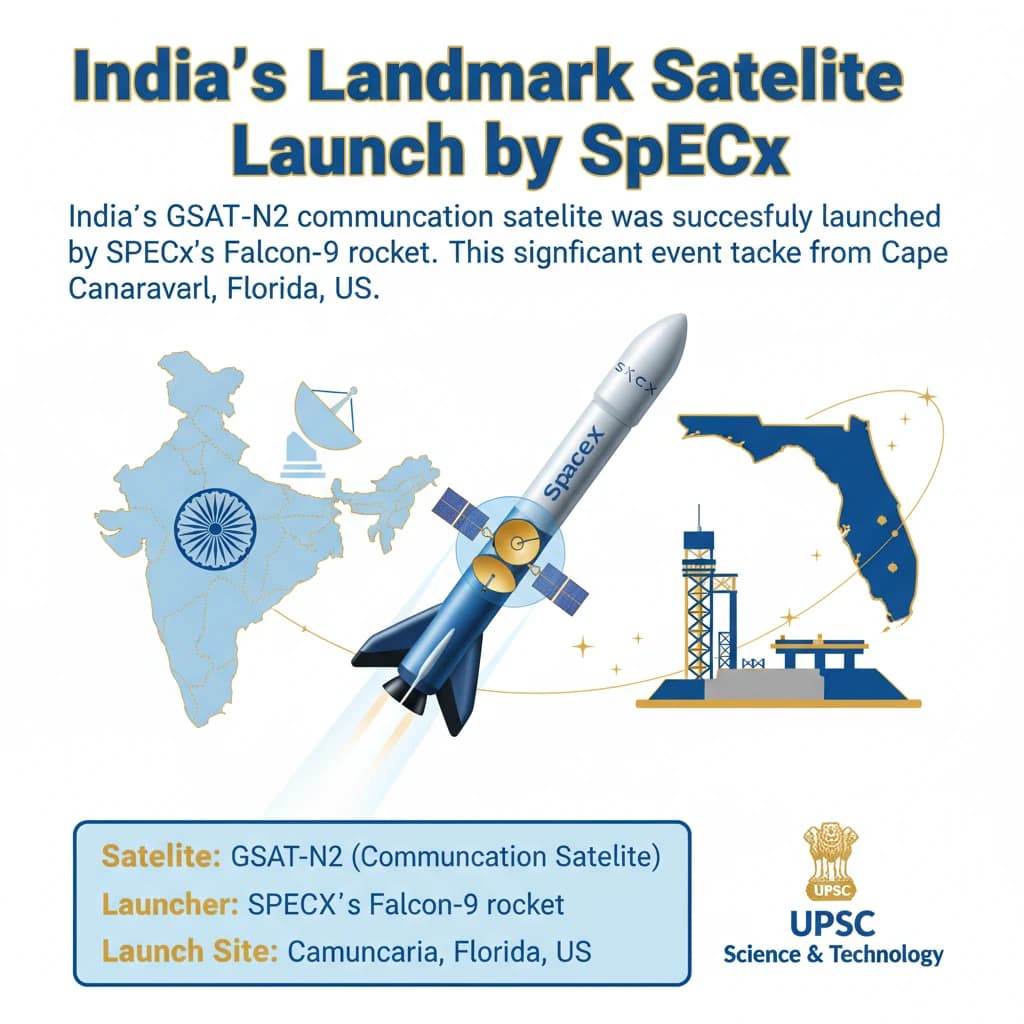
India's Landmark Satellite Launch by SpaceX
India's GSAT-N2 communication satellite was successfully launched by SpaceX's Falcon-9 rocket. This significant event took place from Cape Canaveral, Florida, US.
Satellite: GSAT-N2 (Communication Satellite)
Launcher: SpaceX's Falcon-9 rocket
Launch Site: Cape Canaveral, Florida, US
Initial Orbit: Geosynchronous Transfer Orbit (GTO)
The Falcon-9 launched the GSAT-N2 into a geosynchronous transfer orbit (GTO). This is an elliptical orbit, serving as the crucial first step towards reaching a stable geosynchronous or geostationary orbit (GSO).
Geosynchronous Transfer Orbit (GTO): An elliptical orbit with an altitude of around 37,000 km at its highest point (apoapsis).
Transition to Geostationary Orbit (GSO)
To achieve Geostationary Orbit (GSO), the spacecraft performs a critical maneuver. It circularises the GTO orbit by turning parallel to the equator at its apoapsis.
Subsequently, the satellite fires its own rocket engine. This propulsion pushes it into the desired circular GSO, where it appears stationary relative to the Earth's surface.
Apoapsis: The point in an orbit when an object is farthest away from the body it is orbiting.
India's First Collaboration with SpaceX
This launch marks a historic moment as it is India's first collaboration with Elon Musk's SpaceX. It signifies a growing trend of international partnerships in India's space sector.
This collaboration highlights India's strategic move towards leveraging global private sector capabilities for its space missions.
Role of NewSpace India Limited (NSIL)
The GSAT-N2 satellite belongs to NewSpace India Limited (NSIL). NSIL is the commercial arm of ISRO, responsible for commercializing India's space capabilities.
NSIL's Mandate: To build, launch, own, and operate satellites in a “demand-driven mode” to meet the service needs of users, both domestic and international.
The GSAT-N2 is notably the second demand-driven satellite of NSIL. These satellites are designed and launched based on specific user requirements, ensuring optimal utilization of space assets.
- First demand-driven satellite of NSIL: GSAT-24, launched in June 2022.
💡 Key Takeaways
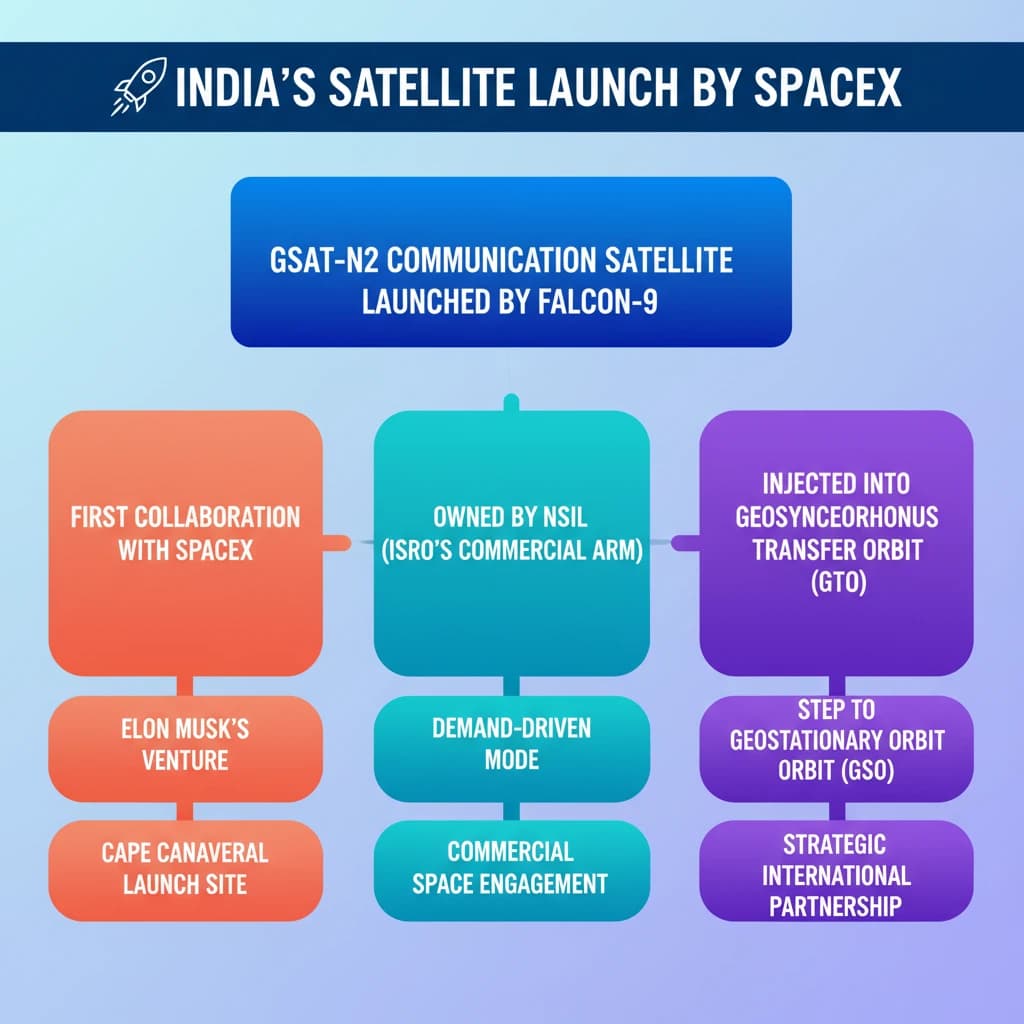
- •India's GSAT-N2 communication satellite was launched by SpaceX's Falcon-9 rocket from Cape Canaveral.
- •This marks India's first collaboration with Elon Musk's SpaceX.
- •GSAT-N2 is owned by NewSpace India Limited (NSIL), ISRO's commercial arm, operating in a demand-driven mode.
- •The satellite was injected into a Geosynchronous Transfer Orbit (GTO), a step towards achieving Geostationary Orbit (GSO).
- •This event highlights India's growing commercial space engagement and strategic international partnerships.
🧠 Memory Techniques

95% Verified Content
📚 Reference Sources
•Official ISRO/NSIL Press Releases (assumed)
•SpaceX Mission Archives (assumed)