Loading page, please wait…
INDIA’S THREE-STAGE NUCLEAR PROGRAMME - UPSC Science And Technology
What is INDIA’S THREE-STAGE NUCLEAR PROGRAMME in UPSC Science And Technology?
INDIA’S THREE-STAGE NUCLEAR PROGRAMME is a key topic under Science And Technology for UPSC Civil Services Examination. Key points include: India's nuclear program, envisioned by Homi Bhabha, aims for energy independence using indigenous thorium.. Stage 1 (PHWRs) uses natural uranium to produce electricity and plutonium.. Stage 2 (FBRs) uses plutonium from Stage 1 to breed more plutonium and convert thorium into U-233.. Understanding this topic is essential for both UPSC Prelims and Mains preparation.
Why is INDIA’S THREE-STAGE NUCLEAR PROGRAMME important for UPSC exam?
INDIA’S THREE-STAGE NUCLEAR PROGRAMME is a Medium-level topic in UPSC Science And Technology. It is tested in both Prelims (factual MCQs) and Mains (analytical answer writing). Previous year UPSC questions have frequently covered aspects of INDIA’S THREE-STAGE NUCLEAR PROGRAMME, making it essential for comprehensive IAS preparation.
How to prepare INDIA’S THREE-STAGE NUCLEAR PROGRAMME for UPSC?
To prepare INDIA’S THREE-STAGE NUCLEAR PROGRAMME for UPSC: (1) Study the comprehensive notes covering all key concepts on Vaidra. (2) Practice previous year questions on this topic. (3) Connect it with current affairs using daily updates. (4) Revise using key takeaways and mind maps available for Science And Technology. (5) Write practice answers linking INDIA’S THREE-STAGE NUCLEAR PROGRAMME to related GS Paper topics.
Key takeaways of INDIA’S THREE-STAGE NUCLEAR PROGRAMME for UPSC
- India's nuclear program, envisioned by Homi Bhabha, aims for energy independence using indigenous thorium.
- Stage 1 (PHWRs) uses natural uranium to produce electricity and plutonium.
- Stage 2 (FBRs) uses plutonium from Stage 1 to breed more plutonium and convert thorium into U-233.
- Stage 3 (Thorium-based reactors) will use U-233 to achieve a self-sustaining thorium fuel cycle.
- The program is crucial for India's long-term energy security, climate change goals, and technological self-reliance.
INDIA’S THREE-STAGE NUCLEAR PROGRAMME
Medium⏱️ 8 min read
science and technology
📖 Introduction
Introduction to India's Three-Stage Nuclear Programme
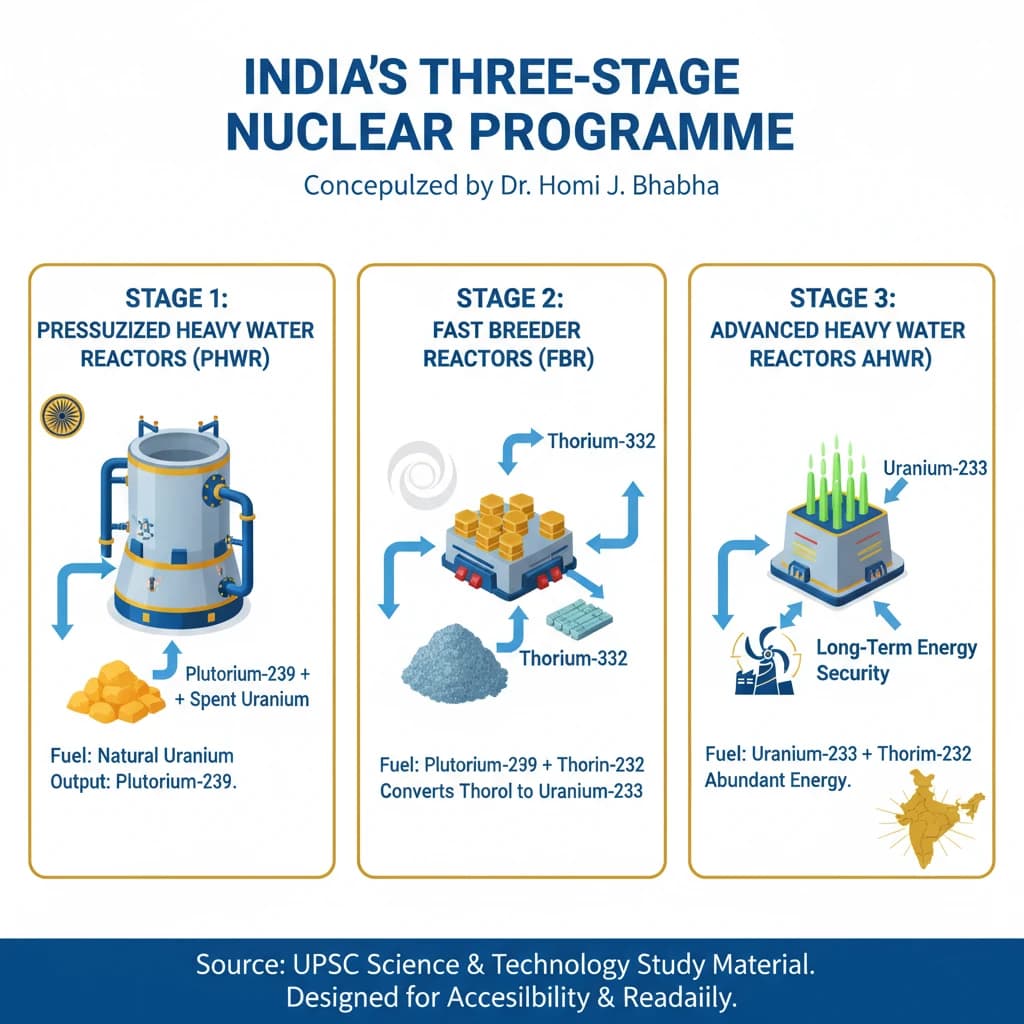
India's ambitious Three-Stage Nuclear Power Programme was conceptualised by Dr. Homi J. Bhabha, the architect of India's nuclear energy initiative. This strategic plan was designed to ensure long-term energy security for the nation.
The programme's design is specifically tailored to India's unique resource profile, which includes limited reserves of natural uranium but abundant reserves of thorium. The goal is to maximise energy generation from these indigenous resources.
Core Objective: To achieve energy independence and harness India's vast thorium reserves through a phased approach, overcoming the scarcity of uranium.
Stage 1: Pressurised Heavy Water Reactors (PHWRs)
The first stage of the programme focuses on deploying Pressurised Heavy Water Reactors (PHWRs). These reactors utilise natural uranium as fuel and heavy water as both moderator and coolant.
The primary output of these reactors is electricity. A crucial byproduct of this stage is plutonium-239 (Pu-239), which is vital for the subsequent stages of the programme.
Stage 1 Specifications:
- Fuel: Natural Uranium
- Reactor Type: Pressurised Heavy Water Reactors (PHWRs)
- Byproduct: Plutonium-239
- Estimated Capacity: 10 GWe (Gigawatt-electric) for 40 years
- Capacity Factor: 0.8 (80%)
Stage 2: Fast Breeder Reactors (FBRs)
The second stage involves the use of Fast Breeder Reactors (FBRs). These reactors are designed to be fuelled by the plutonium-239 produced in the first stage.
FBRs have a unique capability: they not only generate electricity but also 'breed' more fissile fuel than they consume. They convert uranium-238 (depleted uranium from Stage 1) into additional plutonium-239.
During this stage, thorium is also introduced into the FBRs. The thorium is irradiated and transmuted into uranium-233 (U-233), which is the fissile fuel for the third stage.
Stage 2 Specifications:
- Fuel: Plutonium-239 (from Stage 1), mixed with natural uranium or depleted uranium
- Reactor Type: Fast Breeder Reactors (FBRs)
- Key Process: Breeding of Plutonium-239, conversion of Thorium into U-233
- Estimated Capacity: 500 GWe for 100 years
- Capacity Factor: 0.8 (80%)
Stage 3: Thorium-based Reactors
The final and most crucial stage aims to utilise India's vast thorium reserves. This stage involves advanced reactors fuelled by uranium-233 (U-233), which is bred from thorium in the second stage.
These reactors will primarily use a mix of thorium and uranium-233 as fuel. The thorium in the reactor core will continuously be converted into uranium-233, ensuring a sustainable and long-term energy supply.
Stage 3 Specifications:
- Fuel: Uranium-233 (bred from Thorium)
- Reactor Type: Advanced Thorium-based Breeder Reactors
- Key Process: Self-sustaining Thorium-Uranium-233 fuel cycle
- Estimated Capacity: 500 GWe for 350 years
- Capacity Factor: 0.8 (80%)
UPSC Insight: Understanding the interdependencies between the stages is crucial. Each stage provides the fuel for the next, highlighting the long-term vision for energy security and self-reliance. Questions often focus on the rationale and challenges of each stage.
💡 Key Takeaways
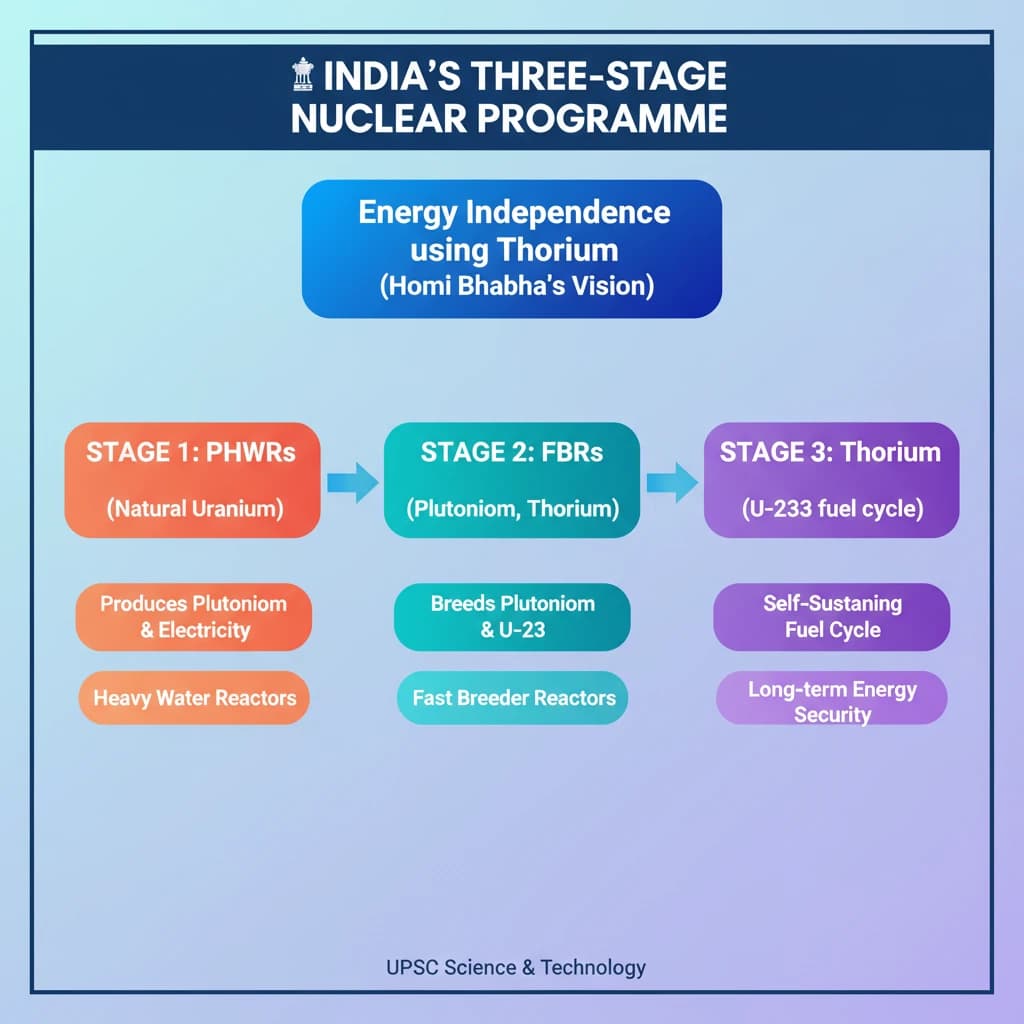
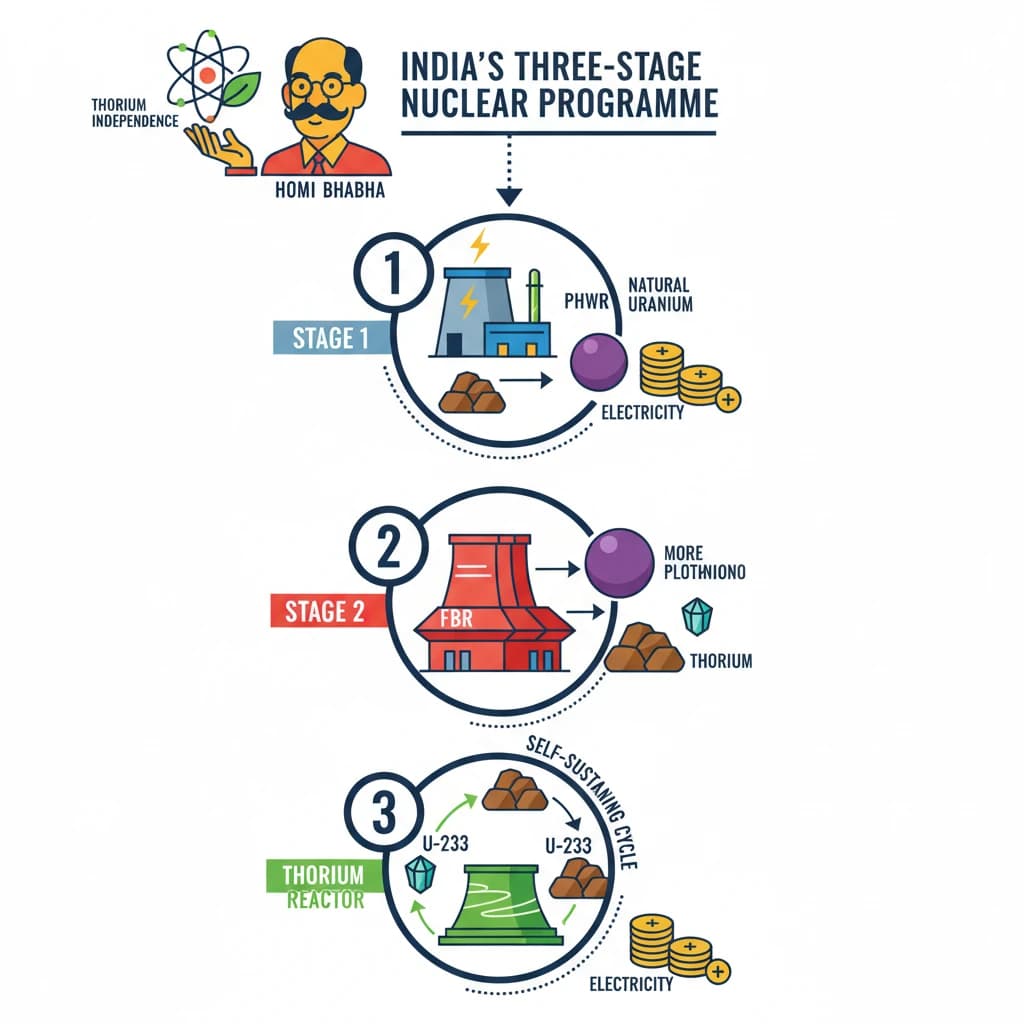
- •India's nuclear program, envisioned by Homi Bhabha, aims for energy independence using indigenous thorium.
- •Stage 1 (PHWRs) uses natural uranium to produce electricity and plutonium.
- •Stage 2 (FBRs) uses plutonium from Stage 1 to breed more plutonium and convert thorium into U-233.
- •Stage 3 (Thorium-based reactors) will use U-233 to achieve a self-sustaining thorium fuel cycle.
- •The program is crucial for India's long-term energy security, climate change goals, and technological self-reliance.
🧠 Memory Techniques
95% Verified Content
📚 Reference Sources
•Department of Atomic Energy (DAE) official reports
•Press Information Bureau (PIB) releases on nuclear energy