Loading page, please wait…
Kodaikanal Solar Observatory - UPSC Science And Technology
What is Kodaikanal Solar Observatory in UPSC Science And Technology?
Kodaikanal Solar Observatory is a key topic under Science And Technology for UPSC Civil Services Examination. Key points include: Kodaikanal Solar Observatory (KSO) recently celebrated its 125th anniversary.. It has played a crucial role in advancing understanding of solar activity.. KSO's research is vital for studying the impact of solar activity on Earth’s climate and space weather.. Understanding this topic is essential for both UPSC Prelims and Mains preparation.
Why is Kodaikanal Solar Observatory important for UPSC exam?
Kodaikanal Solar Observatory is a Medium-level topic in UPSC Science And Technology. It is tested in both Prelims (factual MCQs) and Mains (analytical answer writing). Previous year UPSC questions have frequently covered aspects of Kodaikanal Solar Observatory, making it essential for comprehensive IAS preparation.
How to prepare Kodaikanal Solar Observatory for UPSC?
To prepare Kodaikanal Solar Observatory for UPSC: (1) Study the comprehensive notes covering all key concepts on Vaidra. (2) Practice previous year questions on this topic. (3) Connect it with current affairs using daily updates. (4) Revise using key takeaways and mind maps available for Science And Technology. (5) Write practice answers linking Kodaikanal Solar Observatory to related GS Paper topics.
Key takeaways of Kodaikanal Solar Observatory for UPSC
- Kodaikanal Solar Observatory (KSO) recently celebrated its 125th anniversary.
- It has played a crucial role in advancing understanding of solar activity.
- KSO's research is vital for studying the impact of solar activity on Earth’s climate and space weather.
- It maintains one of the longest continuous solar data archives globally, dating back to 1901.
- KSO's data is essential for validating modern space missions and understanding long-term solar trends.
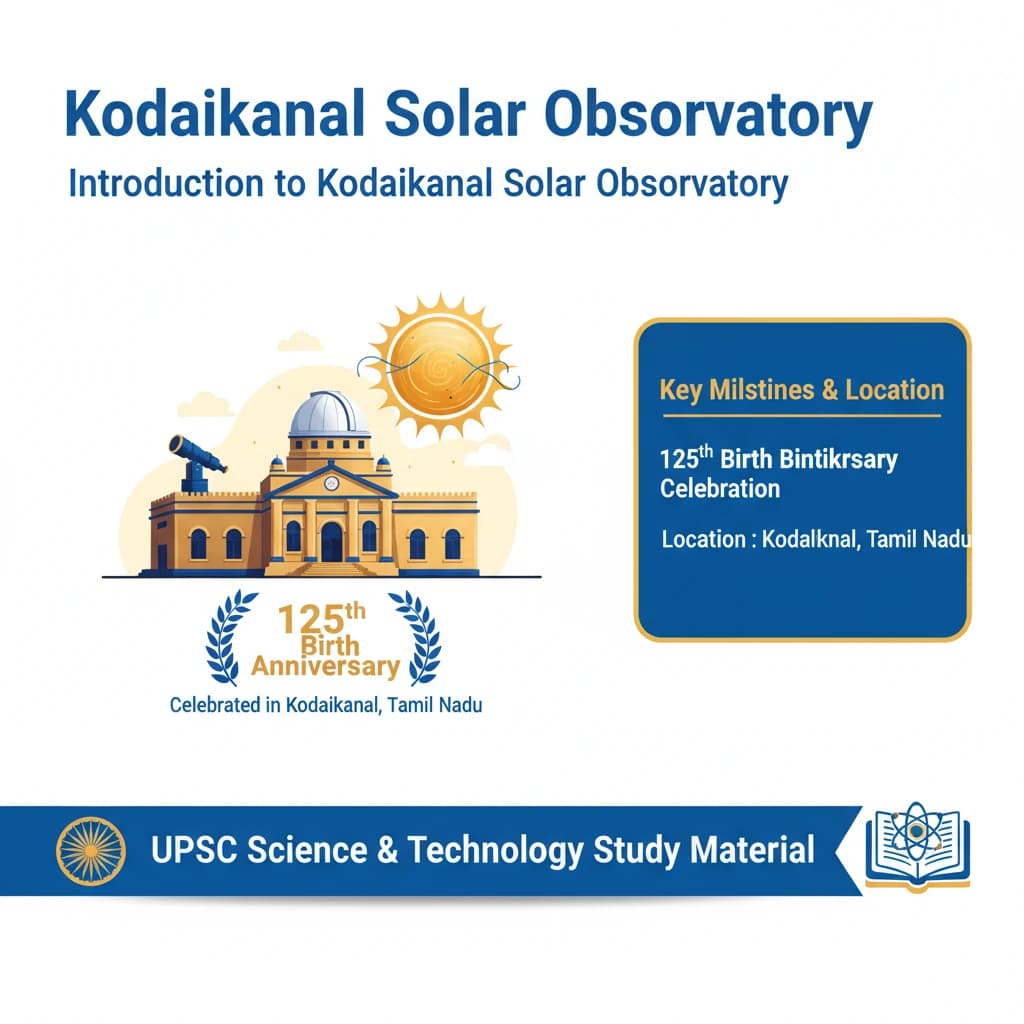
Kodaikanal Solar Observatory
Medium⏱️ 8 min read
science and technology
📖 Introduction
Introduction to Kodaikanal Solar Observatory
The Kodaikanal Solar Observatory (KSO) recently marked a significant milestone, celebrating its 125th birth anniversary. This institution, nestled in the Palani Hills of Kodaikanal, Tamil Nadu, has been a cornerstone of solar research for over a century.
Key Milestone: 125th Birth Anniversary Celebration
Location: Kodaikanal, Palani Hills, Tamil Nadu
Pivotal Role in Solar Science
Over its extensive history, KSO has played a crucial role in advancing humanity's understanding of solar activity. Its continuous observations provide invaluable data for studying the Sun's dynamic behavior.
KSO's primary contribution lies in its long-term, uninterrupted observation of the Sun, forming one of the longest continuous solar data archives globally.
Impact on Earth's Climate and Space Weather
The research conducted at KSO is vital for comprehending the profound impact of solar activity on Earth’s climate. Solar variations can influence atmospheric processes and long-term climate patterns.
Furthermore, KSO's work is instrumental in the study of space weather. Understanding solar flares, coronal mass ejections, and solar wind is critical for protecting satellites, communication systems, and power grids on Earth.
UPSC Relevance: The Kodaikanal Solar Observatory is significant for GS-III Science & Technology (Space and Astronomy) and GS-I Geography (Climatology, Solar phenomena).
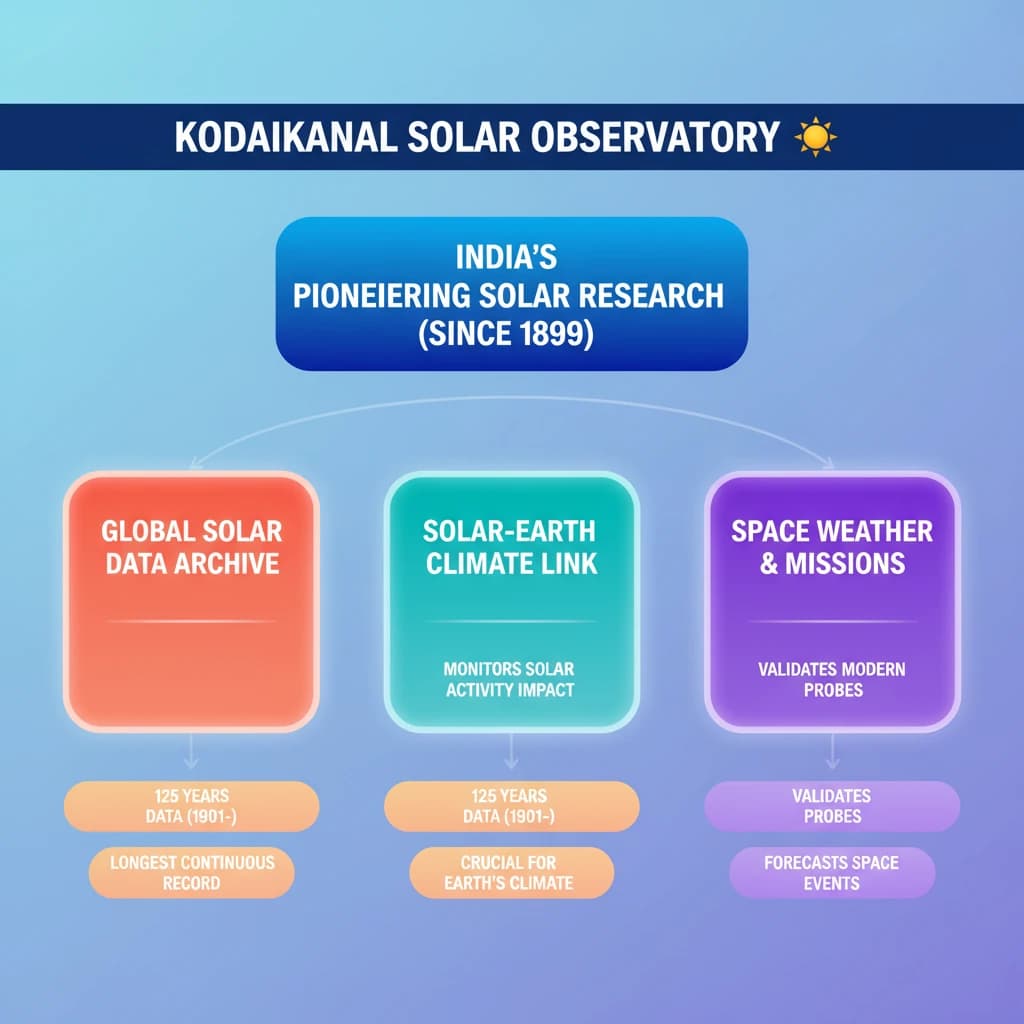
💡 Key Takeaways
- •Kodaikanal Solar Observatory (KSO) recently celebrated its 125th anniversary.
- •It has played a crucial role in advancing understanding of solar activity.
- •KSO's research is vital for studying the impact of solar activity on Earth’s climate and space weather.
- •It maintains one of the longest continuous solar data archives globally, dating back to 1901.
- •KSO's data is essential for validating modern space missions and understanding long-term solar trends.
🧠 Memory Techniques
95% Verified Content
📚 Reference Sources
•Indian Institute of Astrophysics (IIA) official website (for general KSO details and history)
•General knowledge about solar observatories and space weather