Loading page, please wait…
Last Universal Common Ancestor (LUCA) - UPSC Science And Technology
What is Last Universal Common Ancestor (LUCA) in UPSC Science And Technology?
Last Universal Common Ancestor (LUCA) is a key topic under Science And Technology for UPSC Civil Services Examination. Key points include: LUCA is the Last Universal Common Ancestor, the single cell from which all life on Earth diverged.. Recent studies suggest LUCA formed about 200 million years after Earth, earlier than previously thought.. LUCA had a small genome (2.5M bases, 2000 proteins) and possibly immunity genes.. Understanding this topic is essential for both UPSC Prelims and Mains preparation.
Why is Last Universal Common Ancestor (LUCA) important for UPSC exam?
Last Universal Common Ancestor (LUCA) is a Medium-level topic in UPSC Science And Technology. It is tested in both Prelims (factual MCQs) and Mains (analytical answer writing). Previous year UPSC questions have frequently covered aspects of Last Universal Common Ancestor (LUCA), making it essential for comprehensive IAS preparation.
How to prepare Last Universal Common Ancestor (LUCA) for UPSC?
To prepare Last Universal Common Ancestor (LUCA) for UPSC: (1) Study the comprehensive notes covering all key concepts on Vaidra. (2) Practice previous year questions on this topic. (3) Connect it with current affairs using daily updates. (4) Revise using key takeaways and mind maps available for Science And Technology. (5) Write practice answers linking Last Universal Common Ancestor (LUCA) to related GS Paper topics.
Key takeaways of Last Universal Common Ancestor (LUCA) for UPSC
- LUCA is the Last Universal Common Ancestor, the single cell from which all life on Earth diverged.
- Recent studies suggest LUCA formed about 200 million years after Earth, earlier than previously thought.
- LUCA had a small genome (2.5M bases, 2000 proteins) and possibly immunity genes.
- The Molecular Clock theory uses mutation rates to reconstruct the 'tree of life' and date evolutionary events.
- Competing theories for life's origin include Oparin-Haldane (primordial soup, supported by Miller-Urey experiment) and Panspermia (extraterrestrial origin).
- Research on LUCA is crucial for astrobiology, synthetic biology, and understanding Earth's evolutionary history.
- Recent discovery of "obelisks" highlights ongoing exploration of fundamental life forms.
Last Universal Common Ancestor (LUCA)
Medium⏱️ 7 min read
science and technology
📖 Introduction
Introduction: The Last Universal Common Ancestor (LUCA)
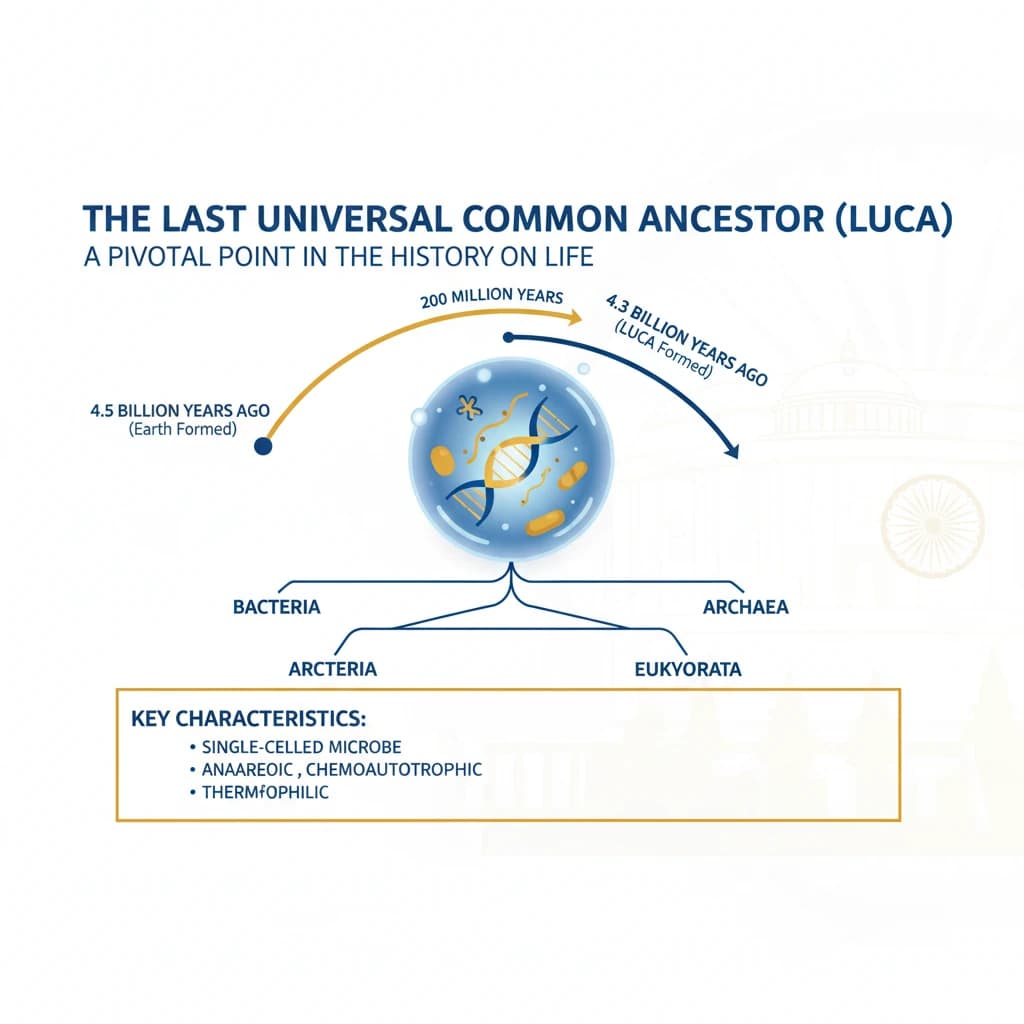
Recent scientific studies have reignited interest in the Last Universal Common Ancestor (LUCA), suggesting its formation occurred just 200 million years after Earth itself formed.
LUCA represents a pivotal point in the history of life, believed to be the single cell from which all known life forms on Earth descended.
Understanding LUCA's Nature
Researchers hypothesize that LUCA was the common progenitor for all three major branches of life: Bacteria, Archaea, and Eukarya.
Despite the absence of direct fossil evidence, insights into LUCA's existence are derived from the shared features observed across modern genomes.
- Genome Size: Estimated to have a small genome of approximately 2.5 million bases.
- Proteins: Possessed around 2,000 proteins, sufficient for survival in its primordial environment.
- Ecosystem Impact: Its metabolites might have fostered a secondary ecosystem, paving the way for other microbes.
- Immunity: Possibly contained immunity genes to defend against early viruses.
The Molecular Clock Theory and LUCA
The concept of the molecular clock has been instrumental in reconstructing the 'tree of life' and inferring the timing of evolutionary events.
Molecular Clock Theory: Posits that the rate at which mutations accumulate or are removed from a population's genome is relatively constant and proportional to the rate of acquiring new mutations.
While the mutation rate can vary between different species, this theory allows scientists to estimate the time elapsed between various evolutionary events.
By using known mutation rates and benchmarking against events like the evolution of the first mammal or the age of fossils, researchers can map out the timeline of life's origins.
Early Life Forms and Geological Evidence
Earlier findings from the Pilbara Craton in Australia indicated that the earliest known life forms date back approximately 3.4 billion years ago.
These geological benchmarks are crucial for calibrating the molecular clock and understanding the deep history of life on Earth.
Significance of LUCA Research
Understanding LUCA is fundamental to comprehending the initial stages of life's emergence and subsequent evolution on Earth.
The insights gained are vital for the search for extraterrestrial life and for developing advanced synthetic organisms.
UPSC Relevance: Knowledge of LUCA and theories of life's origin is essential for questions on Evolution, Biotechnology, and Astrobiology in GS Paper III.
Recent Discovery: Obelisks
Separately, scientists at Stanford University recently identified a novel, remarkably simple form of life termed "obelisks."
This discovery highlights the ongoing exploration and expansion of our understanding of biological diversity and fundamental life forms.
💡 Key Takeaways
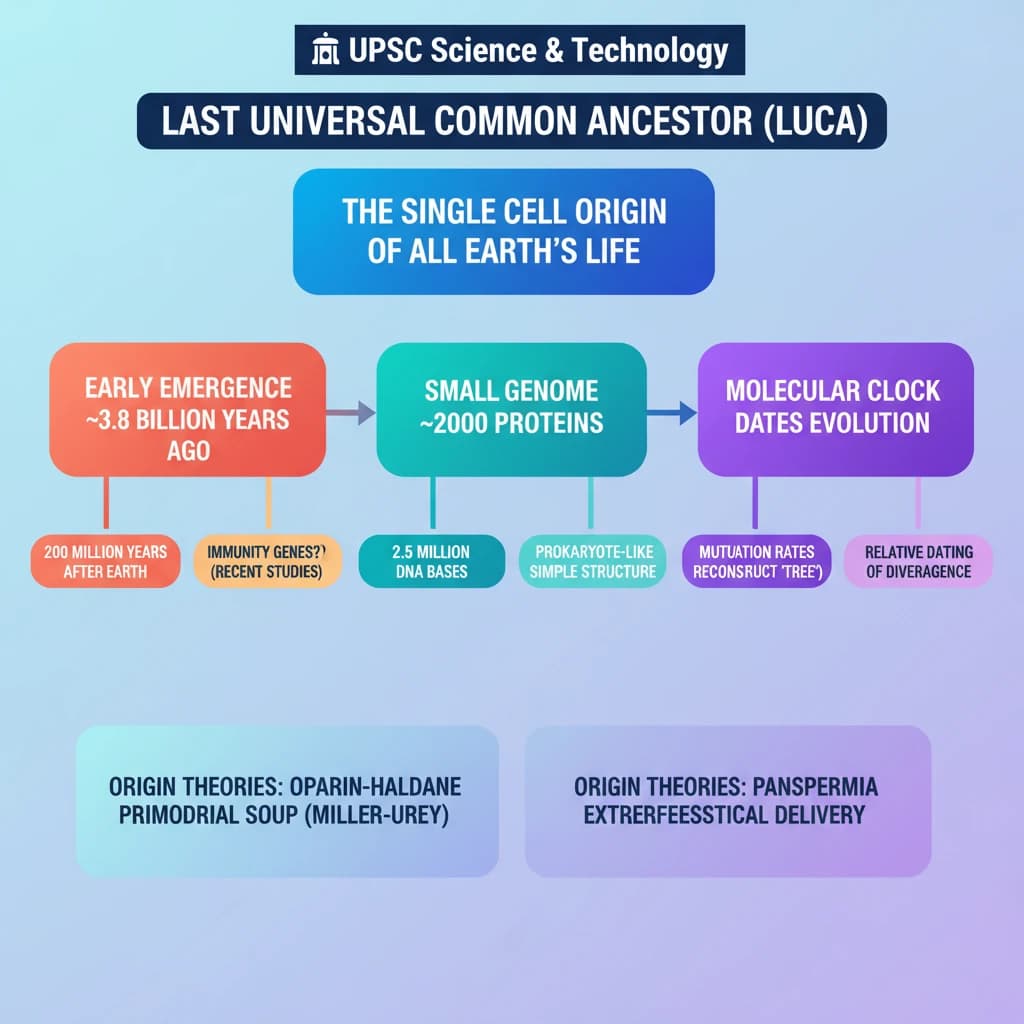
- •LUCA is the Last Universal Common Ancestor, the single cell from which all life on Earth diverged.
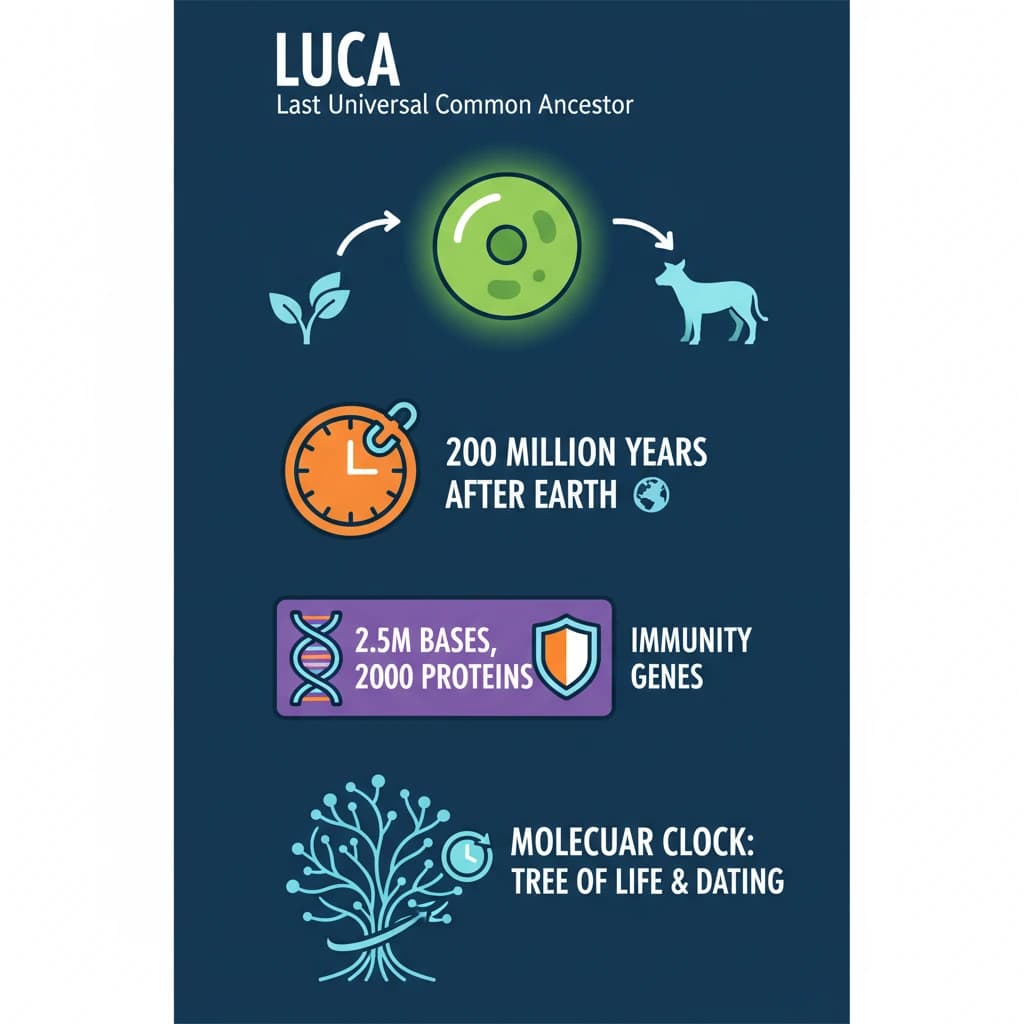
- •Recent studies suggest LUCA formed about 200 million years after Earth, earlier than previously thought.
- •LUCA had a small genome (2.5M bases, 2000 proteins) and possibly immunity genes.
- •The Molecular Clock theory uses mutation rates to reconstruct the 'tree of life' and date evolutionary events.
- •Competing theories for life's origin include Oparin-Haldane (primordial soup, supported by Miller-Urey experiment) and Panspermia (extraterrestrial origin).
- •Research on LUCA is crucial for astrobiology, synthetic biology, and understanding Earth's evolutionary history.
- •Recent discovery of "obelisks" highlights ongoing exploration of fundamental life forms.
🧠 Memory Techniques
95% Verified Content
📚 Reference Sources
•General scientific consensus on evolutionary biology and astrobiology