Loading page, please wait…
Moiré Materials and Superconductivity - UPSC Science And Technology
What is Moiré Materials and Superconductivity in UPSC Science And Technology?
Moiré Materials and Superconductivity is a key topic under Science And Technology for UPSC Civil Services Examination. Key points include: Moiré materials are formed by twisting two layers of 2D materials at a slight angle, creating unique interference patterns.. This twist induces 'flat bands' in the electronic structure, slowing electrons and boosting electron-electron interactions.. Enhanced electron-electron interactions are crucial for the emergence of superconductivity in these materials.. Understanding this topic is essential for both UPSC Prelims and Mains preparation.
Why is Moiré Materials and Superconductivity important for UPSC exam?
Moiré Materials and Superconductivity is a Medium-level topic in UPSC Science And Technology. It is tested in both Prelims (factual MCQs) and Mains (analytical answer writing). Previous year UPSC questions have frequently covered aspects of Moiré Materials and Superconductivity, making it essential for comprehensive IAS preparation.
How to prepare Moiré Materials and Superconductivity for UPSC?
To prepare Moiré Materials and Superconductivity for UPSC: (1) Study the comprehensive notes covering all key concepts on Vaidra. (2) Practice previous year questions on this topic. (3) Connect it with current affairs using daily updates. (4) Revise using key takeaways and mind maps available for Science And Technology. (5) Write practice answers linking Moiré Materials and Superconductivity to related GS Paper topics.
Key takeaways of Moiré Materials and Superconductivity for UPSC
- Moiré materials are formed by twisting two layers of 2D materials at a slight angle, creating unique interference patterns.
- This twist induces 'flat bands' in the electronic structure, slowing electrons and boosting electron-electron interactions.
- Enhanced electron-electron interactions are crucial for the emergence of superconductivity in these materials.
- Superconductivity, previously thought exclusive to graphene moiré materials, has now been found in semiconductor moiré materials like Tungsten Diselenide (WSe2).
- WSe2 exhibited stable superconductivity at approximately -272.93° C, comparable to high-temperature superconductors.
- These materials hold significant promise for quantum computing, lossless energy transmission, and next-generation electronics.
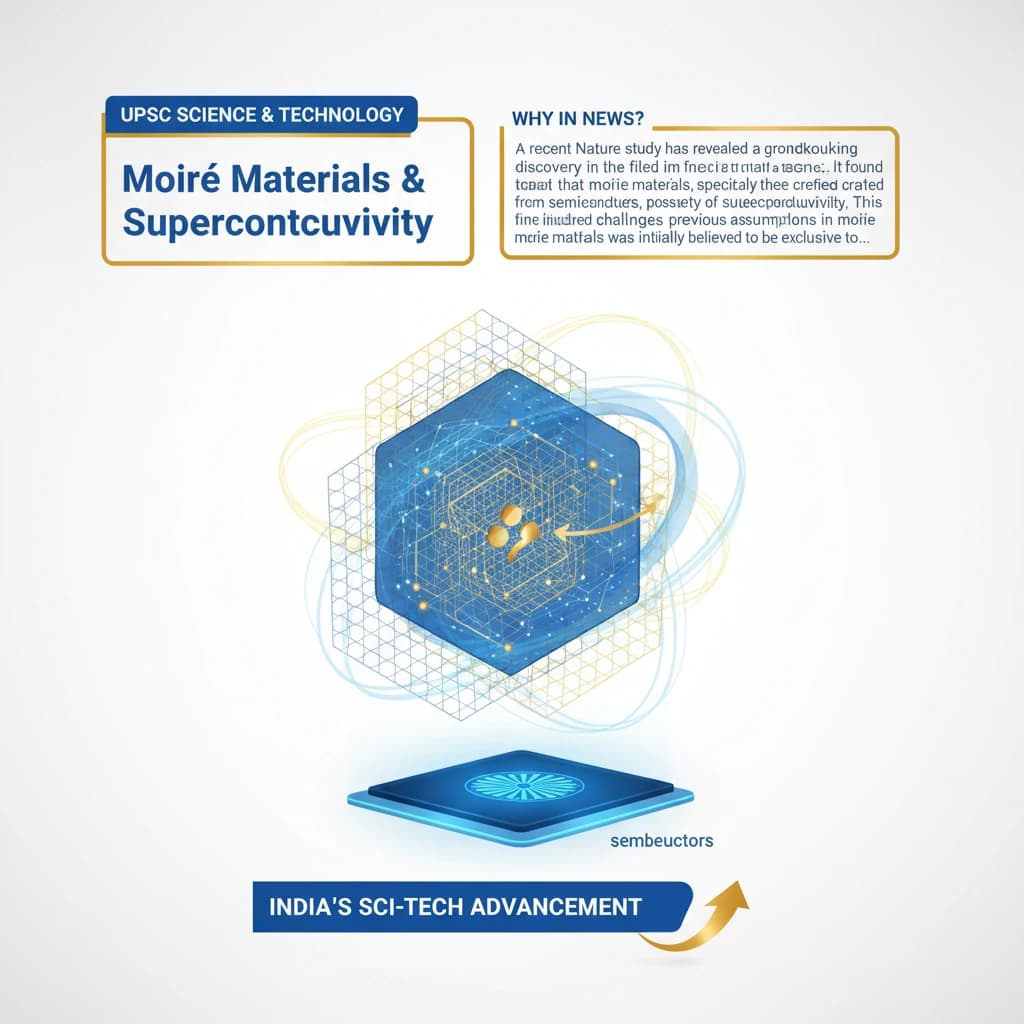
Moiré Materials and Superconductivity
Medium⏱️ 7 min read
science and technology
📖 Introduction
Why in News?
A recent Nature study has revealed a groundbreaking discovery in the field of material science. It found that moiré materials, specifically those crafted from semiconductors, possess the property of superconductivity.
This finding challenges previous assumptions, as superconductivity in moiré materials was initially believed to be exclusive to graphene-based structures.
What are Moiré Materials?
Moiré materials are advanced engineered materials that exhibit unique properties. These properties arise from an interference pattern formed when two highly repetitive structures are precisely overlaid with a slight rotational misalignment.
Definition: A Moiré pattern is a visual interference pattern created, for example, when two sets of parallel lines or grids are superimposed at an angle, or when they have slightly different pitches.
Creation of Moiré Materials
The creation of moiré materials typically involves a precise layering technique. Two layers of a two-dimensional (2-D) material are stacked upon each other.
One layer is then subtly twisted at a small, specific angle relative to the other. For instance, in research, an angle of approximately 3.65° has been used for materials like tungsten diselenide.
The deliberate twist between the material layers is crucial. It generates a distinctive moiré pattern that fundamentally alters the material's electronic behavior, leading to properties not present in the individual layers.
Electronic Properties of Moiré Materials
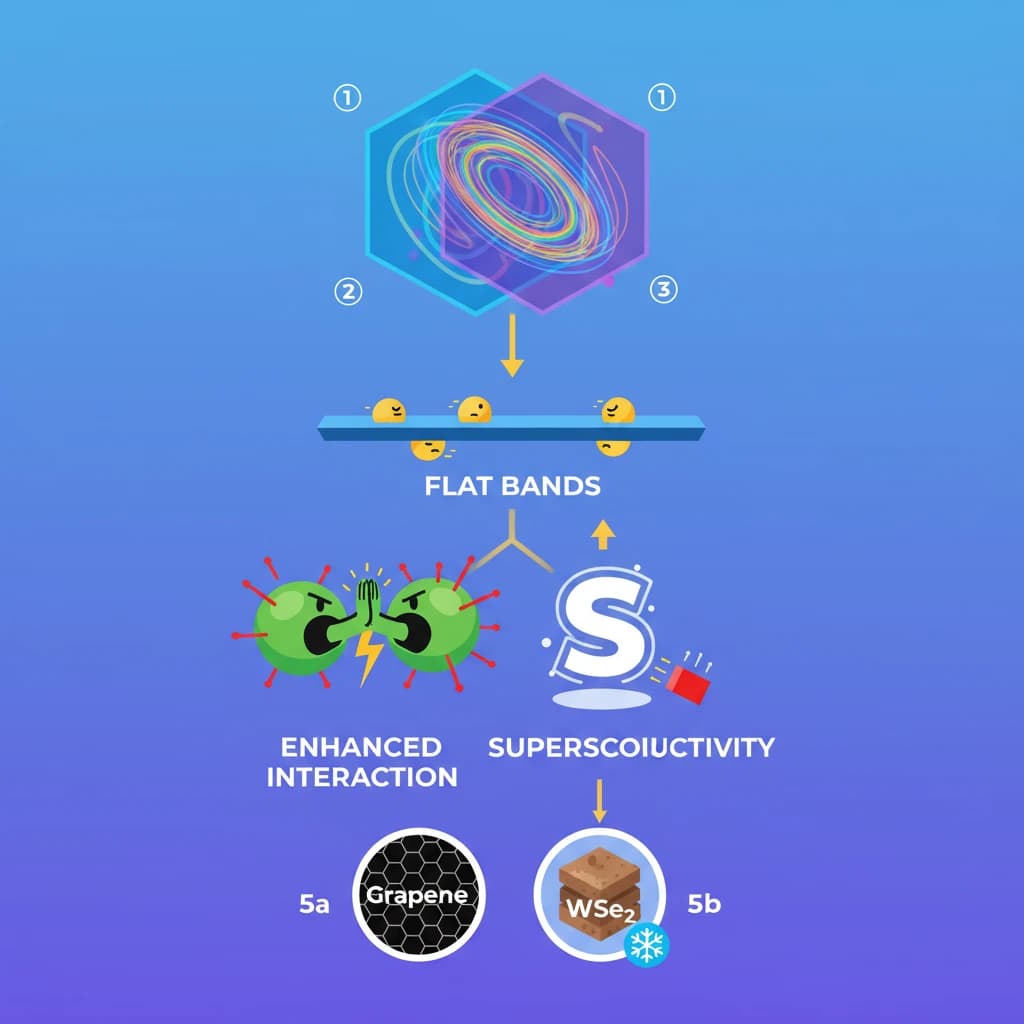
The unique twist in moiré materials has a profound effect on their electronic structure. It leads to the formation of what are known as flat bands.
In these flat bands, electrons move exceptionally slowly and maintain a nearly constant energy level. This sluggish movement is a critical factor.
The slow electron movement significantly enhances electron-electron interactions. These amplified interactions are fundamentally important and considered crucial for the emergence of superconductivity within the material.
Research on Tungsten Diselenide (WSe2)
Recent studies have focused on Tungsten Diselenide (WSe2), which is a prominent example of a semiconductor moiré material. This research has yielded significant results regarding its superconducting capabilities.
WSe2 demonstrated superconductivity at a remarkably low transition temperature of approximately −272.93° C. This temperature is comparable to those observed in some high-temperature superconductors.
Key Finding: The superconducting state observed in WSe2 was found to be more stable compared to other moiré materials investigated, highlighting its potential for practical applications.
UPSC Insight: Questions on advanced materials often focus on their unique properties and potential applications. Understanding the mechanism (flat bands, electron-electron interactions) and specific examples like WSe2 is vital for both Prelims and Mains (GS Paper 3: Science & Technology).
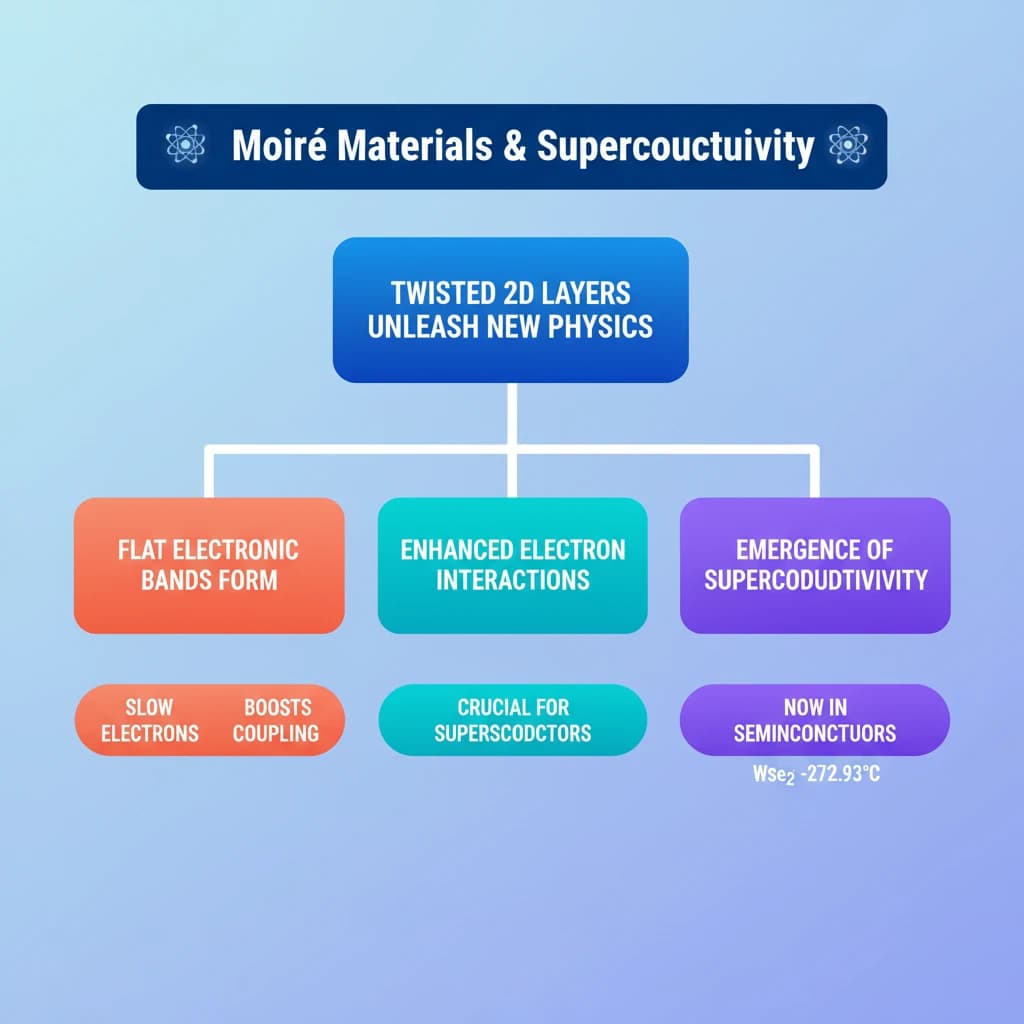
💡 Key Takeaways
- •Moiré materials are formed by twisting two layers of 2D materials at a slight angle, creating unique interference patterns.
- •This twist induces 'flat bands' in the electronic structure, slowing electrons and boosting electron-electron interactions.
- •Enhanced electron-electron interactions are crucial for the emergence of superconductivity in these materials.
- •Superconductivity, previously thought exclusive to graphene moiré materials, has now been found in semiconductor moiré materials like Tungsten Diselenide (WSe2).
- •WSe2 exhibited stable superconductivity at approximately -272.93° C, comparable to high-temperature superconductors.
- •These materials hold significant promise for quantum computing, lossless energy transmission, and next-generation electronics.
🧠 Memory Techniques
95% Verified Content
📚 Reference Sources
•Nature Journal study (referenced in the source content)
•General scientific literature on Moiré materials, 2D materials, and superconductivity (e.g., academic papers, physics textbooks, reputable science news outlets)