Loading page, please wait…
NASA’s PREFIRE Mission - UPSC Science And Technology
What is NASA’s PREFIRE Mission in UPSC Science And Technology?
NASA’s PREFIRE Mission is a key topic under Science And Technology for UPSC Civil Services Examination. Key points include: PREFIRE is a NASA mission using two CubeSats to measure heat loss from Earth's poles.. It aims to fill a critical gap in understanding the planet's energy budget, specifically far-infrared radiation.. The data will improve predictions for ice melt, sea levels, and weather patterns.. Understanding this topic is essential for both UPSC Prelims and Mains preparation.
Why is NASA’s PREFIRE Mission important for UPSC exam?
NASA’s PREFIRE Mission is a Medium-level topic in UPSC Science And Technology. It is tested in both Prelims (factual MCQs) and Mains (analytical answer writing). Previous year UPSC questions have frequently covered aspects of NASA’s PREFIRE Mission, making it essential for comprehensive IAS preparation.
How to prepare NASA’s PREFIRE Mission for UPSC?
To prepare NASA’s PREFIRE Mission for UPSC: (1) Study the comprehensive notes covering all key concepts on Vaidra. (2) Practice previous year questions on this topic. (3) Connect it with current affairs using daily updates. (4) Revise using key takeaways and mind maps available for Science And Technology. (5) Write practice answers linking NASA’s PREFIRE Mission to related GS Paper topics.
Key takeaways of NASA’s PREFIRE Mission for UPSC
- PREFIRE is a NASA mission using two CubeSats to measure heat loss from Earth's poles.
- It aims to fill a critical gap in understanding the planet's energy budget, specifically far-infrared radiation.
- The data will improve predictions for ice melt, sea levels, and weather patterns.
- CubeSats are standardized, low-cost nanosatellites (<10 kgs) used for research and tech demos.
- The mission is crucial for enhancing climate models and informing climate policy.
NASA’s PREFIRE Mission
Medium⏱️ 8 min read
science and technology
📖 Introduction
Introduction to PREFIRE Mission
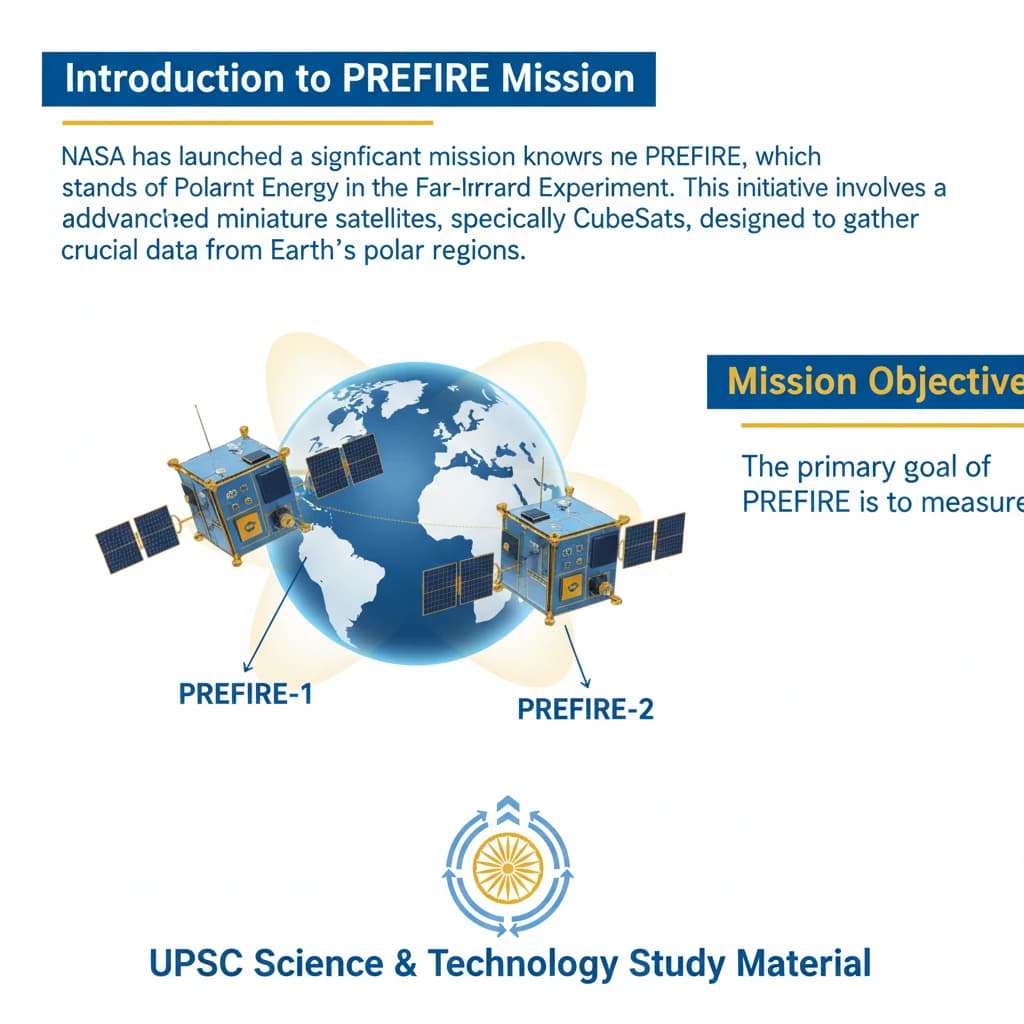
NASA has launched a significant mission known as PREFIRE, which stands for Polar Radiant Energy in the Far-Infrared Experiment.
This initiative involves a pair of advanced miniature satellites, specifically CubeSats, designed to gather crucial data from Earth's polar regions.
Mission Objective
The primary goal of PREFIRE is to measure the heat lost from the Earth’s poles. This addresses a critical gap in our current understanding of the planet's overall energy budget.
Understanding the heat emissions from the Arctic and Antarctica is vital for accurate climate modeling and predicting future environmental changes.
Technology and Instrumentation
The mission deploys two CubeSats, each classified as a 6U CubeSat, indicating its specific size and configuration.
These satellites are equipped with specialized instruments: thermal infrared spectrometers. These devices are engineered to precisely measure both far-infrared and general infrared radiation.
Target Regions: The measurements are focused on radiation emitted from both the Arctic and Antarctica, providing comprehensive polar data.
Significance of Data
The data collected by PREFIRE will significantly enhance scientists' comprehension of the delicate balance between incoming and outgoing heat on Earth.
This improved understanding is absolutely crucial for creating more accurate predictions regarding future changes in Earth’s ice sheets, sea levels, and global weather patterns.
UPSC Relevance: The mission's focus on polar ice melt and climate change makes it highly relevant for GS Paper 3 (Environment & Science and Technology). Questions may link this to global warming impacts.
💡 Key Takeaways
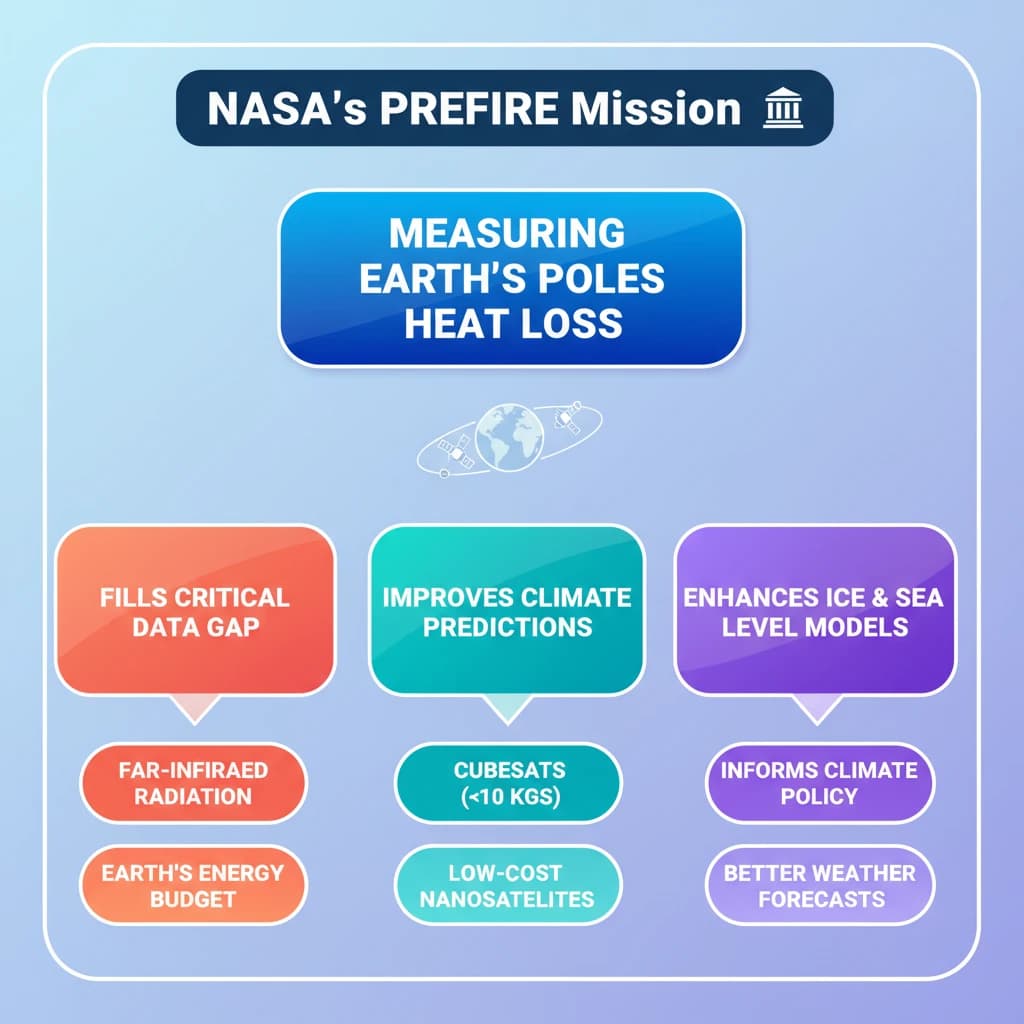
- •PREFIRE is a NASA mission using two CubeSats to measure heat loss from Earth's poles.
- •It aims to fill a critical gap in understanding the planet's energy budget, specifically far-infrared radiation.
- •The data will improve predictions for ice melt, sea levels, and weather patterns.
- •CubeSats are standardized, low-cost nanosatellites (<10 kgs) used for research and tech demos.
- •The mission is crucial for enhancing climate models and informing climate policy.
🧠 Memory Techniques
95% Verified Content
📚 Reference Sources
•NASA PREFIRE Mission Website (assumed general knowledge source for details)