Loading page, please wait…
Nitrogen Use Efficiency and Biofortification - UPSC Science And Technology
What is Nitrogen Use Efficiency and Biofortification in UPSC Science And Technology?
Nitrogen Use Efficiency and Biofortification is a key topic under Science And Technology for UPSC Civil Services Examination. Key points include: Nitrogen Use Efficiency (NUE) is critical for sustainable agriculture, reducing fertilizer waste and pollution.. Indian rice varieties show significant NUE variation, offering potential for developing low-nitrogen, high-yielding crops.. Poor NUE in India leads to substantial economic loss (Rs 1 lakh crore/year) and makes India the second-largest N2O emitter globally.. Understanding this topic is essential for both UPSC Prelims and Mains preparation.
Why is Nitrogen Use Efficiency and Biofortification important for UPSC exam?
Nitrogen Use Efficiency and Biofortification is a Medium-level topic in UPSC Science And Technology. It is tested in both Prelims (factual MCQs) and Mains (analytical answer writing). Previous year UPSC questions have frequently covered aspects of Nitrogen Use Efficiency and Biofortification, making it essential for comprehensive IAS preparation.
How to prepare Nitrogen Use Efficiency and Biofortification for UPSC?
To prepare Nitrogen Use Efficiency and Biofortification for UPSC: (1) Study the comprehensive notes covering all key concepts on Vaidra. (2) Practice previous year questions on this topic. (3) Connect it with current affairs using daily updates. (4) Revise using key takeaways and mind maps available for Science And Technology. (5) Write practice answers linking Nitrogen Use Efficiency and Biofortification to related GS Paper topics.
Key takeaways of Nitrogen Use Efficiency and Biofortification for UPSC
- Nitrogen Use Efficiency (NUE) is critical for sustainable agriculture, reducing fertilizer waste and pollution.
- Indian rice varieties show significant NUE variation, offering potential for developing low-nitrogen, high-yielding crops.
- Poor NUE in India leads to substantial economic loss (Rs 1 lakh crore/year) and makes India the second-largest N2O emitter globally.
- Biofortification involves enhancing crop nutritional value, addressing hidden hunger and boosting farmer income.
- ICAR launched 109 high-yielding, climate-resilient, biofortified seed varieties to improve farm productivity and nutrition.
- Both NUE improvement and biofortification are vital for India's food security, public health, and climate change mitigation goals.
Nitrogen Use Efficiency and Biofortification
Medium⏱️ 8 min read
science and technology
📖 Introduction
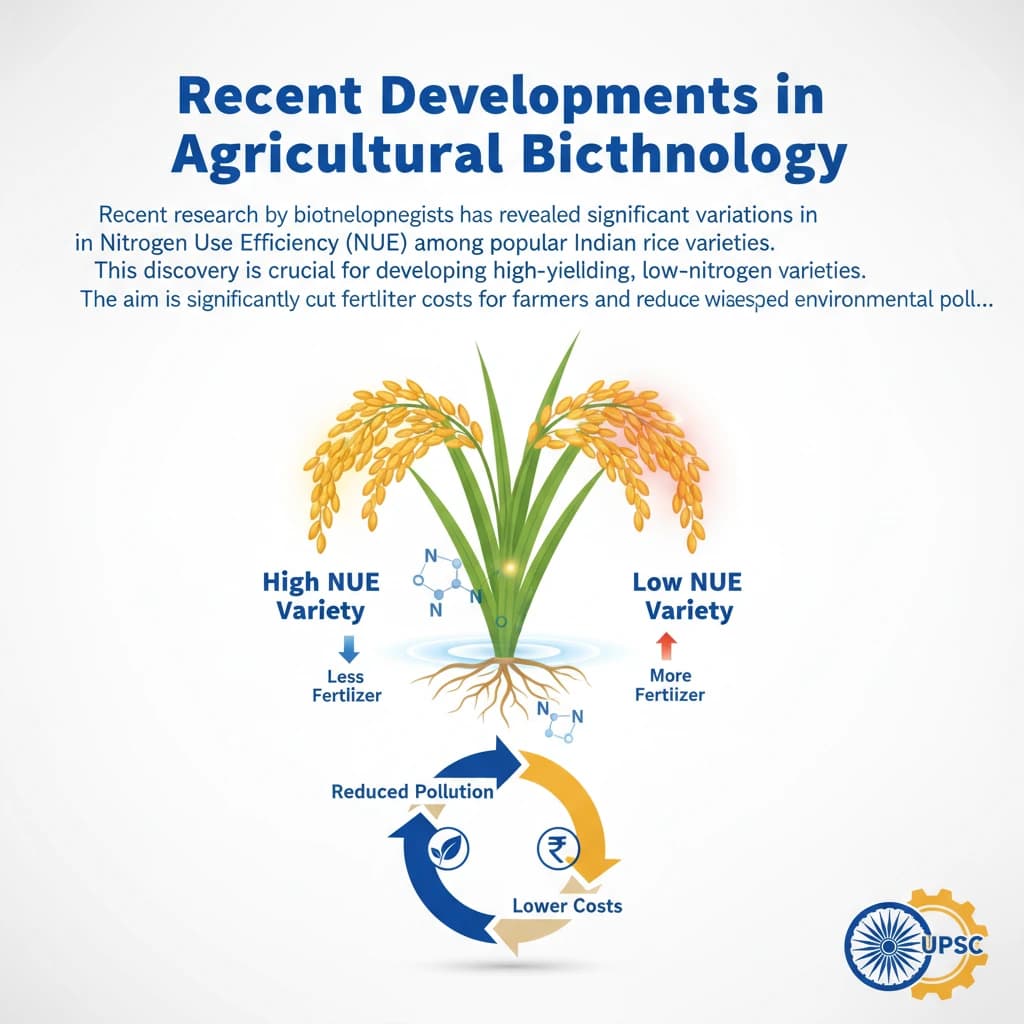
Recent Developments in Agricultural Biotechnology
Recent research by biotechnologists has revealed significant variations in Nitrogen Use Efficiency (NUE) among popular Indian rice varieties. This discovery is crucial for developing high-yielding, low-nitrogen varieties.
The aim is to significantly cut fertiliser costs for farmers and reduce widespread environmental pollution caused by nitrogenous fertilisers. The most efficient rice varieties demonstrated a NUE five times higher than the least efficient ones.
This finding is highly relevant for UPSC GS-III (Agriculture, Environment), particularly concerning sustainable farming practices and reducing agricultural pollution.
In a separate, but related, development, the Prime Minister of India launched 109 high-yielding, climate-resilient, biofortified seed varieties. These varieties were developed by the Indian Council of Agricultural Research (ICAR).
The initiative aims to boost overall farm productivity and directly enhance farmers’ incomes, contributing to agricultural sustainability and food security.
Understanding Nitrogen Use Efficiency (NUE)
Nitrogen Use Efficiency (NUE) describes a plant's effectiveness in utilizing applied or fixed nitrogen for its growth and biomass production. It is a critical metric in modern agriculture.
Definition: NUE is the ratio between crop yield and the amount of nitrogen absorbed by the plant. This nitrogen can be absorbed from the soil through roots or from the atmosphere through biological fixation by bacteria.
For sustainable agriculture, NUE is a particularly vital factor in cereals, especially rice. Improving NUE in these staple crops can have a profound impact on global food systems.
Concerns Regarding Poor Nitrogen Use Efficiency (NUE)
The current low NUE in agricultural practices presents several significant challenges, impacting both economic stability and environmental health.
- Economic Waste: Poor NUE leads to the wastage of Nitrogen fertilisers. This amounts to approximately Rs 1 lakh crore annually in India and over USD 170 billion globally.
- Air Pollution: Nitrogen fertilisers are a primary source of nitrous oxide (N₂O) and ammonia pollution in the air. These gases contribute to respiratory issues and environmental degradation.
- Water Pollution: The overuse of fertilisers results in nitrate/ammonium pollution of water bodies. This impacts aquatic ecosystems and human health.
- Climate Change: Nitrous oxide (N₂O) is a potent greenhouse gas, heating the atmosphere far more effectively than carbon dioxide. Its emissions significantly contribute to climate change.
India's Contribution: India is the world’s second-largest source of nitrous oxide (N₂O) emissions. In 2020, nearly 11% of global man-made N₂O emissions originated from India, trailing only China (16%). The major source of these emissions is fertiliser usage.
💡 Key Takeaways
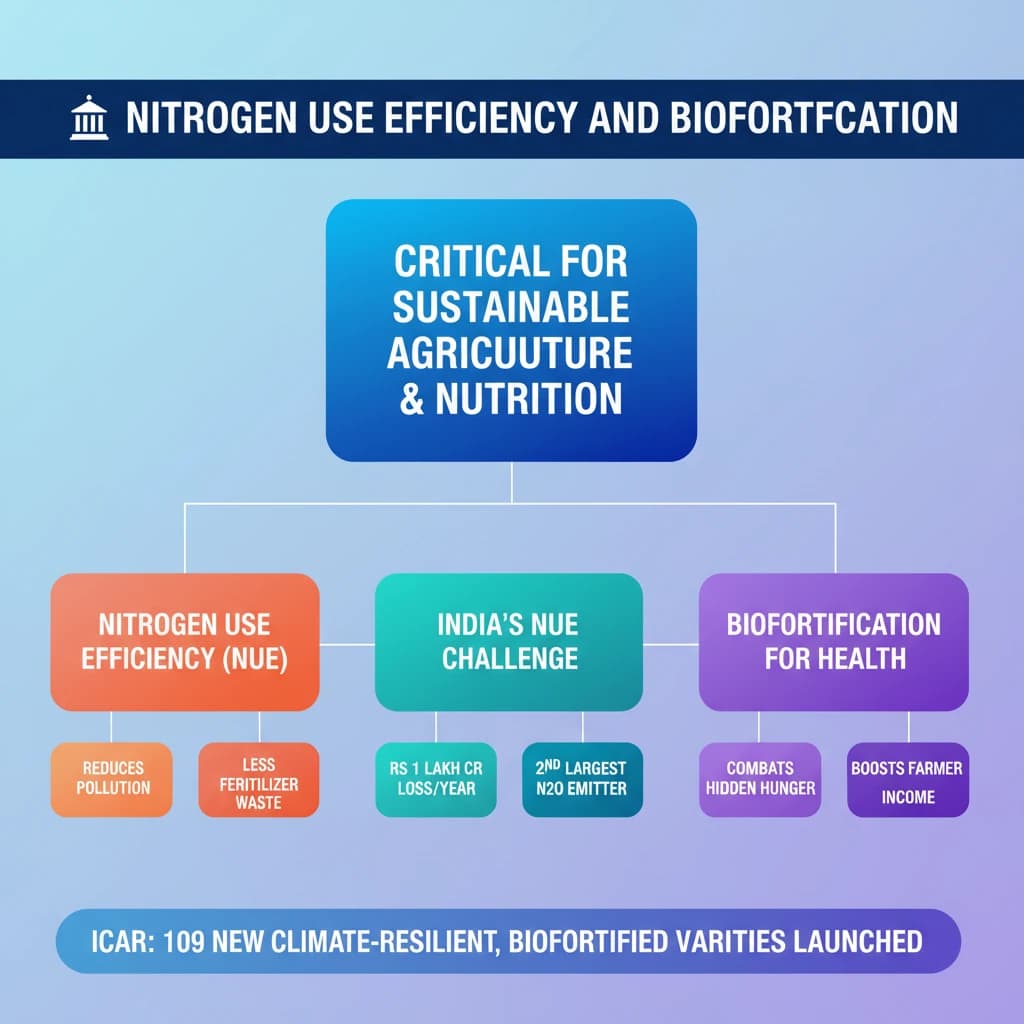
- •Nitrogen Use Efficiency (NUE) is critical for sustainable agriculture, reducing fertilizer waste and pollution.
- •Indian rice varieties show significant NUE variation, offering potential for developing low-nitrogen, high-yielding crops.
- •Poor NUE in India leads to substantial economic loss (Rs 1 lakh crore/year) and makes India the second-largest N2O emitter globally.
- •Biofortification involves enhancing crop nutritional value, addressing hidden hunger and boosting farmer income.
- •ICAR launched 109 high-yielding, climate-resilient, biofortified seed varieties to improve farm productivity and nutrition.
- •Both NUE improvement and biofortification are vital for India's food security, public health, and climate change mitigation goals.
🧠 Memory Techniques
95% Verified Content
📚 Reference Sources
•Indian Council of Agricultural Research (ICAR) official reports (general knowledge)
•Government of India reports on agricultural policy and climate change (general knowledge)