Loading page, please wait…
One Nation One Time - UPSC Science And Technology
What is One Nation One Time in UPSC Science And Technology?
One Nation One Time is a key topic under Science And Technology for UPSC Civil Services Examination. Key points include: <strong>'One Nation, One Time'</strong> aims to standardize Indian Standard Time (IST) adoption across all sectors.. The <strong>Legal Metrology (IST) Rules, 2023</strong>, drafted by the <strong>Department of Consumer Affairs</strong> with <strong>CSIR-NPL</strong> and <strong>ISRO</strong>, mandate IST.. <strong>IST</strong> is based on <strong>82.5° East longitude</strong>, 5 hours 30 minutes ahead of UTC (UTC+5:30).. Understanding this topic is essential for both UPSC Prelims and Mains preparation.
Why is One Nation One Time important for UPSC exam?
One Nation One Time is a Medium-level topic in UPSC Science And Technology. It is tested in both Prelims (factual MCQs) and Mains (analytical answer writing). Previous year UPSC questions have frequently covered aspects of One Nation One Time, making it essential for comprehensive IAS preparation.
How to prepare One Nation One Time for UPSC?
To prepare One Nation One Time for UPSC: (1) Study the comprehensive notes covering all key concepts on Vaidra. (2) Practice previous year questions on this topic. (3) Connect it with current affairs using daily updates. (4) Revise using key takeaways and mind maps available for Science And Technology. (5) Write practice answers linking One Nation One Time to related GS Paper topics.
Key takeaways of One Nation One Time for UPSC
- <strong>'One Nation, One Time'</strong> aims to standardize Indian Standard Time (IST) adoption across all sectors.
- The <strong>Legal Metrology (IST) Rules, 2023</strong>, drafted by the <strong>Department of Consumer Affairs</strong> with <strong>CSIR-NPL</strong> and <strong>ISRO</strong>, mandate IST.
- <strong>IST</strong> is based on <strong>82.5° East longitude</strong>, 5 hours 30 minutes ahead of UTC (UTC+5:30).
- Standardized time is crucial for efficient railway operations, financial markets, national security, and digital services.
- Historically, <strong>IST</strong> was established in <strong>1905</strong> for railways and telegraphs, adopted nationally post-1947.
- Its contemporary relevance lies in supporting <strong>Digital India</strong>, <strong>Smart Cities</strong>, and critical national infrastructure.
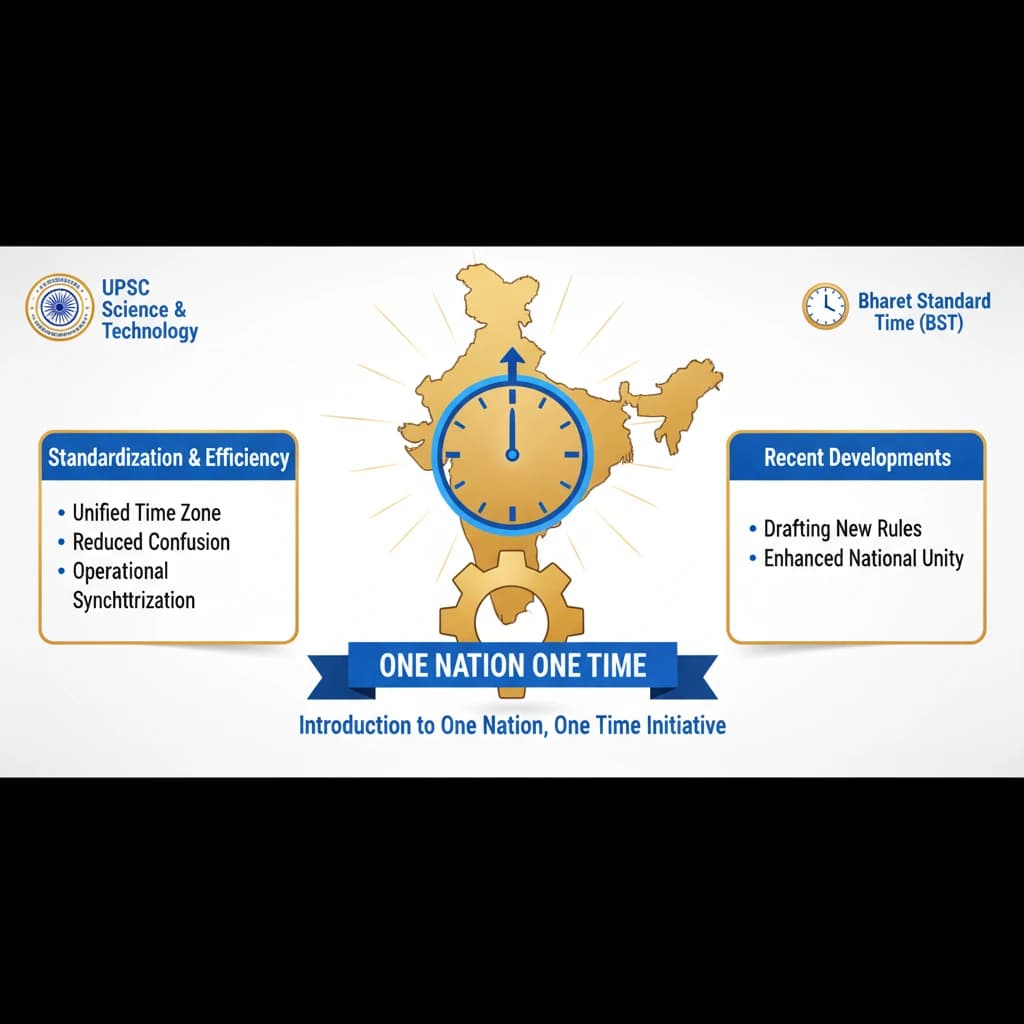
One Nation One Time
Medium⏱️ 8 min read
science and technology
📖 Introduction
Introduction to One Nation, One Time Initiative
The concept of 'One Nation, One Time' signifies a national initiative to standardize and mandate the adoption of a single, unified time zone across all sectors within India. This aims to eliminate any potential confusion or operational discrepancies arising from varied timekeeping practices.
The initiative has gained recent traction with the drafting of new rules to reinforce this vision.
Why in News? Drafting of Legal Metrology (IST) Rules, 2023
The Department of Consumer Affairs, in collaboration with key scientific and research bodies, has recently drafted the Legal Metrology (Indian Standard Time (IST) Rules), 2023. This legislative step underscores the government's commitment to formalizing a singular time standard.
Key collaborating organizations include the Council of Scientific & Industrial Research - National Physical Laboratory (CSIR-NPL) and the Indian Space Research Organisation (ISRO).
Objective of the Legal Metrology (IST) Rules, 2023
The primary goal of these newly drafted rules is to ensure the consistent and mandatory adoption of Indian Standard Time (IST) across all sectors nationwide. This standardization is crucial for seamless operations and national integration.
The rules are a significant step towards realizing the overarching vision of 'One Nation, One Time', ensuring uniformity in timekeeping throughout the country.
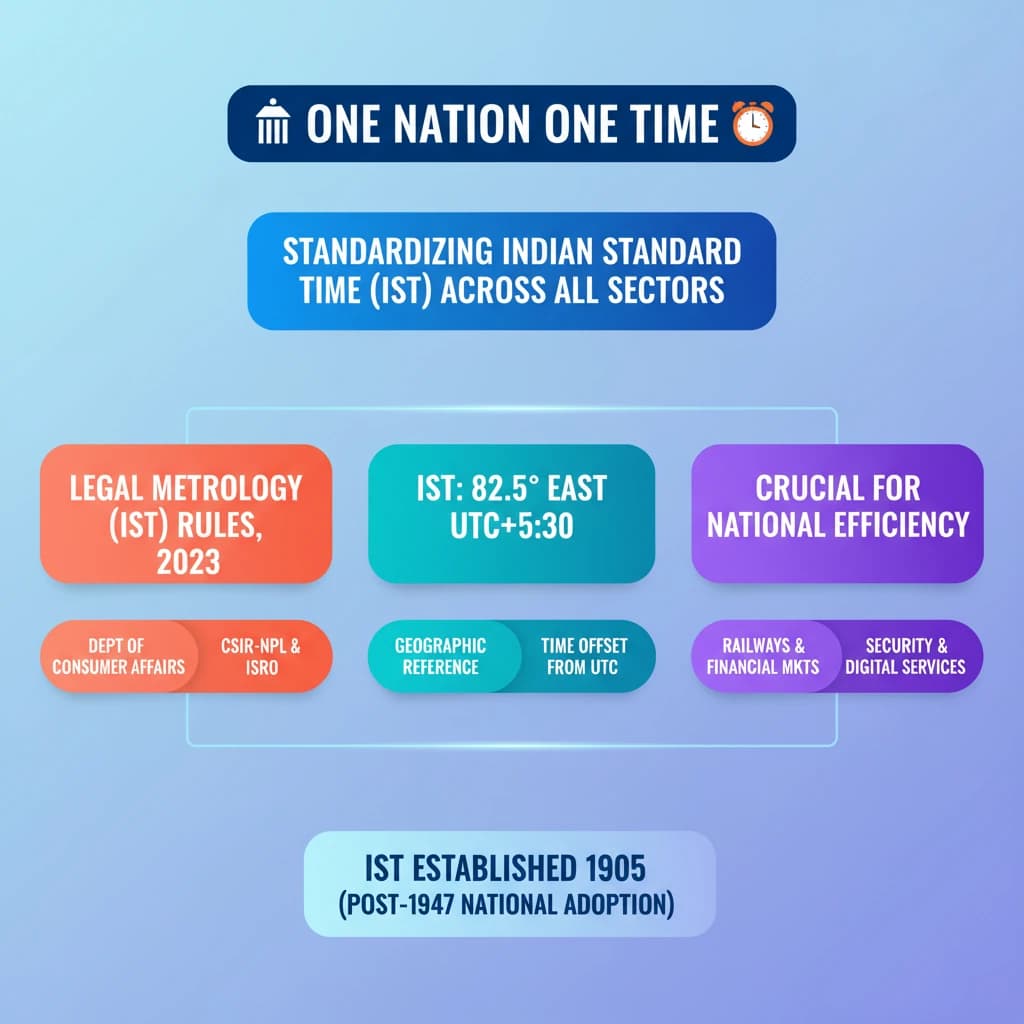
💡 Key Takeaways
- •<strong>'One Nation, One Time'</strong> aims to standardize Indian Standard Time (IST) adoption across all sectors.
- •The <strong>Legal Metrology (IST) Rules, 2023</strong>, drafted by the <strong>Department of Consumer Affairs</strong> with <strong>CSIR-NPL</strong> and <strong>ISRO</strong>, mandate IST.
- •<strong>IST</strong> is based on <strong>82.5° East longitude</strong>, 5 hours 30 minutes ahead of UTC (UTC+5:30).
- •Standardized time is crucial for efficient railway operations, financial markets, national security, and digital services.
- •Historically, <strong>IST</strong> was established in <strong>1905</strong> for railways and telegraphs, adopted nationally post-1947.
- •Its contemporary relevance lies in supporting <strong>Digital India</strong>, <strong>Smart Cities</strong>, and critical national infrastructure.
🧠 Memory Techniques

95% Verified Content
📚 Reference Sources
•Press Information Bureau (PIB) releases on Legal Metrology and CSIR-NPL
•Official websites of CSIR-NPL and ISRO for their roles in timekeeping
•NCERT Geography textbooks for concepts of time zones and meridians