Loading page, please wait…
One Nation One Time - UPSC Science And Technology
What is One Nation One Time in UPSC Science And Technology?
One Nation One Time is a key topic under Science And Technology for UPSC Civil Services Examination. Key points include: The Legal Metrology (IST) Rules, 2023, mandate the adoption of Indian Standard Time (IST) across all sectors.. IST is maintained by CSIR-NPL and is 5 hours 30 minutes ahead of Universal Coordinated Time (UTC).. The rules prohibit the general use of foreign time references like GPS time, reinforcing national time sovereignty.. Understanding this topic is essential for both UPSC Prelims and Mains preparation.
Why is One Nation One Time important for UPSC exam?
One Nation One Time is a Medium-level topic in UPSC Science And Technology. It is tested in both Prelims (factual MCQs) and Mains (analytical answer writing). Previous year UPSC questions have frequently covered aspects of One Nation One Time, making it essential for comprehensive IAS preparation.
How to prepare One Nation One Time for UPSC?
To prepare One Nation One Time for UPSC: (1) Study the comprehensive notes covering all key concepts on Vaidra. (2) Practice previous year questions on this topic. (3) Connect it with current affairs using daily updates. (4) Revise using key takeaways and mind maps available for Science And Technology. (5) Write practice answers linking One Nation One Time to related GS Paper topics.
Key takeaways of One Nation One Time for UPSC
- The Legal Metrology (IST) Rules, 2023, mandate the adoption of Indian Standard Time (IST) across all sectors.
- IST is maintained by CSIR-NPL and is 5 hours 30 minutes ahead of Universal Coordinated Time (UTC).
- The rules prohibit the general use of foreign time references like GPS time, reinforcing national time sovereignty.
- Critical sectors including government, finance, telecom, and power grids must synchronize their systems with IST.
- IST was established in 1906, replacing multiple regional time zones from the British era.
- The initiative aligns with the vision of "One Nation, One Time" for enhanced national coordination and efficiency.
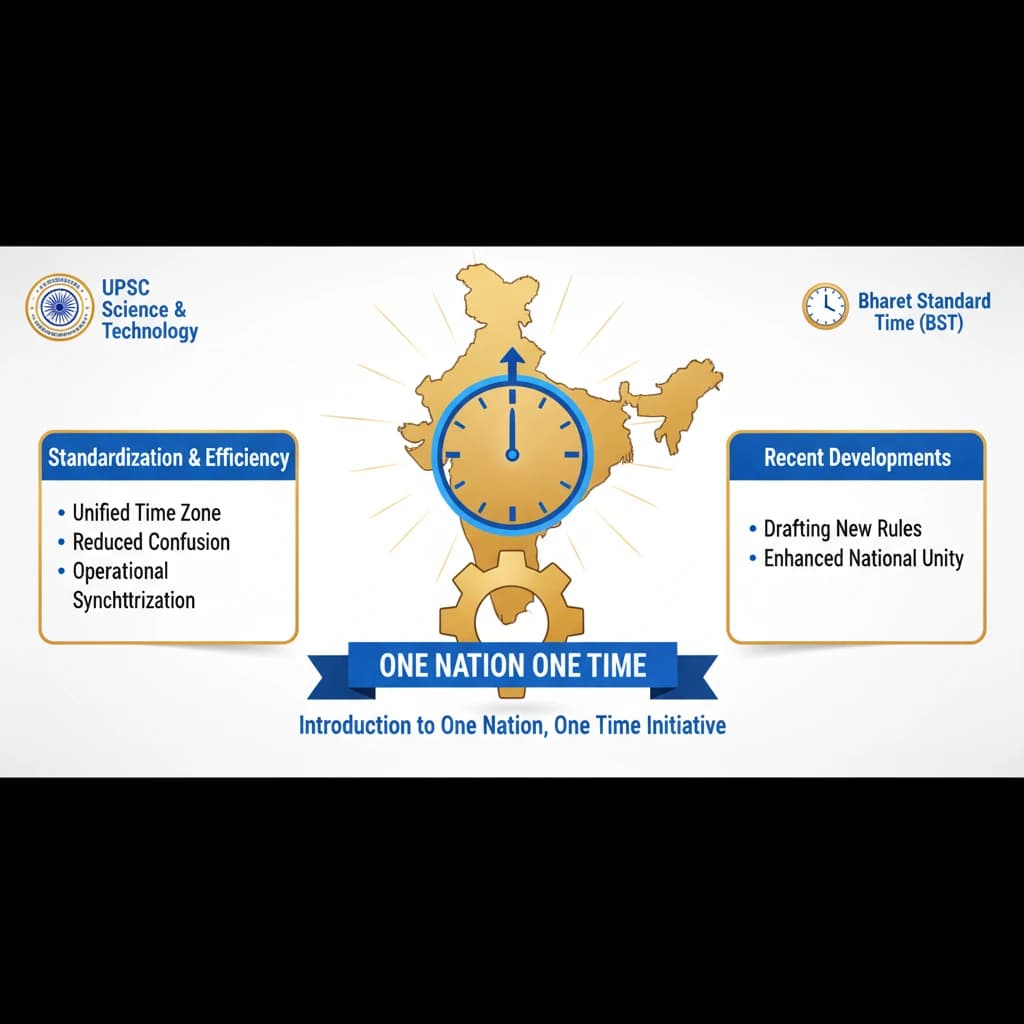
One Nation One Time
Medium⏱️ 7 min read
science and technology
📖 Introduction
Context and Introduction
The Department of Consumer Affairs, in collaboration with the Council of Scientific & Industrial Research - National Physical Laboratory (CSIR-NPL) and the Indian Space Research Organisation (ISRO), has drafted the Legal Metrology (Indian Standard Time (IST)) Rules, 2023.
These rules aim to standardize and mandate the adoption of Indian Standard Time (IST) across all sectors, reinforcing the national vision of “One Nation, One Time”.
Key Features of the Legal Metrology (IST) Rules, 2023
Mandatory Adoption of IST: IST, as maintained by the CSIR-NPL, will be the only legally recognized time standard in India. This move solidifies the “One Nation, One Time” initiative.
- The use of foreign time references, such as Global Positioning System (GPS) time, will be prohibited unless specifically approved by the government.
- Synchronization of Critical Sectors: All government institutions, financial entities, telecom service providers, power grids, and digital infrastructure must synchronize their systems with IST.
- Regulatory Framework & Compliance: Compliance with these rules will be monitored through periodic audits. Penalties will be imposed for any non-adherence.
- Special Provisions: Certain applications like scientific research, astronomy, and navigational applications may use alternative time references, but only with prior government approval.
- The rules also provide necessary flexibility for strategic and national security applications.
Understanding Indian Standard Time (IST)
The Indian Standard Time (IST) is based on a specific longitude of 82.5° East.
This reference longitude passes through Mirzapur, Uttar Pradesh, serving as the central meridian for India's time zone.
IST is precisely 5 hours and 30 minutes ahead of Greenwich Mean Time (GMT), which is now universally known as Universal Coordinated Time (UTC).
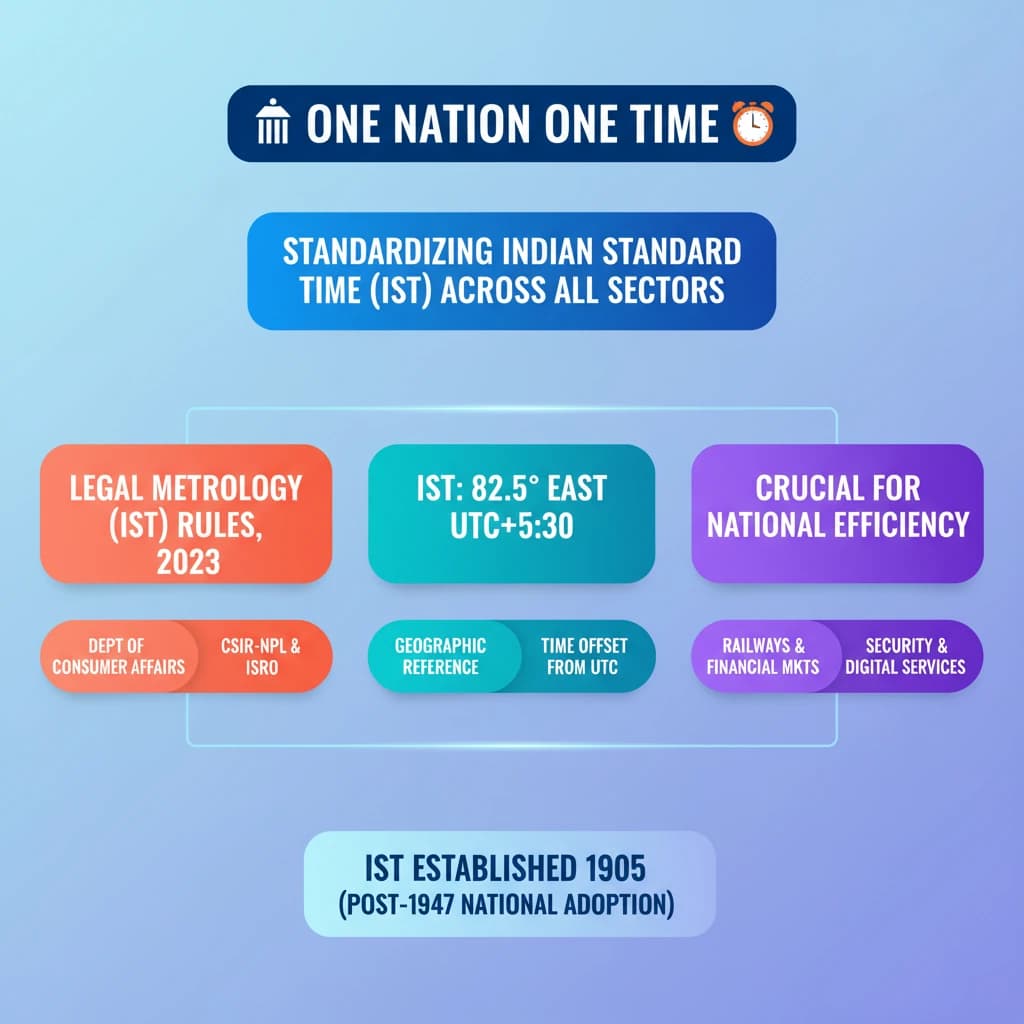
💡 Key Takeaways
- •The Legal Metrology (IST) Rules, 2023, mandate the adoption of Indian Standard Time (IST) across all sectors.
- •IST is maintained by CSIR-NPL and is 5 hours 30 minutes ahead of Universal Coordinated Time (UTC).
- •The rules prohibit the general use of foreign time references like GPS time, reinforcing national time sovereignty.
- •Critical sectors including government, finance, telecom, and power grids must synchronize their systems with IST.
- •IST was established in 1906, replacing multiple regional time zones from the British era.
- •The initiative aligns with the vision of "One Nation, One Time" for enhanced national coordination and efficiency.
🧠 Memory Techniques

95% Verified Content
📚 Reference Sources
•Legal Metrology Act, 2009 (contextual for Legal Metrology Rules)
•CSIR-National Physical Laboratory (NPL) official website (for IST maintenance role)
•Indian Space Research Organisation (ISRO) official website (for general contributions to national infrastructure and timing)