Loading page, please wait…
Piezoelectric Materials: Properties, Examples, and Applications - UPSC Science And Technology
What is Piezoelectric Materials: Properties, Examples, and Applications in UPSC Science And Technology?
Piezoelectric Materials: Properties, Examples, and Applications is a key topic under Science And Technology for UPSC Civil Services Examination. Key points include: Piezoelectric materials generate electricity from mechanical stress and deform under electric fields.. Examples include natural (Quartz), ceramic (PZT), and polymer (PVDF) types.. Applications span sensors, actuators, energy harvesting, and medical devices.. Understanding this topic is essential for both UPSC Prelims and Mains preparation.
Why is Piezoelectric Materials: Properties, Examples, and Applications important for UPSC exam?
Piezoelectric Materials: Properties, Examples, and Applications is a Medium-level topic in UPSC Science And Technology. It is tested in both Prelims (factual MCQs) and Mains (analytical answer writing). Previous year UPSC questions have frequently covered aspects of Piezoelectric Materials: Properties, Examples, and Applications, making it essential for comprehensive IAS preparation.
How to prepare Piezoelectric Materials: Properties, Examples, and Applications for UPSC?
To prepare Piezoelectric Materials: Properties, Examples, and Applications for UPSC: (1) Study the comprehensive notes covering all key concepts on Vaidra. (2) Practice previous year questions on this topic. (3) Connect it with current affairs using daily updates. (4) Revise using key takeaways and mind maps available for Science And Technology. (5) Write practice answers linking Piezoelectric Materials: Properties, Examples, and Applications to related GS Paper topics.
Key takeaways of Piezoelectric Materials: Properties, Examples, and Applications for UPSC
- Piezoelectric materials generate electricity from mechanical stress and deform under electric fields.
- Examples include natural (Quartz), ceramic (PZT), and polymer (PVDF) types.
- Applications span sensors, actuators, energy harvesting, and medical devices.
- Polymers are large molecules made of repeating monomer units.
- Piezoelectric polymers like PVDF offer flexibility for wearable tech.
- Nanomaterials (1-100 nm) and nanocomposites enhance polymer properties (mechanical, thermal, electrical).
Piezoelectric Materials: Properties, Examples, and Applications
Medium⏱️ 7 min read
science and technology
📖 Introduction
Understanding Piezoelectric Materials
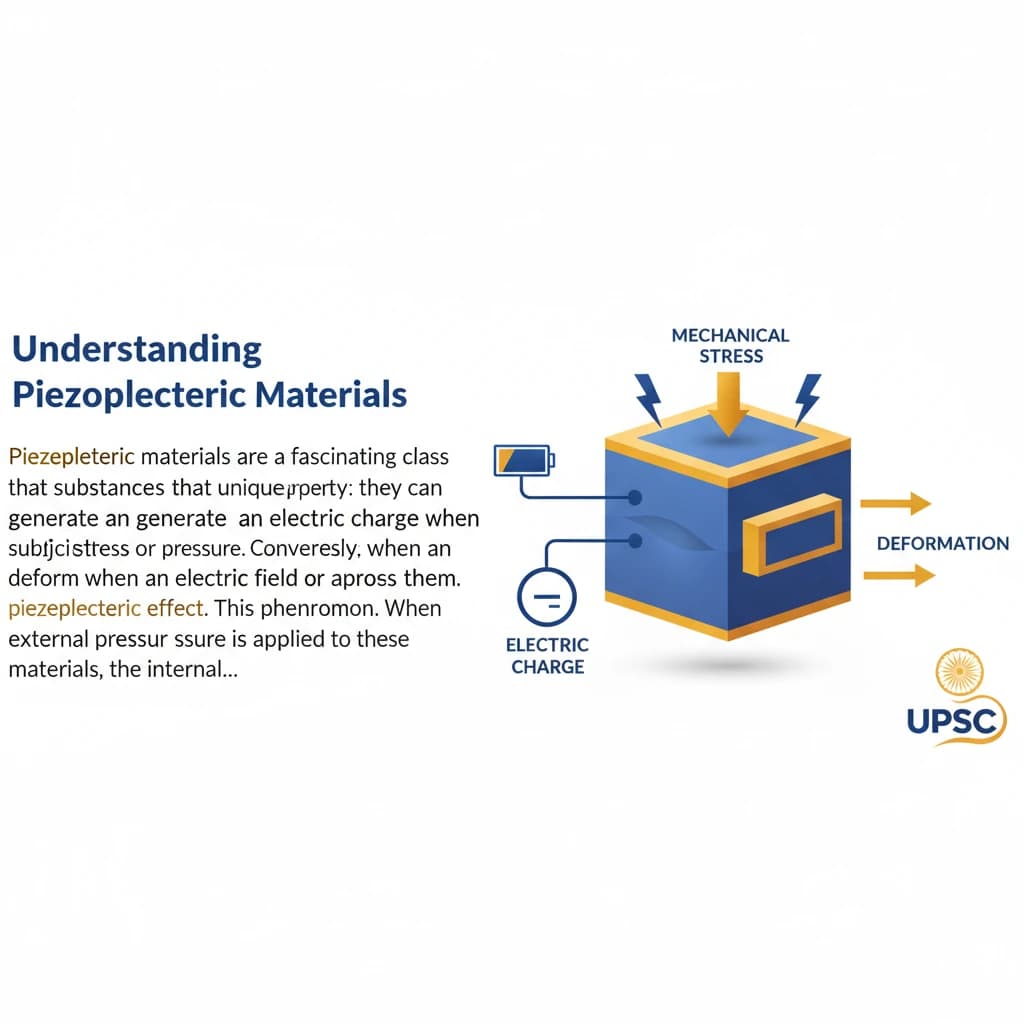
Piezoelectric materials are a fascinating class of substances that exhibit a unique property: they can generate an electric charge when subjected to mechanical stress or pressure. Conversely, they deform when an electric field is applied across them. This phenomenon is known as the piezoelectric effect.
When external pressure is applied to these materials, the internal centres of positive and negative charges within their crystal structure shift. This displacement leads to the creation of an external electric field, effectively converting mechanical energy into electrical energy.
Key Concept: Piezoelectric Effect
- Direct Piezoelectric Effect: Mechanical stress generates an electric charge.
- Inverse Piezoelectric Effect: An applied electric field causes mechanical deformation.
Types of Piezoelectric Materials
Piezoelectric properties are found across a diverse range of materials, from naturally occurring crystals to advanced synthetic polymers and ceramics.
- Natural Materials: These include minerals like Quartz, topaz, and tourmaline.
- Organic Materials: Biological substances such as silk, wood, and bone also exhibit piezoelectricity.
- Ceramics: Synthetically produced ceramics like Lead Zirconate Titanate (PZT) and barium titanate (BT) are widely used due to their strong piezoelectric response.
- Polymers: Certain polymers, such as PVDF (Polyvinylidene Fluoride) and PVDF-TrFE (Poly(vinylidene fluoride-trifluoroethylene) copolymer), are engineered for piezoelectric applications.
Ferroelectric Materials: A special class, like Barium Titanate (BaTiO3), can generate an electric charge even without direct mechanical pressure, often due to spontaneous polarization that can be reoriented by an electric field.
Applications of Piezoelectric Materials
The ability of piezoelectric materials to interconvert mechanical and electrical energy makes them invaluable in numerous technological applications across various sectors.
- Sensors: Used in pressure sensors, accelerometers, and microphones to detect mechanical vibrations or forces.
- Actuators: Employed in precision positioning systems, inkjet printers, and haptic feedback devices to produce precise movements.
- Energy Harvesting: Convert ambient mechanical vibrations (e.g., from footsteps, machinery) into usable electrical energy.
- Acoustics: Found in microphones and electric pickups for stringed instruments.
- Frequency Standards: Quartz crystals are crucial for accurate timing in watches and electronic devices.
- Motors: Used in compact and precise piezoelectric motors.
- Noise and Vibration Reduction: Active damping systems utilize piezoelectric materials to counteract unwanted vibrations.
Polymers: An Overview
A polymer is a large molecule, often referred to as a macromolecule, that is composed of many repeating smaller units called monomers. These monomers are linked together in chains or rings.
Polymers typically possess high molecular masses, which contribute to their characteristic high melting and boiling points. They can be broadly categorized into natural and synthetic types.
Examples of Polymers:
- Natural Polymers: Silk, DNA.
- Synthetic Polymers: Nylon, polyethylene (derived from oil or bio-based sources).
Piezoelectric Polymers
These are a specific class of polymers engineered to exhibit the piezoelectric effect. They are capable of generating electric charges on their surface when subjected to mechanical pressure or strain.
This property allows them to efficiently convert mechanical energy directly into electrical energy, making them suitable for flexible and lightweight applications.
Examples of Piezoelectric Polymers:
- Poly(vinylidene fluoride) (PVDF)
- Poly(vinylidene fluoride-trifluoroethylene) copolymer (P(VDF-TrFE))
Polymer Nanocomposites
Polymer nanocomposites are advanced materials formed by combining a polymer matrix with a small percentage of additives that are sized in the nanometer range (typically 1-100 nm).
The primary aim of creating nanocomposites is to significantly enhance various properties of the base polymer, including its mechanical strength, thermal stability, and electrical characteristics, often with minimal additive loading.
Nanomaterials and Nanocomposites
A nanomaterial is defined as any material that has structural components with at least one dimension in the nanometer scale, which is typically between 1 nanometer (nm) and 100 nm.
Nanocomposite Definition: A nanocomposite is a solid material comprising two or more different substances, where at least one of these substances has dimensions specifically in the nanoscale range, often cited as between 1 nm and 3 nm, contributing to its enhanced properties.
UPSC Insight: Understanding the fundamental principles and applications of piezoelectric materials, polymers, and nanocomposites is crucial for the Science & Technology section of the General Studies Paper III. Focus on the interdisciplinary nature and real-world impact.
💡 Key Takeaways
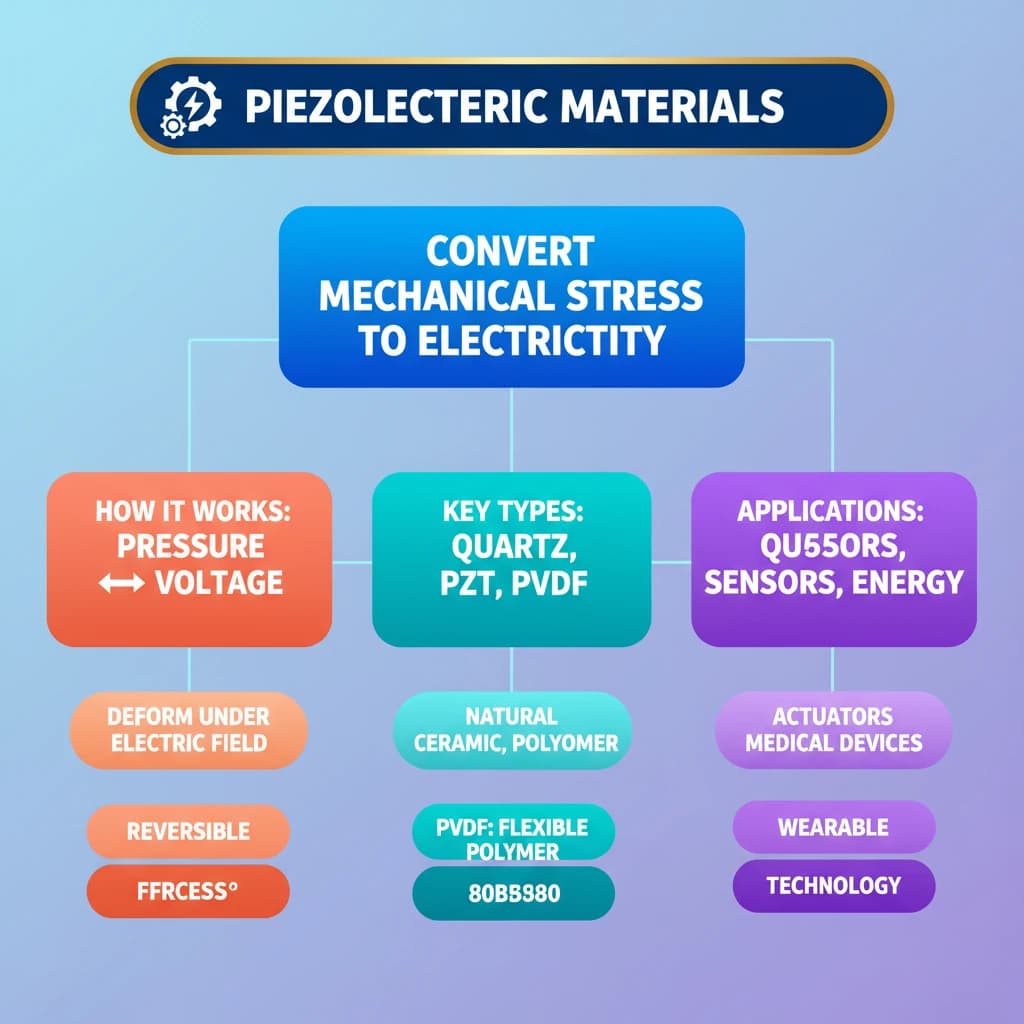
- •Piezoelectric materials generate electricity from mechanical stress and deform under electric fields.
- •Examples include natural (Quartz), ceramic (PZT), and polymer (PVDF) types.
- •Applications span sensors, actuators, energy harvesting, and medical devices.
- •Polymers are large molecules made of repeating monomer units.
- •Piezoelectric polymers like PVDF offer flexibility for wearable tech.
- •Nanomaterials (1-100 nm) and nanocomposites enhance polymer properties (mechanical, thermal, electrical).
🧠 Memory Techniques

95% Verified Content
📚 Reference Sources
•General knowledge of piezoelectric materials, polymers, and nanotechnology concepts