Loading page, please wait…
Quantum Satellite - UPSC Science And Technology
What is Quantum Satellite in UPSC Science And Technology?
Quantum Satellite is a key topic under Science And Technology for UPSC Civil Services Examination. Key points include: Quantum satellites use quantum physics for unconditionally secure communication.. Quantum Key Distribution (QKD) detects any eavesdropping attempt by altering photon states.. Quantum entanglement ensures immediate detection of information alteration.. Understanding this topic is essential for both UPSC Prelims and Mains preparation.
Why is Quantum Satellite important for UPSC exam?
Quantum Satellite is a Medium-level topic in UPSC Science And Technology. It is tested in both Prelims (factual MCQs) and Mains (analytical answer writing). Previous year UPSC questions have frequently covered aspects of Quantum Satellite, making it essential for comprehensive IAS preparation.
How to prepare Quantum Satellite for UPSC?
To prepare Quantum Satellite for UPSC: (1) Study the comprehensive notes covering all key concepts on Vaidra. (2) Practice previous year questions on this topic. (3) Connect it with current affairs using daily updates. (4) Revise using key takeaways and mind maps available for Science And Technology. (5) Write practice answers linking Quantum Satellite to related GS Paper topics.
Key takeaways of Quantum Satellite for UPSC
- Quantum satellites use quantum physics for unconditionally secure communication.
- Quantum Key Distribution (QKD) detects any eavesdropping attempt by altering photon states.
- Quantum entanglement ensures immediate detection of information alteration.
- India's National Quantum Mission aims to launch a quantum satellite in 2-3 years.
- China operates the world's largest QKD network, including three quantum satellites.
- ISRO has demonstrated free-space quantum communication over 300m.
- The UN declared 2025 as the 'International Year of Quantum Science and Technology'.
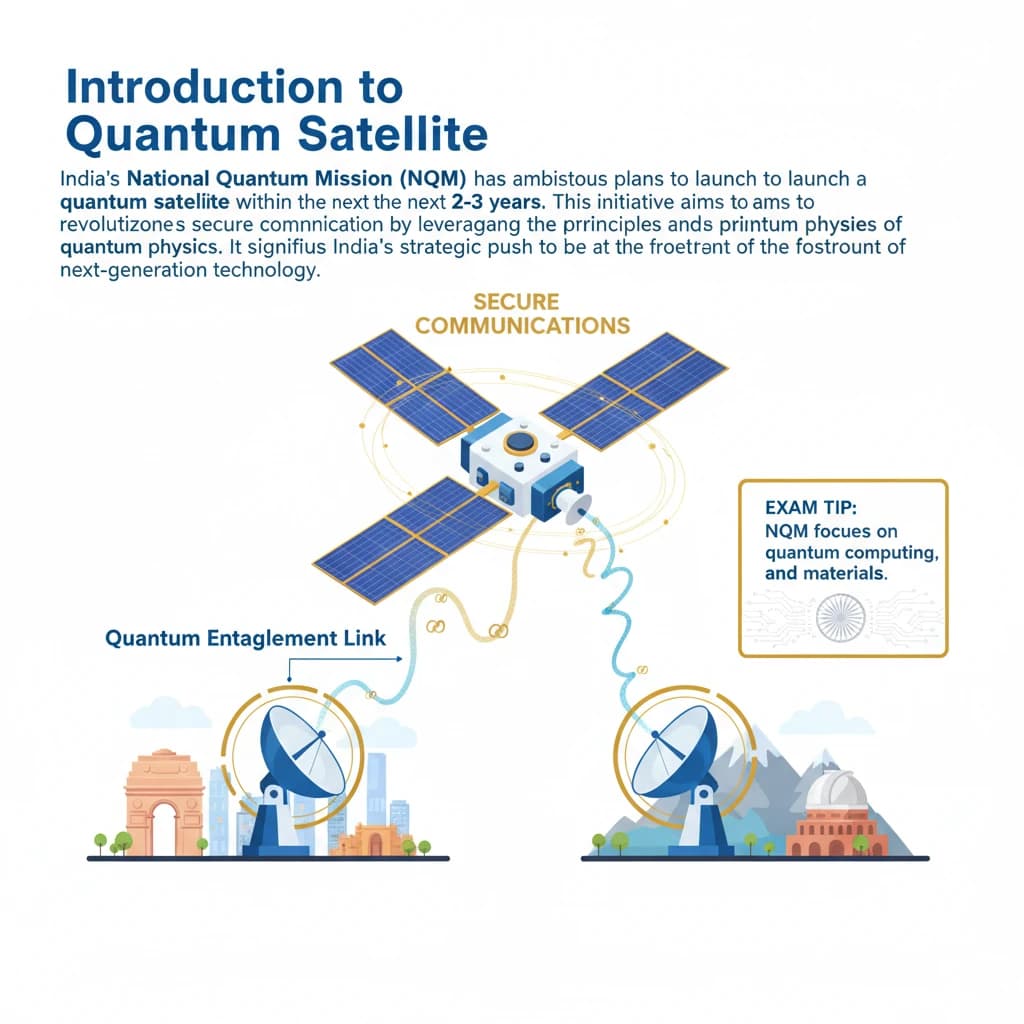
Quantum Satellite
Medium⏱️ 7 min read
science and technology
📖 Introduction
Introduction to Quantum Satellite
India's National Quantum Mission (NQM) has ambitious plans to launch a quantum satellite within the next 2-3 years. This initiative aims to revolutionize secure communications by leveraging the principles of quantum physics. It signifies India's strategic push to be at the forefront of next-generation technology.
UPSC Relevance: The National Quantum Mission and India's advancements in quantum technology are crucial for GS-3 Science & Technology, particularly under 'Developments and their Applications and Effects in Everyday Life'.
What is a Quantum Satellite?
A quantum satellite is a specialized communications satellite that employs quantum physics to secure its signals. This inherent security makes it exceptionally resistant to traditional interception methods.
Definition: A quantum satellite uses quantum cryptography, specifically Quantum Key Distribution (QKD), to encrypt and transmit data, ensuring unparalleled security against eavesdropping.
Understanding Quantum Cryptography
Quantum cryptography is a method that utilizes the principles of quantum mechanics to encrypt and transmit data. Its primary application is in securing communication channels.
Classical Encryption vs. Quantum Encryption
Classical encryption methods, such as the well-known Caesar cipher, encode messages using a secret code. Without the correct key, it is theoretically difficult for eavesdroppers to decipher the message.
However, classical encryption is vulnerable to advanced computational power. Quantum computers, with their immense processing capabilities, could potentially crack these codes much faster than even the most powerful traditional supercomputers.
Quantum encryption, in contrast, uses Quantum Key Distribution (QKD) to establish an unconditionally secure key for messages. This method fundamentally changes how security is maintained.
Quantum Measurement and Eavesdropping Detection
In quantum mechanics, the act of measuring a quantum system, such as a photon (a tiny particle of light), inherently changes its state. This principle is central to QKD's security.
If an eavesdropper attempts to measure the photons carrying a quantum key, this interference will inevitably alter the state of those photons. The legitimate communicating parties will immediately detect this alteration, signaling that the key has been compromised.
Role of Quantum Entanglement
Additionally, quantum entanglement plays a crucial role. This phenomenon ensures that two entangled particles remain connected, meaning any change to one photon instantly affects its entangled partner.
This interconnectedness makes it impossible for an eavesdropper to alter the information carried by entangled photons without immediate detection by the communicating parties. Consequently, QKD offers 'unconditional security' by making any interception detectable.
Global Developments in Quantum Key Distribution (QKD)
Globally, several nations are advancing in quantum communication. China currently leads with the world's largest QKD network.
China's QKD Network: This extensive network includes three quantum satellites and approximately 700 ground stations, demonstrating significant operational capability.
India is also making substantial progress in its quantum communications experiments. There are concrete plans for developing a satellite-based QKD network.
Indian Research: Studies conducted by the Raman Research Institute, Bengaluru, suggest that the Indian Astronomical Observatory in Hanle, Ladakh, offers ideal environmental conditions for establishing such a system.
The Indian Space Research Organisation (ISRO) has already achieved a significant milestone by successfully demonstrating free-space Quantum Communication over a distance of 300 meters.
The United Nations (UN) has recognized the growing importance of quantum science by designating the year 2025 as the 'International Year of Quantum Science and Technology'. This initiative aims to increase public awareness of quantum science and its diverse applications.
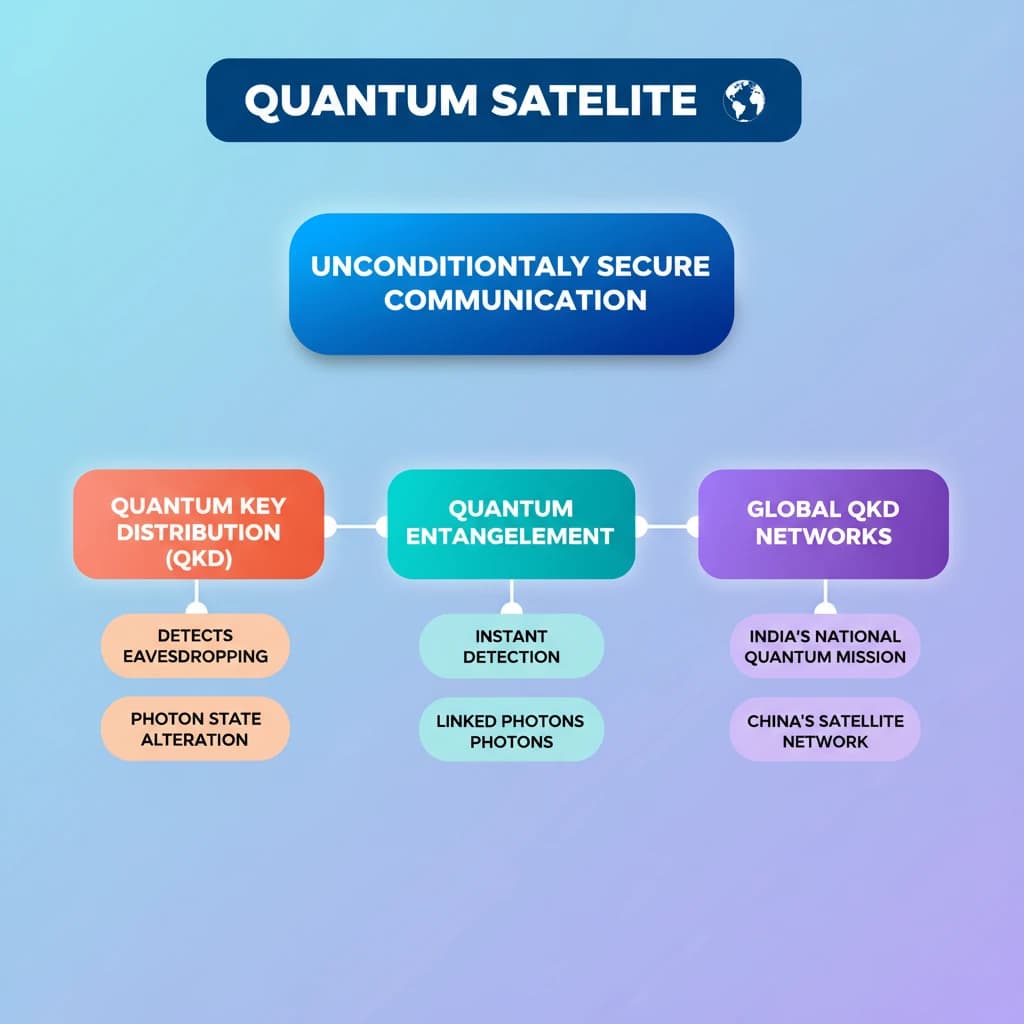
💡 Key Takeaways
- •Quantum satellites use quantum physics for unconditionally secure communication.
- •Quantum Key Distribution (QKD) detects any eavesdropping attempt by altering photon states.
- •Quantum entanglement ensures immediate detection of information alteration.
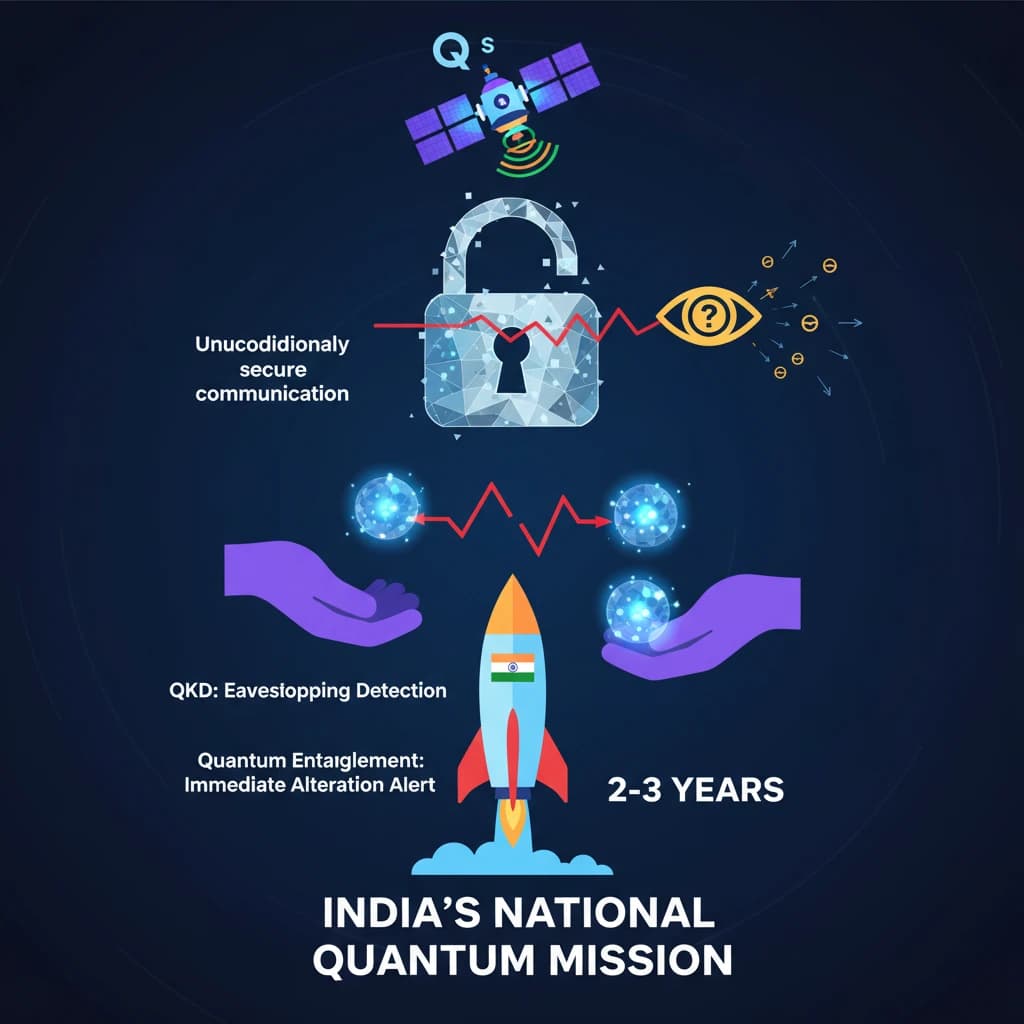
- •India's National Quantum Mission aims to launch a quantum satellite in 2-3 years.
- •China operates the world's largest QKD network, including three quantum satellites.
- •ISRO has demonstrated free-space quantum communication over 300m.
- •The UN declared 2025 as the 'International Year of Quantum Science and Technology'.
🧠 Memory Techniques
95% Verified Content
📚 Reference Sources
•Press Information Bureau (PIB) releases on National Quantum Mission and ISRO achievements
•Scientific articles on Quantum Key Distribution and Quantum Satellites