Loading page, please wait…
Reusable Launch Vehicle - RHUMI-1 - UPSC Science And Technology
What is Reusable Launch Vehicle - RHUMI-1 in UPSC Science And Technology?
Reusable Launch Vehicle - RHUMI-1 is a key topic under Science And Technology for UPSC Civil Services Examination. Key points include: RHUMI-1 is India's first reusable hybrid rocket, developed by Space Zone India.. Its primary mission is to collect data for global warming and climate change research.. It carried 3 Cube satellites (1-10 kg) and 50 Pico satellites (0.1-1 kg) into a suborbital trajectory.. Understanding this topic is essential for both UPSC Prelims and Mains preparation.
Why is Reusable Launch Vehicle - RHUMI-1 important for UPSC exam?
Reusable Launch Vehicle - RHUMI-1 is a Medium-level topic in UPSC Science And Technology. It is tested in both Prelims (factual MCQs) and Mains (analytical answer writing). Previous year UPSC questions have frequently covered aspects of Reusable Launch Vehicle - RHUMI-1, making it essential for comprehensive IAS preparation.
How to prepare Reusable Launch Vehicle - RHUMI-1 for UPSC?
To prepare Reusable Launch Vehicle - RHUMI-1 for UPSC: (1) Study the comprehensive notes covering all key concepts on Vaidra. (2) Practice previous year questions on this topic. (3) Connect it with current affairs using daily updates. (4) Revise using key takeaways and mind maps available for Science And Technology. (5) Write practice answers linking Reusable Launch Vehicle - RHUMI-1 to related GS Paper topics.
Key takeaways of Reusable Launch Vehicle - RHUMI-1 for UPSC
- RHUMI-1 is India's first reusable hybrid rocket, developed by Space Zone India.
- Its primary mission is to collect data for global warming and climate change research.
- It carried 3 Cube satellites (1-10 kg) and 50 Pico satellites (0.1-1 kg) into a suborbital trajectory.
- Key features include a hybrid propulsion system, adjustable launch angle, and an electrically triggered parachute system.
- RHUMI-1 is environmentally friendly, being free of pyrotechnics like TNT, promoting sustainable space exploration.
Reusable Launch Vehicle - RHUMI-1
Medium⏱️ 6 min read
science and technology
📖 Introduction
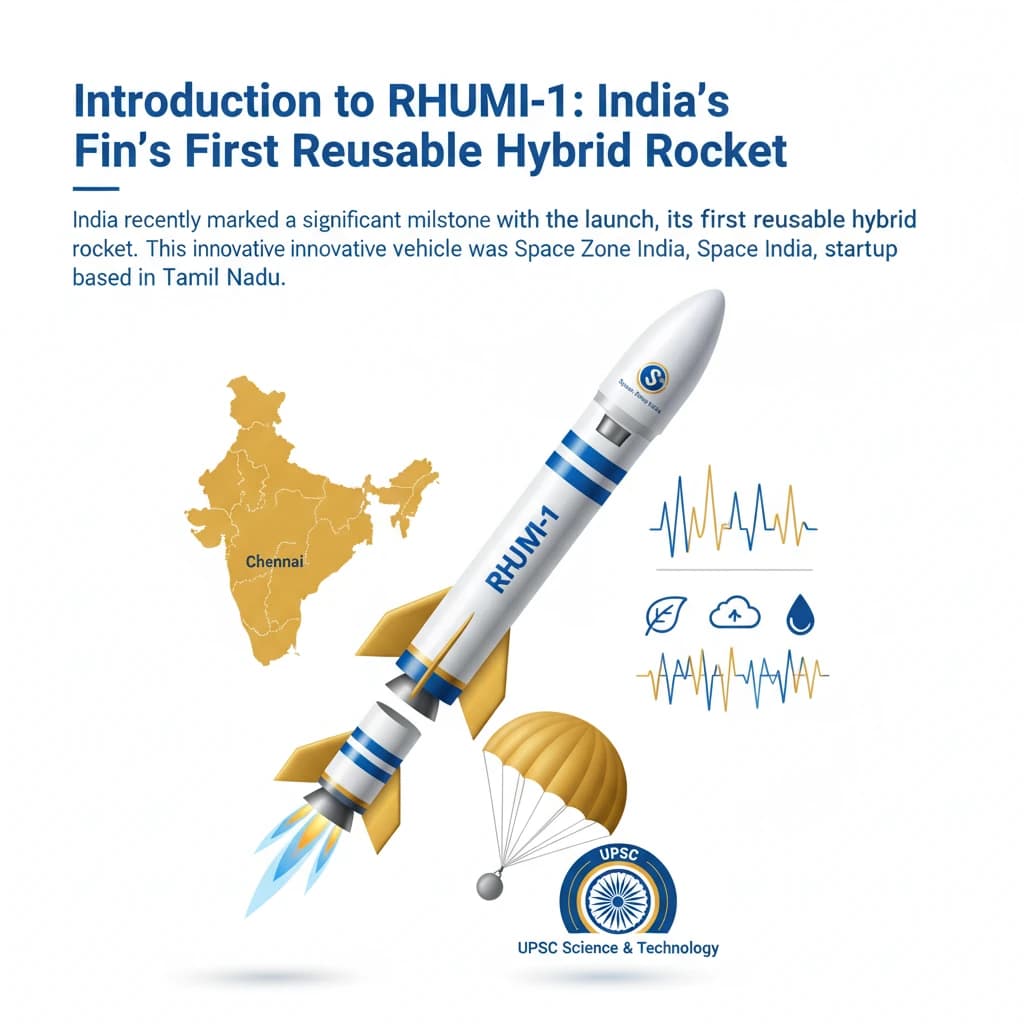
Introduction to RHUMI-1: India's First Reusable Hybrid Rocket
India recently marked a significant milestone with the launch of RHUMI-1, its first reusable hybrid rocket. This innovative vehicle was developed by Space Zone India, a startup based in Tamil Nadu.
The primary mission of RHUMI-1 was to gather crucial data for research purposes, specifically focusing on critical environmental issues such as global warming and climate change.
The launch involved placing the rocket into a suborbital trajectory. It was deployed using a mobile launcher, showcasing flexibility in operational capabilities.
Payload: Cube Satellites and Pico Satellites
RHUMI-1 carried a diverse payload designed for various research objectives. This included 3 cube satellites and an additional 50 pico satellites.
- Cube satellites are a class of nano satellites. They are characterized by their compact size and typically weigh between 1 to 10 kg.
- Pico satellites represent an even smaller category of satellites. Their weights generally range from 0.1 to 1 kg, making them highly cost-effective for specific missions.
Key Features of RHUMI-1
The design and engineering of RHUMI-1 incorporate several advanced features aimed at enhancing efficiency, safety, and environmental sustainability.
Hybrid Propulsion System
RHUMI-1 utilizes a sophisticated hybrid propulsion system. This system ingeniously combines both solid and liquid propellants, leading to enhanced operational efficiency and significantly lower costs.
Adjustable Launch Angle
The rocket's engine is equipped with an advanced mechanism that allows for precise control over its trajectory. It features an adjustable launch angle, which can be set anywhere from 0 to 120 degrees.
Electrically Triggered Parachute System
For safe recovery of its components, RHUMI-1 employs an electrically triggered parachute system. This advanced and eco-friendly descent mechanism ensures that rocket parts can be safely retrieved, offering both economic and environmental advantages.
Environmentally Friendly Design
A core principle in the development of RHUMI-1 was its commitment to sustainability. The rocket is entirely free of pyrotechnics, including common explosives like TNT (trinitrotoluene), highlighting its dedication to minimizing environmental impact.
UPSC Insight: Understanding the features of indigenous space technologies like RHUMI-1 is crucial for GS-III Science & Technology. Focus on the 'why' (global warming research) and 'how' (hybrid propulsion, reusability, eco-friendly design).
💡 Key Takeaways
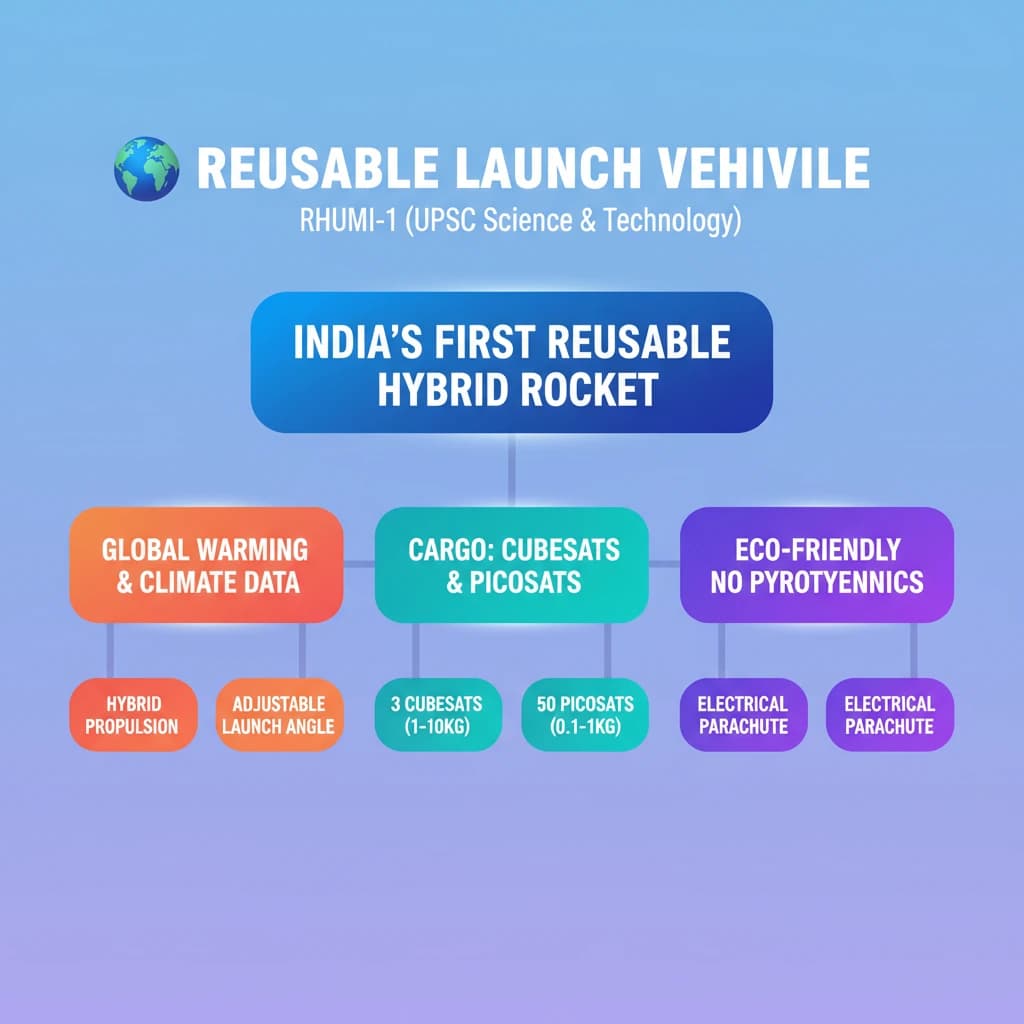
- •RHUMI-1 is India's first reusable hybrid rocket, developed by Space Zone India.
- •Its primary mission is to collect data for global warming and climate change research.
- •It carried 3 Cube satellites (1-10 kg) and 50 Pico satellites (0.1-1 kg) into a suborbital trajectory.
- •Key features include a hybrid propulsion system, adjustable launch angle, and an electrically triggered parachute system.
- •RHUMI-1 is environmentally friendly, being free of pyrotechnics like TNT, promoting sustainable space exploration.
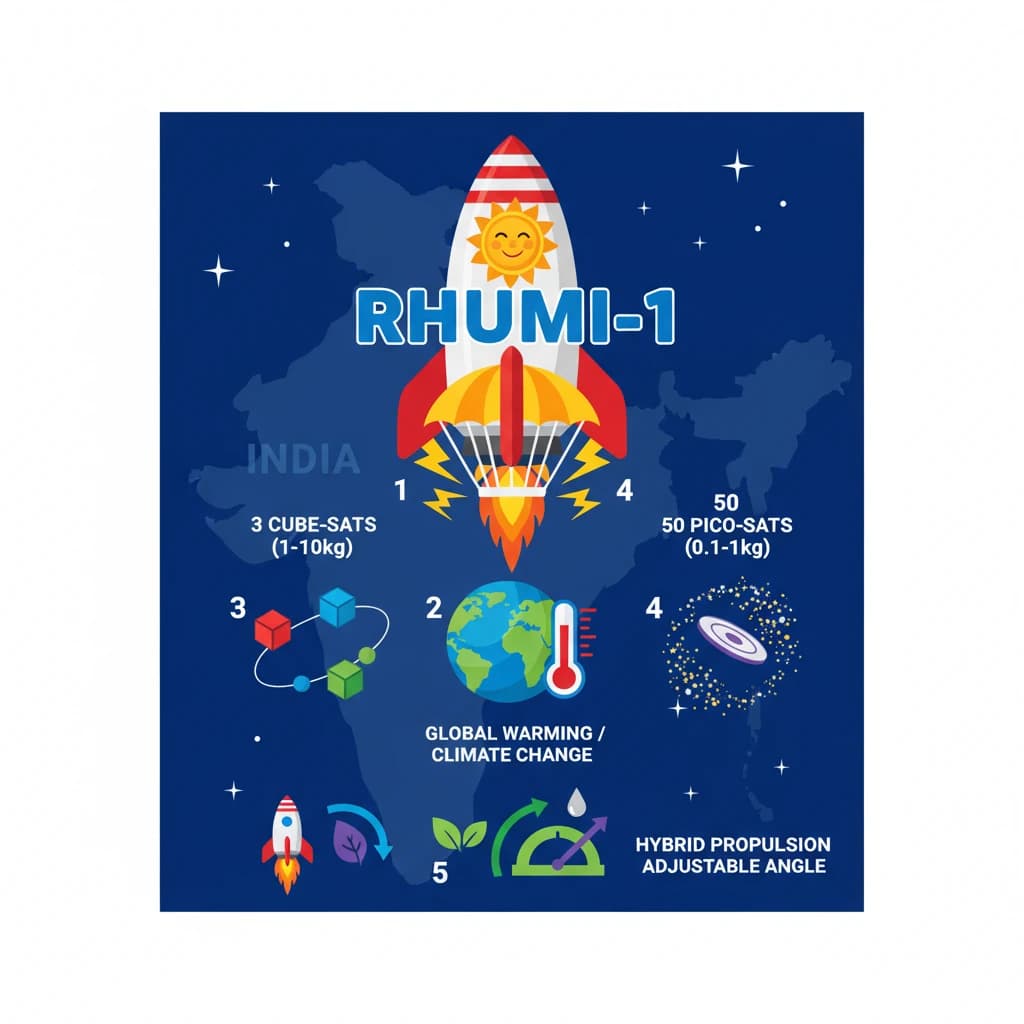
🧠 Memory Techniques
95% Verified Content
📚 Reference Sources
•General knowledge on CubeSats, PicoSats, and Hybrid Propulsion Systems