Loading page, please wait…
Snake Venom Neutralising Antibody - UPSC Science And Technology
What is Snake Venom Neutralising Antibody in UPSC Science And Technology?
Snake Venom Neutralising Antibody is a key topic under Science And Technology for UPSC Civil Services Examination. Key points include: IISc Bengaluru developed a synthetic human antibody to neutralize elapid snake neurotoxins.. The antibody targets a conserved region of the three-finger toxin (3FTx).. It demonstrated 15 times higher potency than conventional antivenom in animal models.. Understanding this topic is essential for both UPSC Prelims and Mains preparation.
Why is Snake Venom Neutralising Antibody important for UPSC exam?
Snake Venom Neutralising Antibody is a Medium-level topic in UPSC Science And Technology. It is tested in both Prelims (factual MCQs) and Mains (analytical answer writing). Previous year UPSC questions have frequently covered aspects of Snake Venom Neutralising Antibody, making it essential for comprehensive IAS preparation.
How to prepare Snake Venom Neutralising Antibody for UPSC?
To prepare Snake Venom Neutralising Antibody for UPSC: (1) Study the comprehensive notes covering all key concepts on Vaidra. (2) Practice previous year questions on this topic. (3) Connect it with current affairs using daily updates. (4) Revise using key takeaways and mind maps available for Science And Technology. (5) Write practice answers linking Snake Venom Neutralising Antibody to related GS Paper topics.
Key takeaways of Snake Venom Neutralising Antibody for UPSC
- IISc Bengaluru developed a synthetic human antibody to neutralize elapid snake neurotoxins.
- The antibody targets a conserved region of the three-finger toxin (3FTx).
- It demonstrated 15 times higher potency than conventional antivenom in animal models.
- This new approach adapts successful strategies from HIV and COVID-19 antibody development.
- The innovation addresses the significant global burden of snakebite fatalities, especially in India and Africa.
Snake Venom Neutralising Antibody
Medium⏱️ 8 min read
science and technology
📖 Introduction
Introduction to Snake Venom Neutralising Antibody
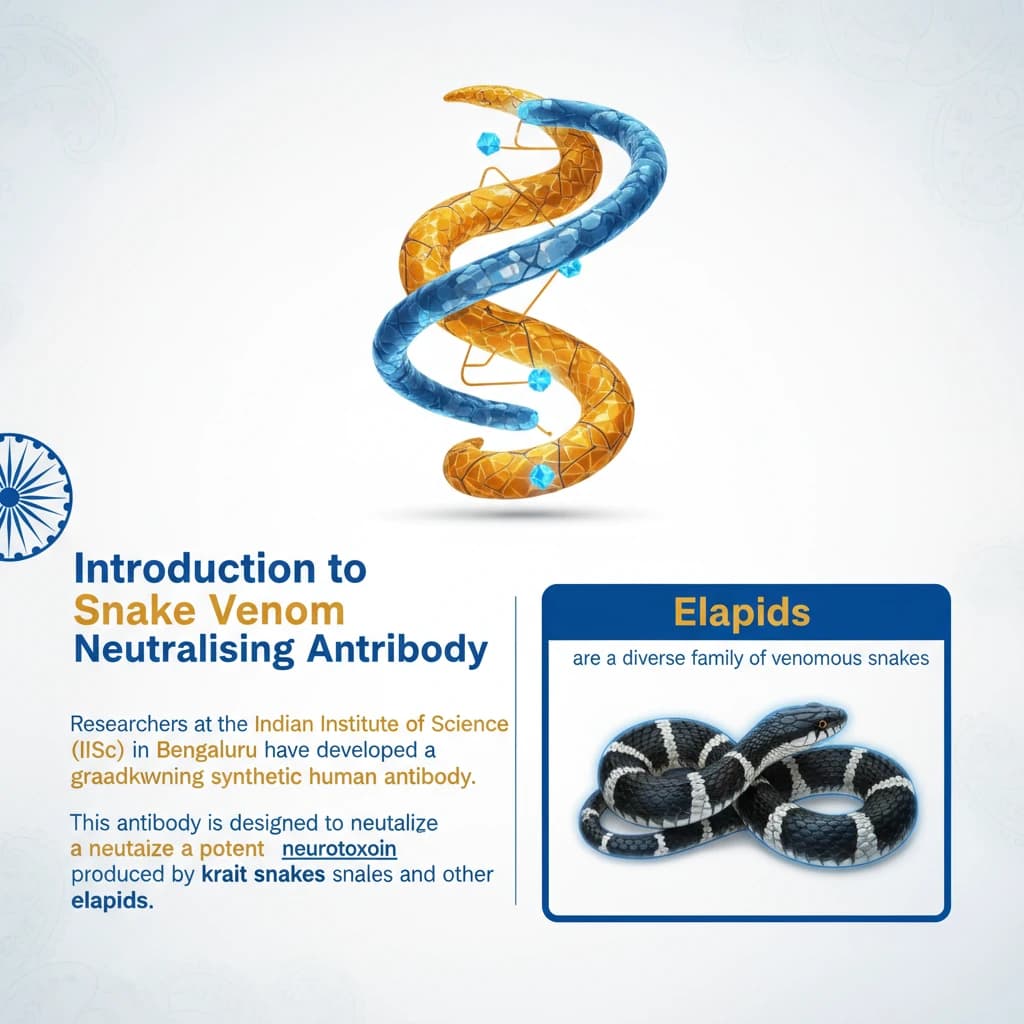
Researchers at the Indian Institute of Science (IISc) in Bengaluru have developed a groundbreaking synthetic human antibody.
This antibody is designed to neutralise a potent neurotoxin produced by krait snakes and other elapids.
Elapids are a diverse family of venomous snakes. They possess hollow, front fangs that efficiently deliver venom.
This family includes over 300 species globally, found in various habitats, such as cobra, king cobra, krait, and black mamba.
The New Venom-Neutralising Antibody: Development and Methodology
The IISc team successfully adapted a previously established approach for creating antibodies against HIV and COVID-19.
This marks the first application of this specific strategy for snakebite treatment, highlighting its innovative nature.
Methodology: The synthetic antibody targets a conserved region within the core of the three-finger toxin (3FTx).
This 3FTx is a common component found in the venoms of various elapid species, despite variations in the toxin itself.
Effectiveness and Potency
Researchers rigorously tested their synthetic antibody on animal models.
It demonstrated significant effectiveness against toxins from the Taiwanese banded krait, monocled cobra, and black mamba.
The synthetic antibody showed a potency nearly 15 times greater than conventional antivenom.
Crucially, it remained effective even when administered with a delay following venom injection, offering a wider therapeutic window.
Distinction from Conventional Antivenom
Conventional antibodies, used in traditional antivenom, are not uniform in composition.
They are a mixture of different types of molecules with varying affinity and specificity to different epitopes of the antigen.
The new synthetic antibody offers a more targeted and potentially more consistent treatment due to its specific design against a conserved region.
The Urgent Need for Better Snakebite Treatment
Snakebites are a significant public health crisis, causing thousands of deaths annually.
The burden is particularly severe in regions like India and sub-Saharan Africa.
According to an Indian Council of Medical Research (ICMR) study, India recorded approximately 1.2 million (12 lakh) snakebite fatalities between 2000 and 2019.
This averages out to an alarming 58,000 deaths annually due to snakebites in India.
Understanding the burden of snakebites and advancements in their treatment is crucial for UPSC Mains GS Paper 3 (Science and Technology) and GS Paper 2 (Health). Mentioning ICMR data adds factual weight to your answers.
💡 Key Takeaways
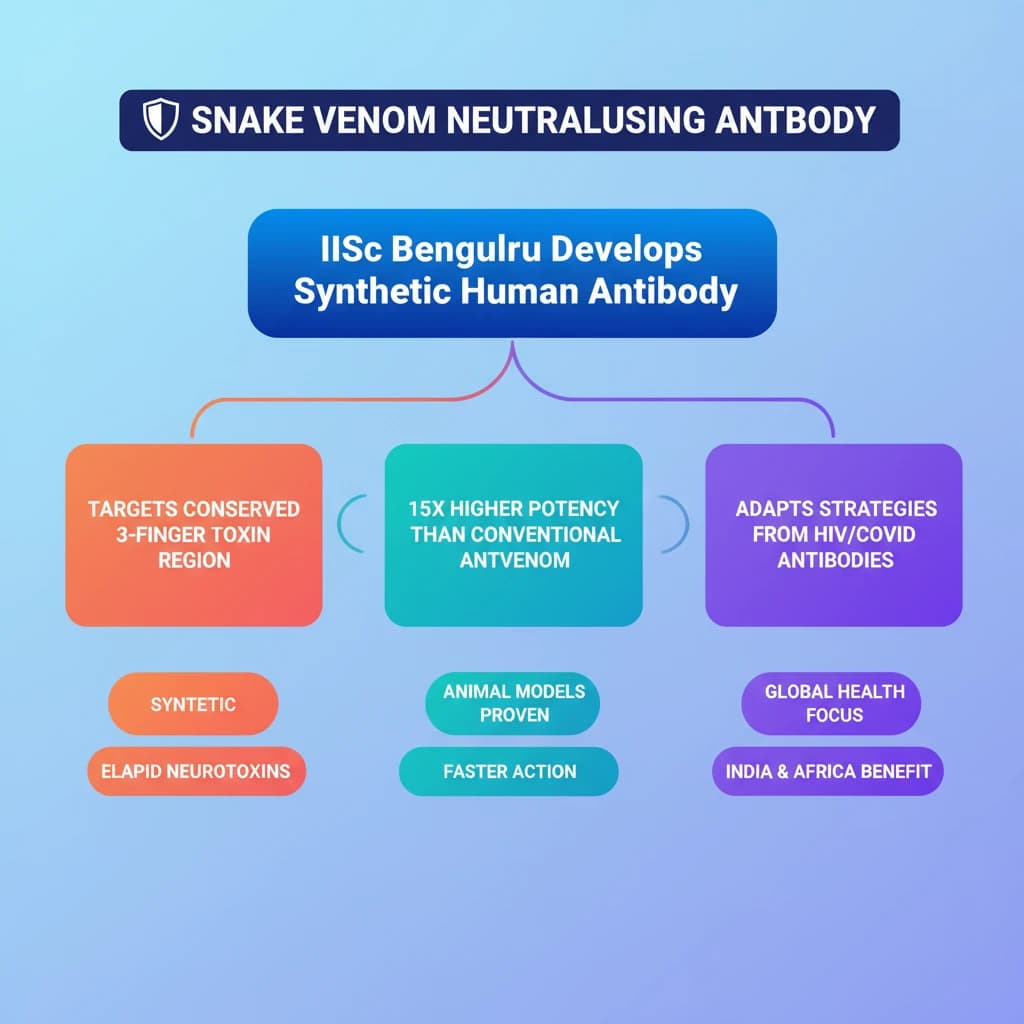
- •IISc Bengaluru developed a synthetic human antibody to neutralize elapid snake neurotoxins.
- •The antibody targets a conserved region of the three-finger toxin (3FTx).
- •It demonstrated 15 times higher potency than conventional antivenom in animal models.
- •This new approach adapts successful strategies from HIV and COVID-19 antibody development.
- •The innovation addresses the significant global burden of snakebite fatalities, especially in India and Africa.
🧠 Memory Techniques

90% Verified Content