Loading page, please wait…
Synchronization protocols such as Network Time Protocol (NTP) and Precision Time Protocol (PTP) will be adopted by government institutions and public organizations. - UPSC Science And Technology
What is Synchronization protocols such as Network Time Protocol (NTP) and Precision Time Protocol (PTP) will be adopted by government institutions and public organizations. in UPSC Science And Technology?
Synchronization protocols such as Network Time Protocol (NTP) and Precision Time Protocol (PTP) will be adopted by government institutions and public organizations. is a key topic under Science And Technology for UPSC Civil Services Examination. Key points include: India is adopting NTP and PTP for precise time synchronization across government and public sectors.. These protocols enhance precision in 5G, AI, IoT, navigation, power grids, and financial transactions.. Benefits include improved operational efficiency, fraud resistance, and strengthened digital infrastructure.. Understanding this topic is essential for both UPSC Prelims and Mains preparation.
Why is Synchronization protocols such as Network Time Protocol (NTP) and Precision Time Protocol (PTP) will be adopted by government institutions and public organizations. important for UPSC exam?
Synchronization protocols such as Network Time Protocol (NTP) and Precision Time Protocol (PTP) will be adopted by government institutions and public organizations. is a Medium-level topic in UPSC Science And Technology. It is tested in both Prelims (factual MCQs) and Mains (analytical answer writing). Previous year UPSC questions have frequently covered aspects of Synchronization protocols such as Network Time Protocol (NTP) and Precision Time Protocol (PTP) will be adopted by government institutions and public organizations., making it essential for comprehensive IAS preparation.
How to prepare Synchronization protocols such as Network Time Protocol (NTP) and Precision Time Protocol (PTP) will be adopted by government institutions and public organizations. for UPSC?
To prepare Synchronization protocols such as Network Time Protocol (NTP) and Precision Time Protocol (PTP) will be adopted by government institutions and public organizations. for UPSC: (1) Study the comprehensive notes covering all key concepts on Vaidra. (2) Practice previous year questions on this topic. (3) Connect it with current affairs using daily updates. (4) Revise using key takeaways and mind maps available for Science And Technology. (5) Write practice answers linking Synchronization protocols such as Network Time Protocol (NTP) and Precision Time Protocol (PTP) will be adopted by government institutions and public organizations. to related GS Paper topics.
Key takeaways of Synchronization protocols such as Network Time Protocol (NTP) and Precision Time Protocol (PTP) will be adopted by government institutions and public organizations. for UPSC
- India is adopting NTP and PTP for precise time synchronization across government and public sectors.
- These protocols enhance precision in 5G, AI, IoT, navigation, power grids, and financial transactions.
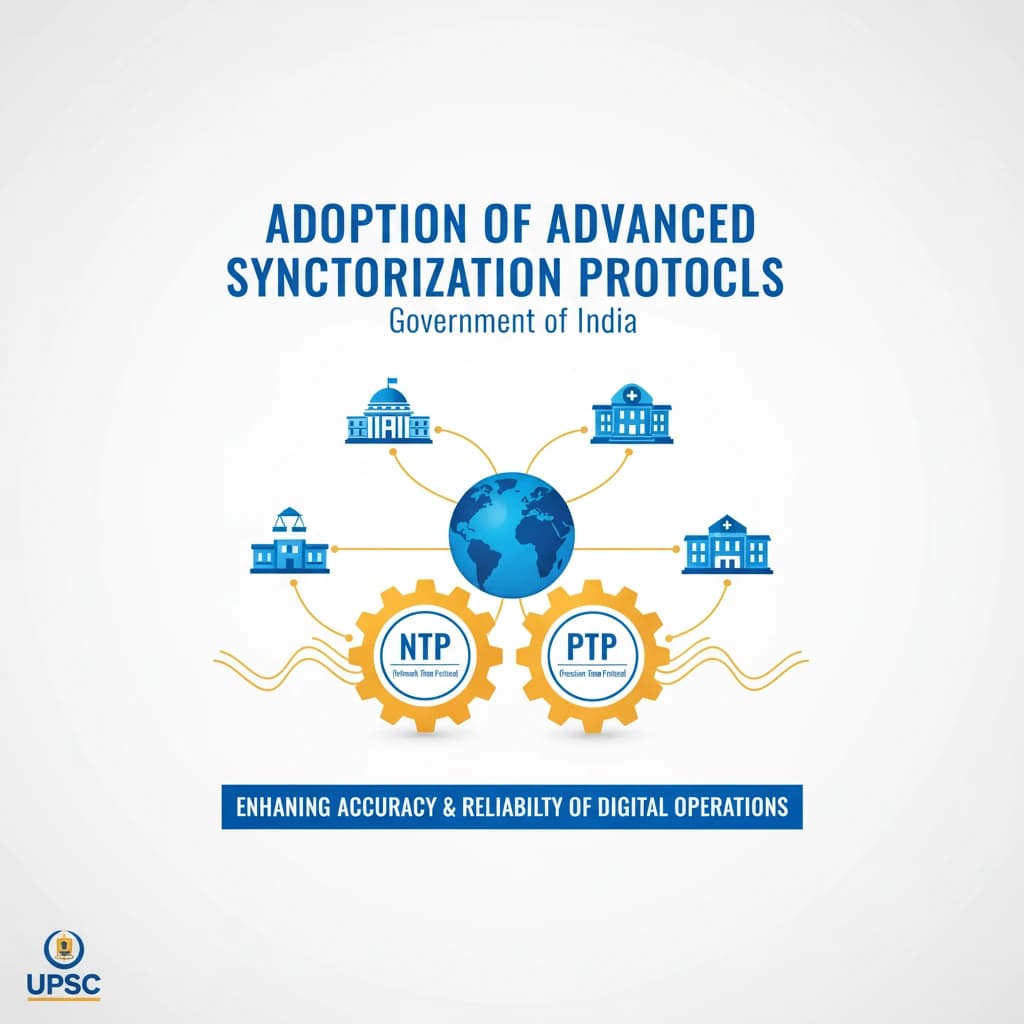
Synchronization protocols such as Network Time Protocol (NTP) and Precision Time Protocol (PTP) will be adopted by government institutions and public organizations.
Medium⏱️ 8 min read
science and technology
📖 Introduction
Adoption of Advanced Synchronization Protocols
The Government of India is set to implement advanced synchronization protocols such as Network Time Protocol (NTP) and Precision Time Protocol (PTP). This initiative will see these protocols adopted across various government institutions and public organizations.
This strategic move aims to enhance the accuracy and reliability of digital operations nationwide. It signifies a commitment to modernizing India's digital infrastructure and aligning with global technological standards.
Benefits of Protocol Adoption
The adoption of NTP and PTP will bring numerous advantages across critical sectors. These benefits are pivotal for India's technological advancement and economic stability.
- Higher Precision in Critical Sectors: Industries like 5G, Artificial Intelligence (AI), Internet of Things (IoT), navigation systems, and power grid synchronization will operate with significantly higher precision and efficiency.
- Enhanced Financial Security: Financial transactions and adherence to regulatory compliance will become more accurate, thereby increasing resistance against fraud and ensuring transparency.
- Improved Operational Efficiency: The synchronization of digital devices and communication networks will lead to improved operational efficiency and better service delivery to consumers.
- Strengthening Digital Infrastructure: This adoption will bolster India’s digital infrastructure, positioning the country as an attractive hub for global technology investments.
- Global Alignment: It ensures alignment with international best practices in areas such as timekeeping, aviation, and telecommunication standards, enhancing India's global standing.
CSIR-National Physical Laboratory (NPL)
The CSIR-National Physical Laboratory (NPL) plays a crucial role in India's scientific and technological advancements. It is one of the nation’s earliest and most significant national laboratories.
Foundation and Inauguration: The foundation stone for NPL was laid by Jawaharlal Nehru in 1947. It was formally inaugurated by Sardar Vallabhbhai Patel in 1950, marking a significant milestone in India's post-independence scientific journey.
Functions of NPL
NPL is entrusted with vital responsibilities concerning physical measurements and standards in India. Its functions are fundamental to maintaining accuracy and consistency across various scientific and industrial domains.
- Maintaining SI Units: NPL is responsible for realizing and maintaining physical measurement units defined in the International System (SI units). This includes fundamental units like metre, kilogram, second, kelvin, ampere, and candela.
- Industrial Support: It actively aids industries by providing expertise in precision measurements. NPL also certifies emission-monitoring instruments, ensuring environmental compliance and accuracy.
Key Contributions of NPL
NPL has made significant contributions, particularly in the realm of timekeeping and calibration services, which are critical for national infrastructure.
- Atomic Clocks and IST: NPL developed advanced Atomic clocks and is responsible for maintaining Indian Standard Time (IST). This is achieved using highly precise Cesium atomic clocks (which work using Cesium atoms) and a Hydrogen maser (which uses hydrogen atoms to serve precision frequency).
- Calibration Services: It provides apex calibration services to various sectors, ensuring the accuracy and reliability of measuring instruments nationwide.
- Accreditation Support: NPL also supports the National Accreditation Board for Testing and Calibration Laboratories (NABL), which is vital for maintaining quality standards in testing and calibration.
UPSC Insight: Understanding the role of institutions like CSIR-NPL and the significance of synchronization protocols is crucial for GS Paper 3 (Science & Technology). Questions can cover their functions, benefits, and impact on national development and digital infrastructure.
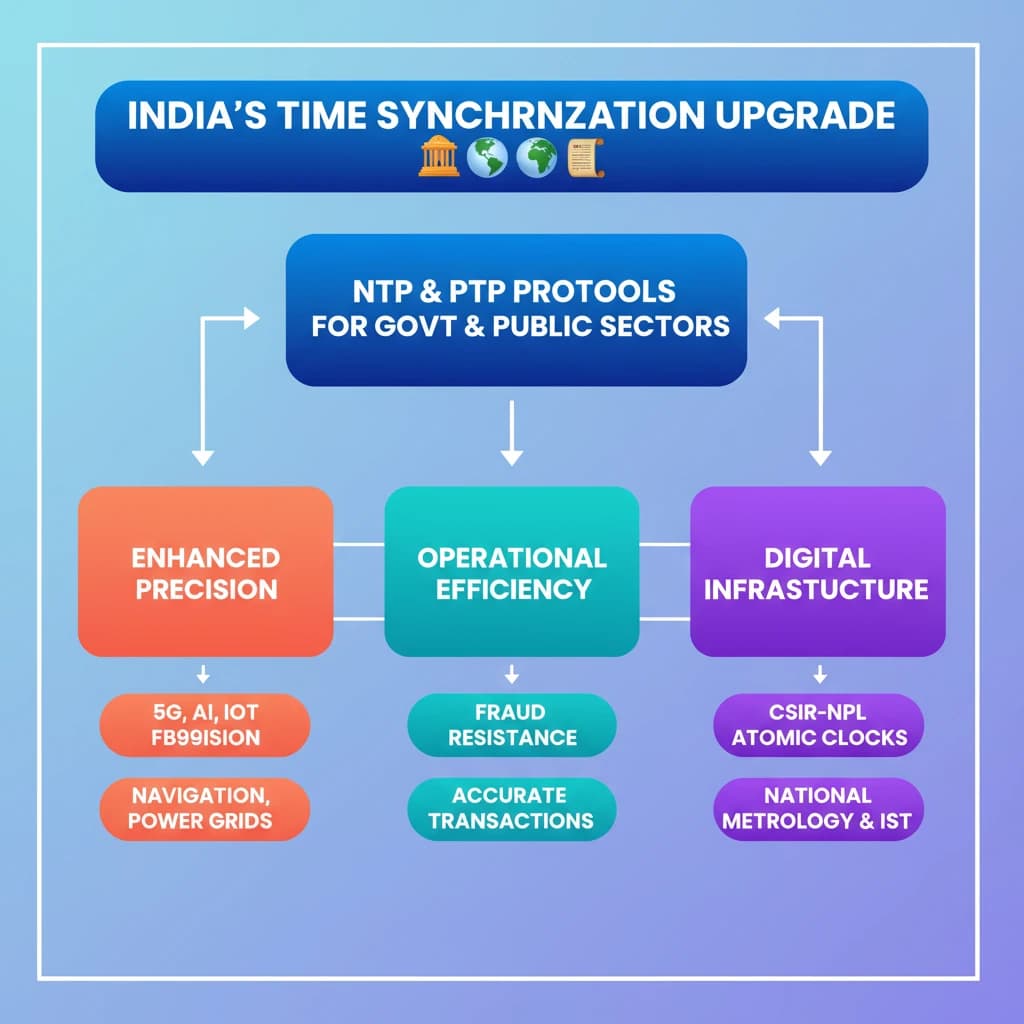
💡 Key Takeaways
- •India is adopting NTP and PTP for precise time synchronization across government and public sectors.
- •These protocols enhance precision in 5G, AI, IoT, navigation, power grids, and financial transactions.
- •Benefits include improved operational efficiency, fraud resistance, and strengthened digital infrastructure.
- •CSIR-National Physical Laboratory (NPL) maintains SI units and Indian Standard Time (IST) using atomic clocks.
- •NPL's contributions are vital for national metrology, industrial precision, and calibration services.
- •The initiative aligns India with international timekeeping standards, boosting global tech investment appeal.
🧠 Memory Techniques
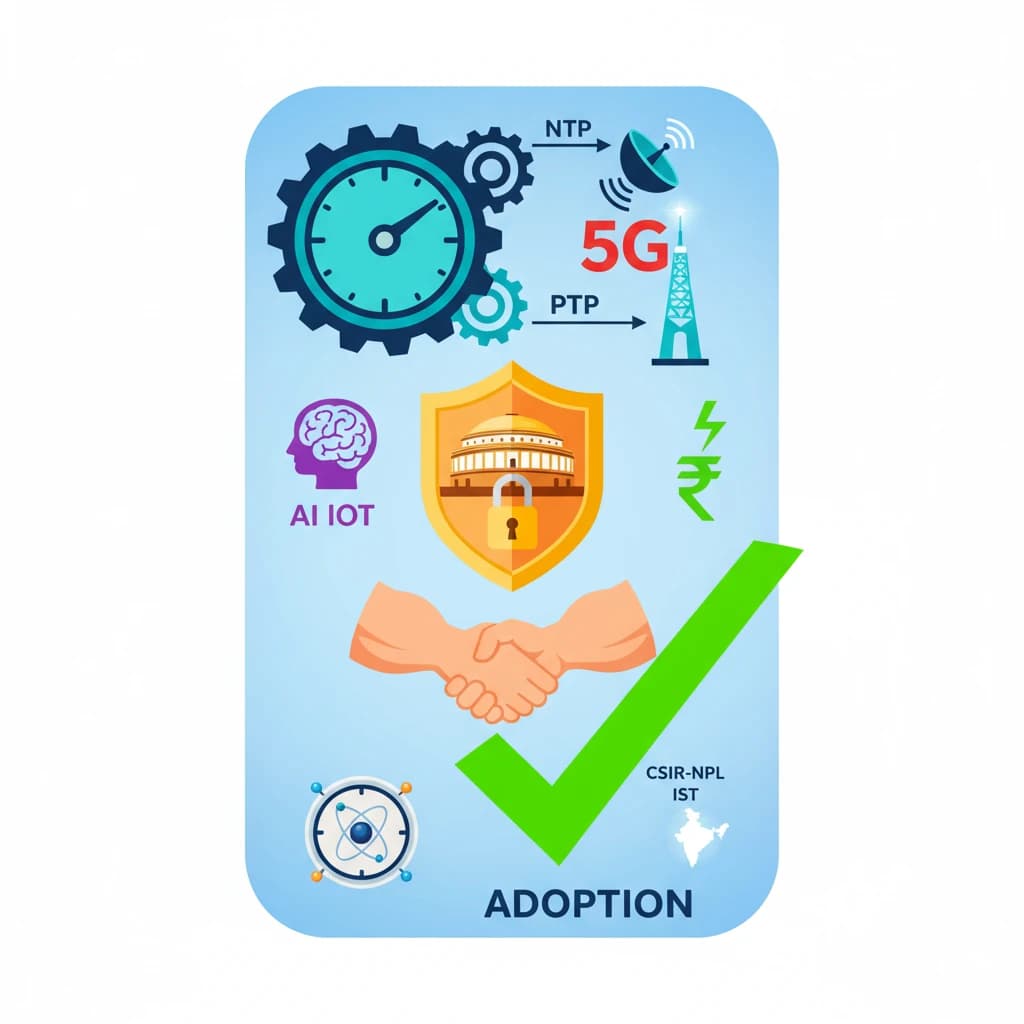
95% Verified Content
📚 Reference Sources
•CSIR-National Physical Laboratory (NPL) Official Website
•Government of India Policy Documents (related to Digital India and critical infrastructure)