Loading page, please wait…
Thirty Meter Telescope (TMT) - UPSC Science And Technology
What is Thirty Meter Telescope (TMT) in UPSC Science And Technology?
Thirty Meter Telescope (TMT) is a key topic under Science And Technology for UPSC Civil Services Examination. Key points include: TMT is a 30-meter international ground-based telescope at Mauna Kea, Hawaii, involving India, US, Canada, China, and Japan.. It features a massive 30-meter primary mirror and an advanced Adaptive Optics System (AOS) for unprecedented resolution and sensitivity.. Primary goals include studying the early universe, first stars/galaxies, and galaxy evolution across cosmic time.. Understanding this topic is essential for both UPSC Prelims and Mains preparation.
Why is Thirty Meter Telescope (TMT) important for UPSC exam?
Thirty Meter Telescope (TMT) is a Medium-level topic in UPSC Science And Technology. It is tested in both Prelims (factual MCQs) and Mains (analytical answer writing). Previous year UPSC questions have frequently covered aspects of Thirty Meter Telescope (TMT), making it essential for comprehensive IAS preparation.
How to prepare Thirty Meter Telescope (TMT) for UPSC?
To prepare Thirty Meter Telescope (TMT) for UPSC: (1) Study the comprehensive notes covering all key concepts on Vaidra. (2) Practice previous year questions on this topic. (3) Connect it with current affairs using daily updates. (4) Revise using key takeaways and mind maps available for Science And Technology. (5) Write practice answers linking Thirty Meter Telescope (TMT) to related GS Paper topics.
Key takeaways of Thirty Meter Telescope (TMT) for UPSC
- TMT is a 30-meter international ground-based telescope at Mauna Kea, Hawaii, involving India, US, Canada, China, and Japan.
- It features a massive 30-meter primary mirror and an advanced Adaptive Optics System (AOS) for unprecedented resolution and sensitivity.
- Primary goals include studying the early universe, first stars/galaxies, and galaxy evolution across cosmic time.
- Indian researchers at IIA developed a star catalogue tool for TMT's AOS, highlighting India's key technical contribution.
- TMT is part of the next generation of 'Extremely Large Telescopes' (ELTs) alongside GMT and ESO's ELT, revolutionizing ground-based astronomy.
Thirty Meter Telescope (TMT)
Medium⏱️ 8 min read
science and technology
📖 Introduction
Introduction to the Thirty Meter Telescope (TMT)
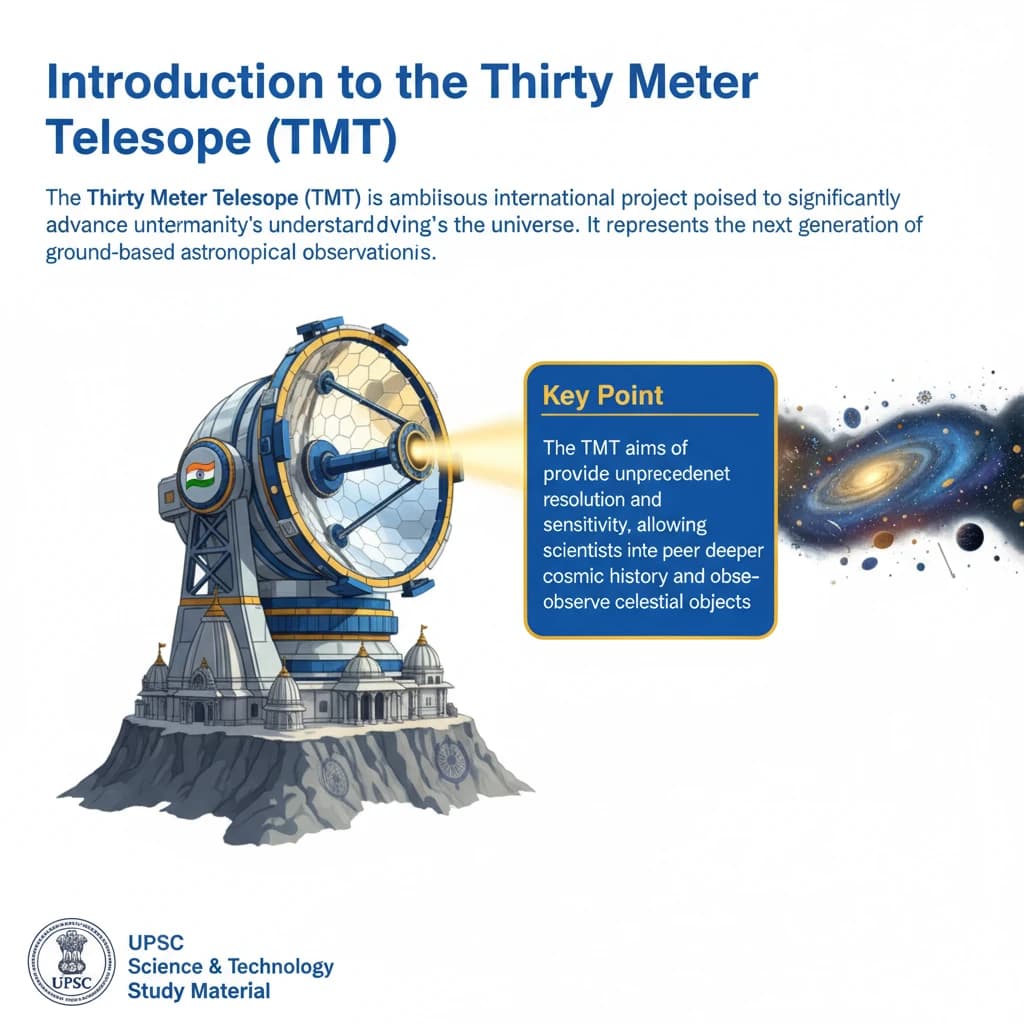
The Thirty Meter Telescope (TMT) is an ambitious international project poised to significantly advance humanity's understanding of the universe. It represents the next generation of ground-based astronomical observatories.
The TMT aims to provide unprecedented resolution and sensitivity, allowing scientists to peer deeper into cosmic history and observe celestial objects with remarkable clarity.
International Collaboration and Location
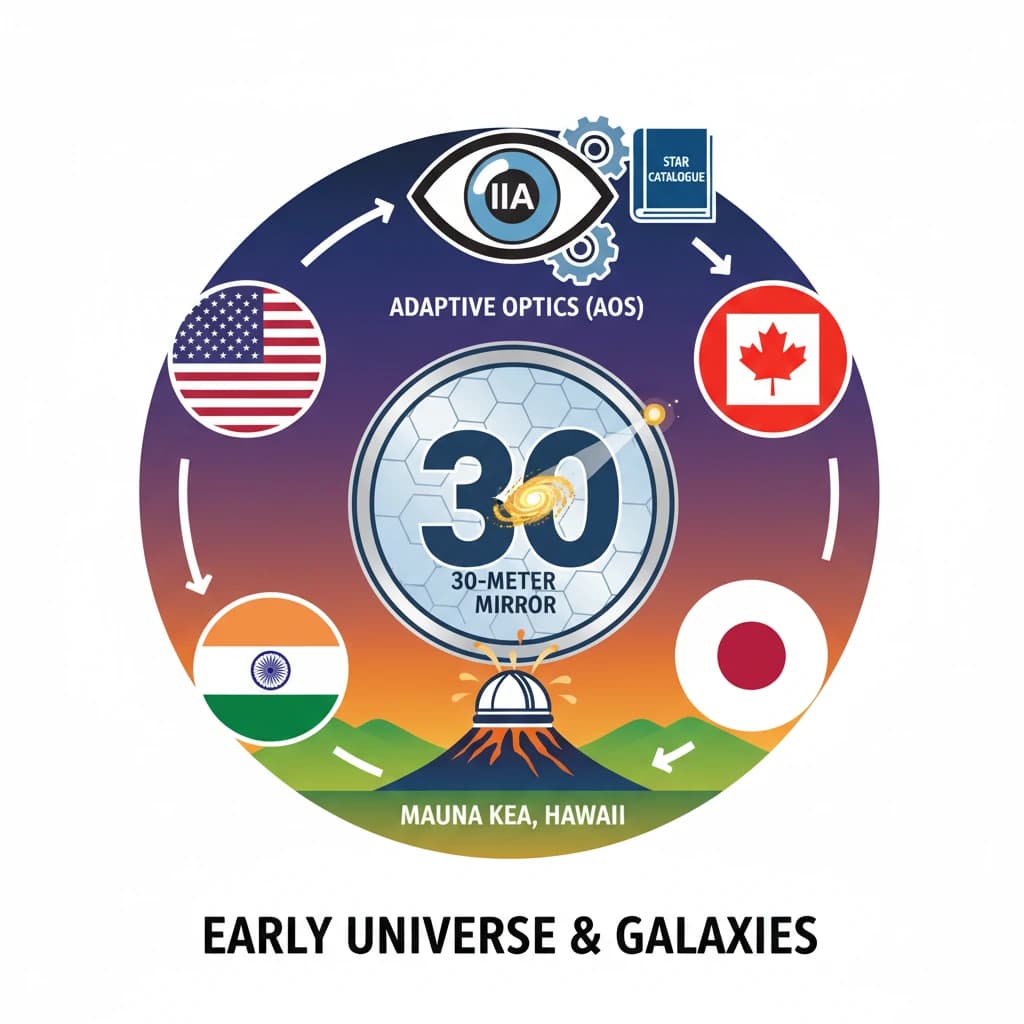
The TMT project is a collaborative effort involving several leading nations in scientific research. Key partners include India, the United States (US), Canada, China, and Japan.
Project Location: The TMT is currently under construction at Mauna Kea in Hawaii, a site renowned for its excellent astronomical viewing conditions.
India plays a crucial role as a key partner, with the India TMT Centre (ITMT) at the Indian Institute of Astrophysics (IIA) in Bengaluru leading the national collaboration and contributions.
Technological Core: The 30-Meter Primary Mirror
The defining feature of the TMT is its massive 30-meter primary mirror. This colossal mirror is designed to collect significantly more light than existing telescopes, enhancing observational capabilities.
Key Specification: The 30-meter primary mirror provides a light-gathering area far superior to current instruments, enabling observations of faint and distant objects.
Advanced Adaptive Optics System (AOS)
Complementing the large mirror is an advanced Adaptive Optics System (AOS). This technology is critical for correcting distortions caused by Earth's atmosphere, ensuring sharper images.
The AOS actively compensates for atmospheric turbulence, allowing the TMT to achieve near space-telescope resolution from the ground.
State-of-the-art instruments will further enhance the TMT's observational power, making it a versatile tool for various astronomical investigations.
Primary Scientific Goals of TMT
The TMT is designed to address fundamental questions in astrophysics and cosmology. Its primary goals are focused on understanding the universe's origins and evolution.
- Early Universe Studies: To investigate the formation and evolution of the first galaxies and stars that emerged shortly after the Big Bang.
- Galaxy Evolution: To study the formation, structure, and evolution of galaxies across vast cosmic timescales.
The Future of Ground-Based Astronomy
The TMT is part of a new generation of "Extremely Large Telescopes" that are set to revolutionize ground-based astronomy. These telescopes represent the cutting edge of observational capabilities.
Other Next-Gen Telescopes: Alongside the TMT, the Giant Magellan Telescope (GMT) and the European Southern Observatory’s Extremely Large Telescope (ELT) are also under development, heralding a new era of astronomical discovery.
💡 Key Takeaways
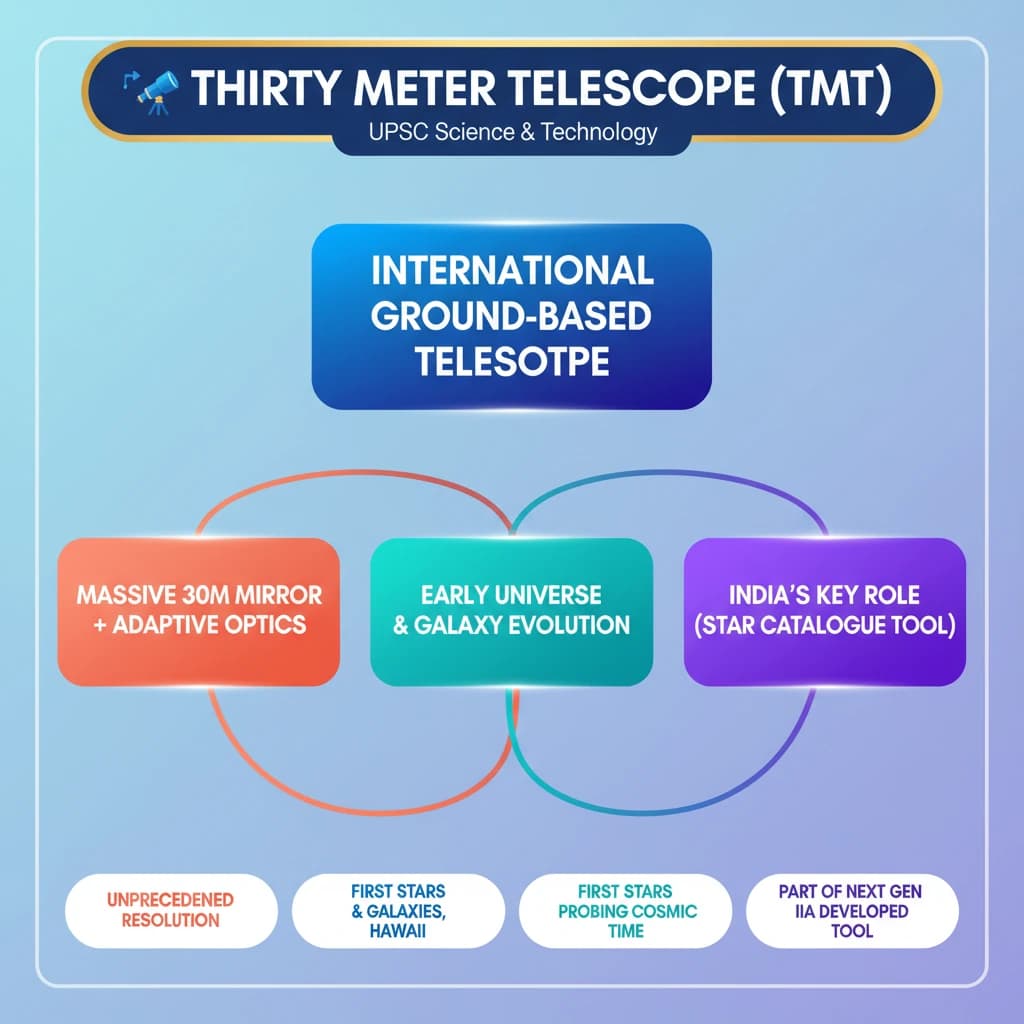
- •TMT is a 30-meter international ground-based telescope at Mauna Kea, Hawaii, involving India, US, Canada, China, and Japan.
- •It features a massive 30-meter primary mirror and an advanced Adaptive Optics System (AOS) for unprecedented resolution and sensitivity.
- •Primary goals include studying the early universe, first stars/galaxies, and galaxy evolution across cosmic time.
- •Indian researchers at IIA developed a star catalogue tool for TMT's AOS, highlighting India's key technical contribution.
- •TMT is part of the next generation of 'Extremely Large Telescopes' (ELTs) alongside GMT and ESO's ELT, revolutionizing ground-based astronomy.
🧠 Memory Techniques
95% Verified Content