Loading page, please wait…
Uranium-to-Lead Ratio Analysis - UPSC Science And Technology
What is Uranium-to-Lead Ratio Analysis in UPSC Science And Technology?
Uranium-to-Lead Ratio Analysis is a key topic under Science And Technology for UPSC Civil Services Examination. Key points include: Uranium-to-Lead (U-Pb) dating is a highly precise radiometric dating technique.. It determines the age of earth materials by measuring the ratio of uranium isotopes (parent) to lead isotopes (daughter).. The method relies on two independent decay chains: Uranium-238 to Lead-206, and Uranium-235 to Lead-207.. Understanding this topic is essential for both UPSC Prelims and Mains preparation.
Why is Uranium-to-Lead Ratio Analysis important for UPSC exam?
Uranium-to-Lead Ratio Analysis is a Medium-level topic in UPSC Science And Technology. It is tested in both Prelims (factual MCQs) and Mains (analytical answer writing). Previous year UPSC questions have frequently covered aspects of Uranium-to-Lead Ratio Analysis, making it essential for comprehensive IAS preparation.
How to prepare Uranium-to-Lead Ratio Analysis for UPSC?
To prepare Uranium-to-Lead Ratio Analysis for UPSC: (1) Study the comprehensive notes covering all key concepts on Vaidra. (2) Practice previous year questions on this topic. (3) Connect it with current affairs using daily updates. (4) Revise using key takeaways and mind maps available for Science And Technology. (5) Write practice answers linking Uranium-to-Lead Ratio Analysis to related GS Paper topics.
Key takeaways of Uranium-to-Lead Ratio Analysis for UPSC
- Uranium-to-Lead (U-Pb) dating is a highly precise radiometric dating technique.
- It determines the age of earth materials by measuring the ratio of uranium isotopes (parent) to lead isotopes (daughter).
- The method relies on two independent decay chains: Uranium-238 to Lead-206, and Uranium-235 to Lead-207.
- This dual-system approach makes U-Pb dating exceptionally accurate and robust, especially with minerals like zircon.
- It has been crucial in establishing the age of the Earth, the Solar System, and various significant geological events.
Uranium-to-Lead Ratio Analysis
Medium⏱️ 8 min read
science and technology
📖 Introduction
Understanding Uranium-to-Lead (U-Pb) Ratio Analysis
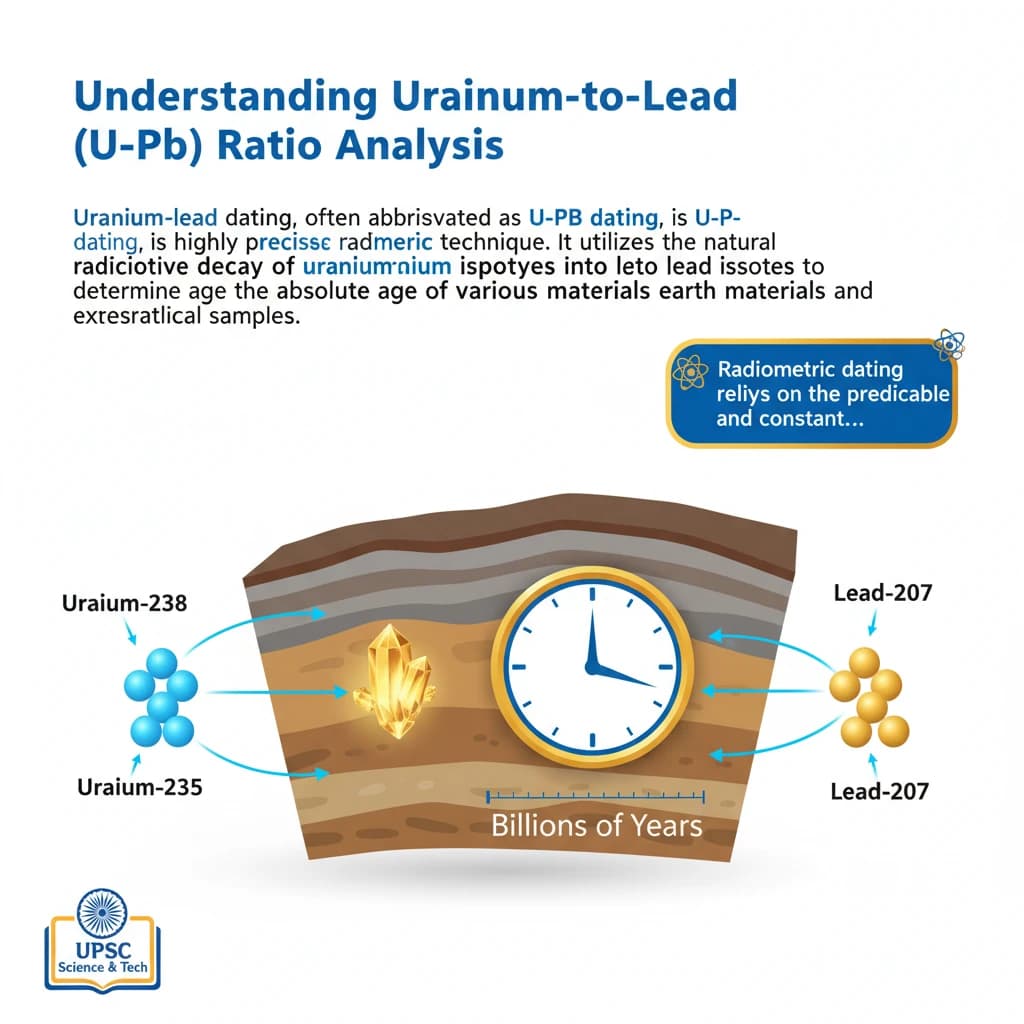
Uranium-lead dating, often abbreviated as U-Pb dating, is a highly precise radiometric dating technique. It utilizes the natural radioactive decay of uranium isotopes into lead isotopes to determine the absolute age of various earth materials and extraterrestrial samples.
Radiometric dating relies on the predictable and constant rate of decay of radioactive isotopes. This method acts like a geological clock, providing crucial insights into the timeline of Earth's formation and evolution.
The Core Principle: Radioactive Decay
The fundamental principle behind U-Pb dating involves the spontaneous transformation of unstable uranium isotopes (the parent isotopes) into stable lead isotopes (the daughter isotopes). This process occurs at a known, constant rate, independent of external environmental conditions like temperature or pressure.
By measuring the ratio of uranium to lead within a sample, scientists can calculate how much time has elapsed since the mineral crystallized and locked in these isotopes. The higher the proportion of daughter lead isotopes relative to parent uranium isotopes, the older the sample.
Key Isotope Systems in U-Pb Dating
U-Pb dating is unique because it employs two independent uranium decay series, enhancing its accuracy and reliability. These are:
- Uranium-238 (238U) to Lead-206 (206Pb): This decay chain has a half-life of approximately 4.47 billion years.
- Uranium-235 (235U) to Lead-207 (207Pb): This decay chain has a shorter half-life of about 704 million years.
The simultaneous use of these two decay systems provides an internal check, allowing for cross-verification of results and detection of any lead loss or gain, a concept known as concordia dating.
Methodology and Reliability
The method involves carefully isolating minerals like zircon (ZrSiO4), which readily incorporate uranium but exclude lead during crystallization. Any lead found in the zircon is thus assumed to be radiogenic (produced by uranium decay).
Sophisticated mass spectrometry techniques are used to precisely measure the isotopic ratios. The concordance of ages derived from both 238U-206Pb and 235U-207Pb systems indicates a highly accurate age determination.
For UPSC Prelims, remember that zircon is a crucial mineral for U-Pb dating due to its robust nature and ability to preserve isotopic ratios. For Mains, understanding the dual decay chains and their significance for accuracy is key.
💡 Key Takeaways
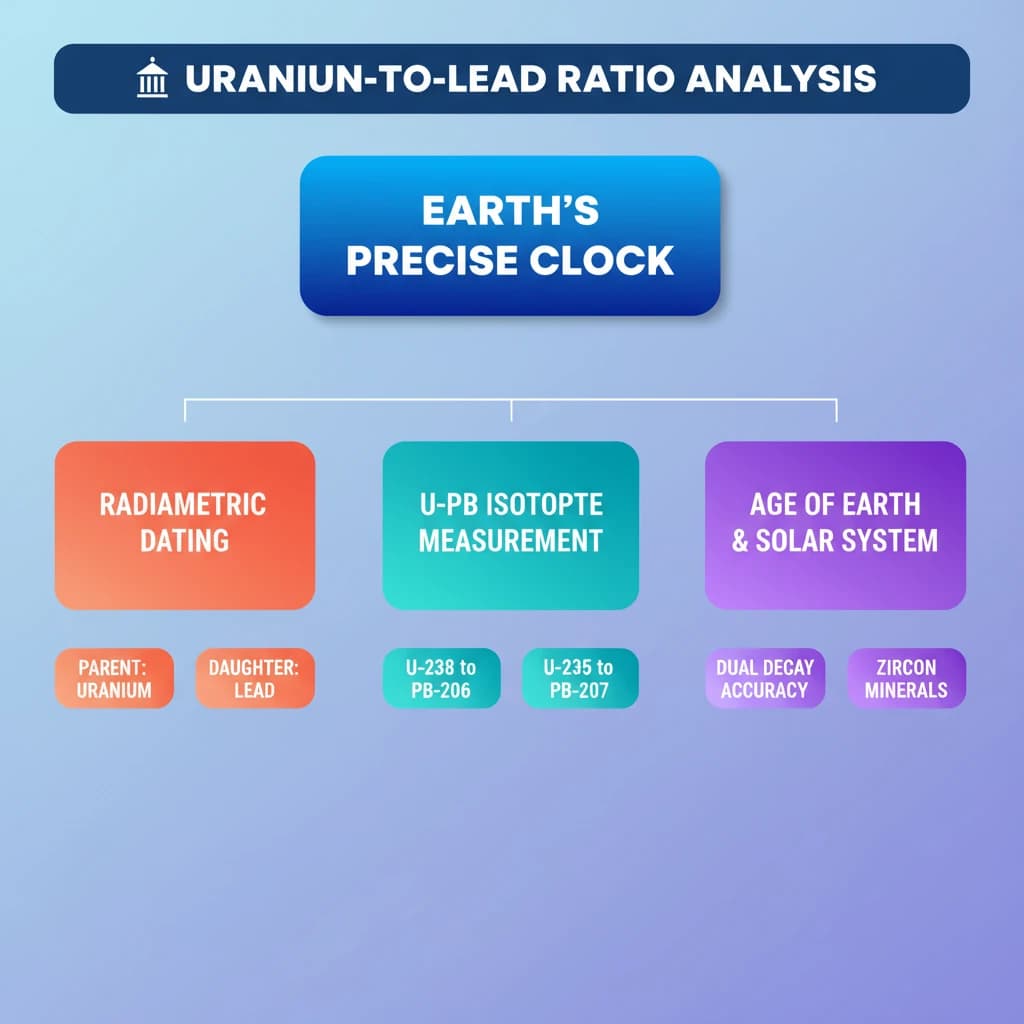
- •Uranium-to-Lead (U-Pb) dating is a highly precise radiometric dating technique.
- •It determines the age of earth materials by measuring the ratio of uranium isotopes (parent) to lead isotopes (daughter).
- •The method relies on two independent decay chains: Uranium-238 to Lead-206, and Uranium-235 to Lead-207.
- •This dual-system approach makes U-Pb dating exceptionally accurate and robust, especially with minerals like zircon.
- •It has been crucial in establishing the age of the Earth, the Solar System, and various significant geological events.
🧠 Memory Techniques

95% Verified Content
📚 Reference Sources
•Dalrymple, G. B. (1991). The Age of the Earth. Stanford University Press.
•Geological Society of America (GSA) publications on geochronology.
•NASA and USGS scientific reports on planetary dating and Earth sciences.