Loading page, please wait…
What is a Solar Observatory? - UPSC Science And Technology
What is What is a Solar Observatory? in UPSC Science And Technology?
What is a Solar Observatory? is a key topic under Science And Technology for UPSC Civil Services Examination. Key points include: Solar observatories are facilities dedicated to studying the Sun using specialized telescopes and instruments.. They observe phenomena like solar flares, CMEs, and sunspots across the electromagnetic spectrum.. Key purpose is space weather forecasting, crucial for protecting satellites and power grids.. Understanding this topic is essential for both UPSC Prelims and Mains preparation.
Why is What is a Solar Observatory? important for UPSC exam?
What is a Solar Observatory? is a Medium-level topic in UPSC Science And Technology. It is tested in both Prelims (factual MCQs) and Mains (analytical answer writing). Previous year UPSC questions have frequently covered aspects of What is a Solar Observatory?, making it essential for comprehensive IAS preparation.
How to prepare What is a Solar Observatory? for UPSC?
To prepare What is a Solar Observatory? for UPSC: (1) Study the comprehensive notes covering all key concepts on Vaidra. (2) Practice previous year questions on this topic. (3) Connect it with current affairs using daily updates. (4) Revise using key takeaways and mind maps available for Science And Technology. (5) Write practice answers linking What is a Solar Observatory? to related GS Paper topics.
Key takeaways of What is a Solar Observatory? for UPSC
- Solar observatories are facilities dedicated to studying the Sun using specialized telescopes and instruments.
- They observe phenomena like solar flares, CMEs, and sunspots across the electromagnetic spectrum.
- Key purpose is space weather forecasting, crucial for protecting satellites and power grids.
- Both ground-based (e.g., DKIST) and space-based (e.g., Aditya-L1, SOHO) observatories contribute to solar research.
- Understanding the Sun helps in astrophysics, climate research, and technological innovation.
What is a Solar Observatory?
Medium⏱️ 7 min read
science and technology
📖 Introduction
Understanding Solar Observatories
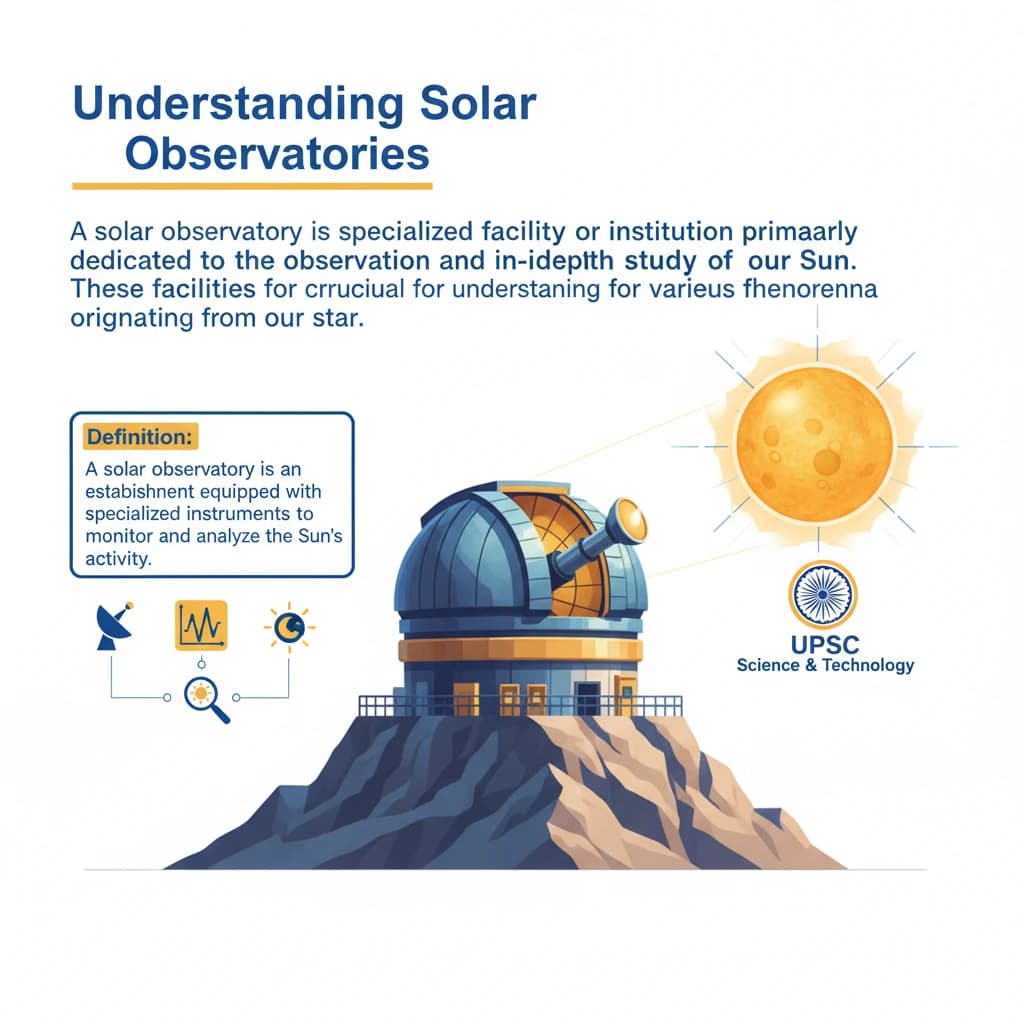
A solar observatory is a specialized facility or institution primarily dedicated to the observation and in-depth study of our Sun. These facilities are crucial for understanding the various phenomena originating from our star.
Definition: A solar observatory is an establishment equipped with specialized instruments to monitor and analyze the Sun's activity across different wavelengths and layers.
Purpose of Solar Observatories
The primary purpose of these observatories is to gain a comprehensive understanding of the Sun's complex processes. This includes studying its surface, atmosphere, and the surrounding heliosphere.
By continuously monitoring the Sun, scientists can better predict and understand phenomena like solar flares, coronal mass ejections (CMEs), and sunspots, which have significant implications for Earth.
Specialized Instruments and Techniques
Solar observatories employ a range of specialised telescopes and other advanced instruments. These are designed to capture different aspects of solar activity that are often invisible to the naked eye or standard optical telescopes.
- Optical Telescopes: Used for observing the Sun's photosphere and chromosphere, often with filters to isolate specific wavelengths.
- Radio Telescopes: Detect radio emissions from the Sun's corona and solar bursts.
- X-ray and UV Telescopes: Essential for studying the extremely hot and energetic processes in the Sun's corona, which emit at these high-energy wavelengths.
- Helioseismology Instruments: Study solar oscillations to probe the Sun's interior structure and dynamics.
Key Function: Solar observatories provide critical data for space weather forecasting, which is vital for protecting satellites, power grids, and astronauts from solar radiation.
UPSC Insight: Questions on space missions, especially those related to the Sun (e.g., Aditya-L1), often require understanding the basic function and importance of solar observatories. Focus on their role in scientific research and practical applications.
💡 Key Takeaways
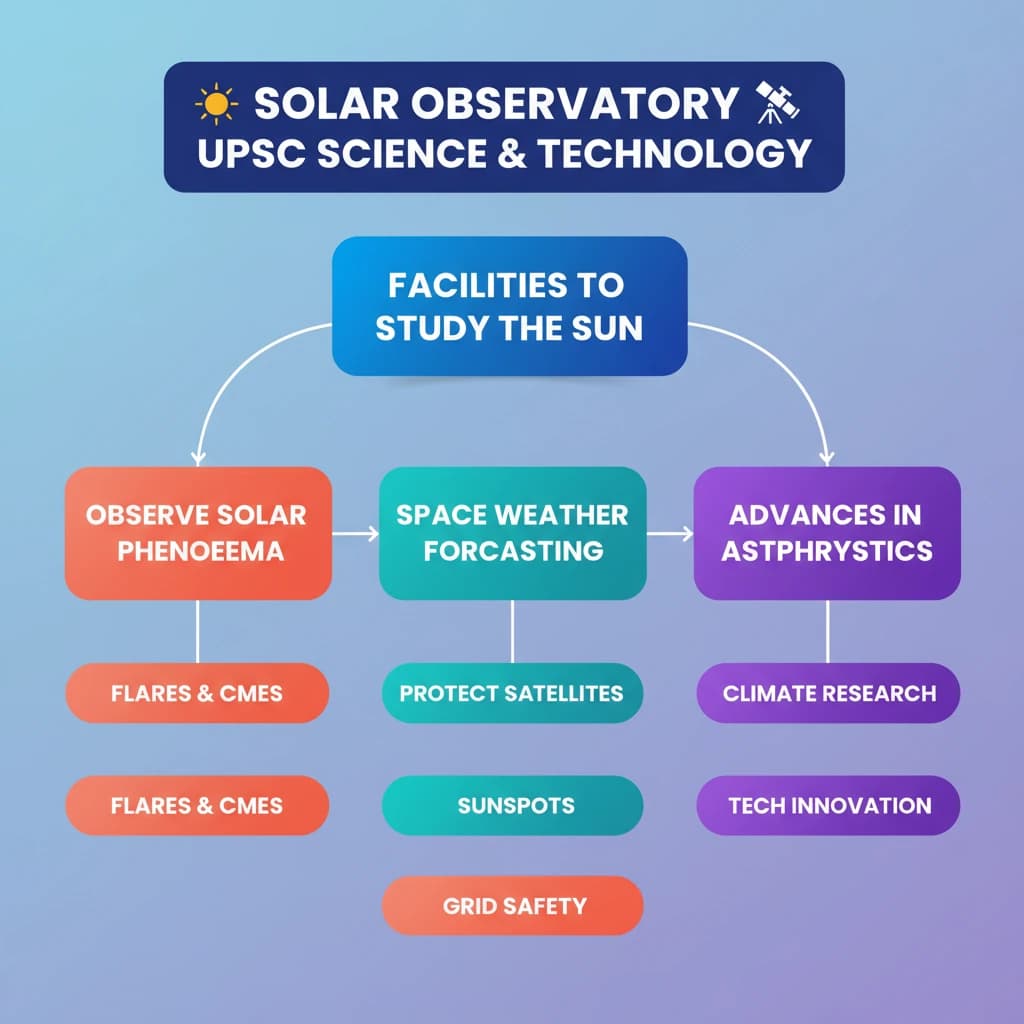
- •Solar observatories are facilities dedicated to studying the Sun using specialized telescopes and instruments.
- •They observe phenomena like solar flares, CMEs, and sunspots across the electromagnetic spectrum.
- •Key purpose is space weather forecasting, crucial for protecting satellites and power grids.
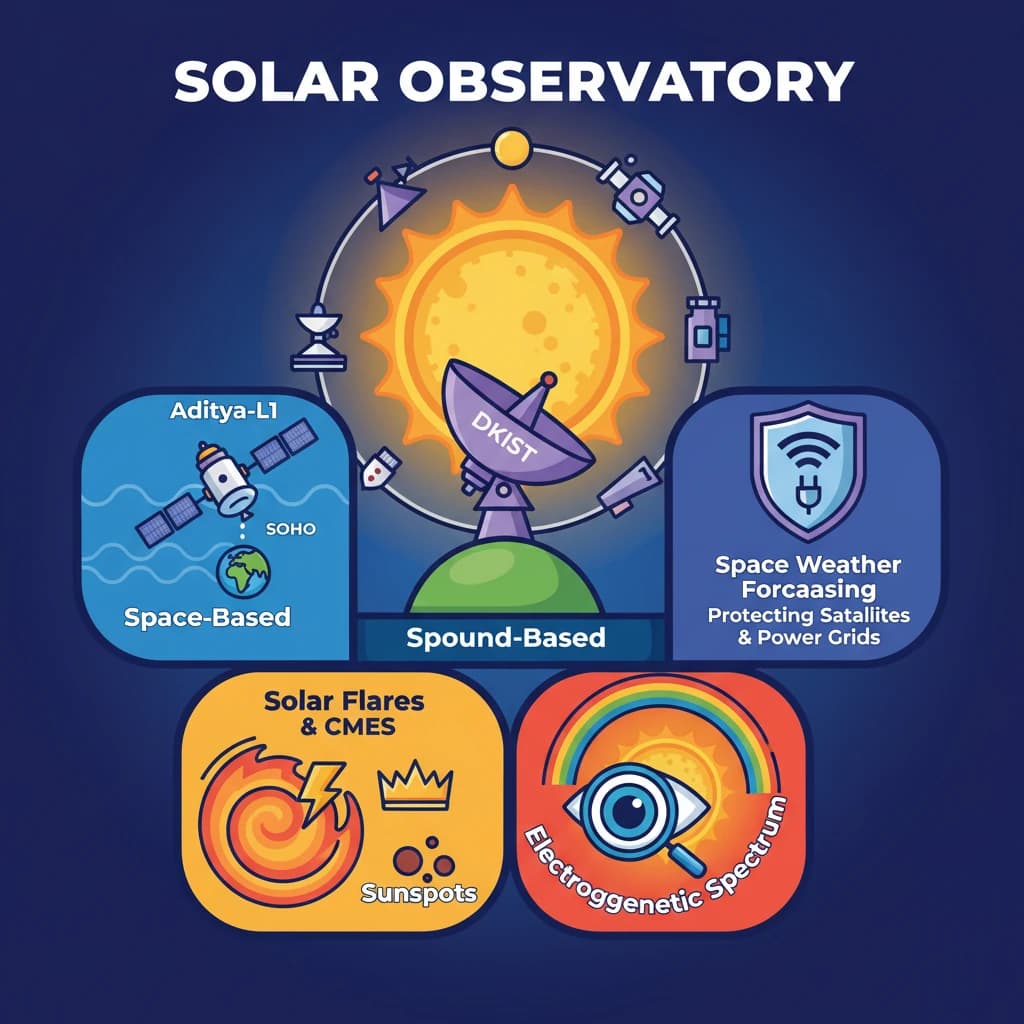
- •Both ground-based (e.g., DKIST) and space-based (e.g., Aditya-L1, SOHO) observatories contribute to solar research.
- •Understanding the Sun helps in astrophysics, climate research, and technological innovation.
🧠 Memory Techniques
98% Verified Content
📚 Reference Sources
•ISRO official website for Aditya-L1 details
•NASA and ESA official websites for SOHO mission
•National Solar Observatory (NSO) website for DKIST details
•General knowledge on solar physics and space weather