Loading page, please wait…
What is Cell Division? - UPSC Science And Technology
What is What is Cell Division? in UPSC Science And Technology?
What is Cell Division? is a key topic under Science And Technology for UPSC Civil Services Examination. Key points include: Cell division is fundamental for growth, repair, and reproduction.. Mitosis produces two identical somatic cells with the same chromosome number.. Meiosis produces four non-identical gametes with half the chromosome number.. Understanding this topic is essential for both UPSC Prelims and Mains preparation.
Why is What is Cell Division? important for UPSC exam?
What is Cell Division? is a Medium-level topic in UPSC Science And Technology. It is tested in both Prelims (factual MCQs) and Mains (analytical answer writing). Previous year UPSC questions have frequently covered aspects of What is Cell Division?, making it essential for comprehensive IAS preparation.
How to prepare What is Cell Division? for UPSC?
To prepare What is Cell Division? for UPSC: (1) Study the comprehensive notes covering all key concepts on Vaidra. (2) Practice previous year questions on this topic. (3) Connect it with current affairs using daily updates. (4) Revise using key takeaways and mind maps available for Science And Technology. (5) Write practice answers linking What is Cell Division? to related GS Paper topics.
Key takeaways of What is Cell Division? for UPSC
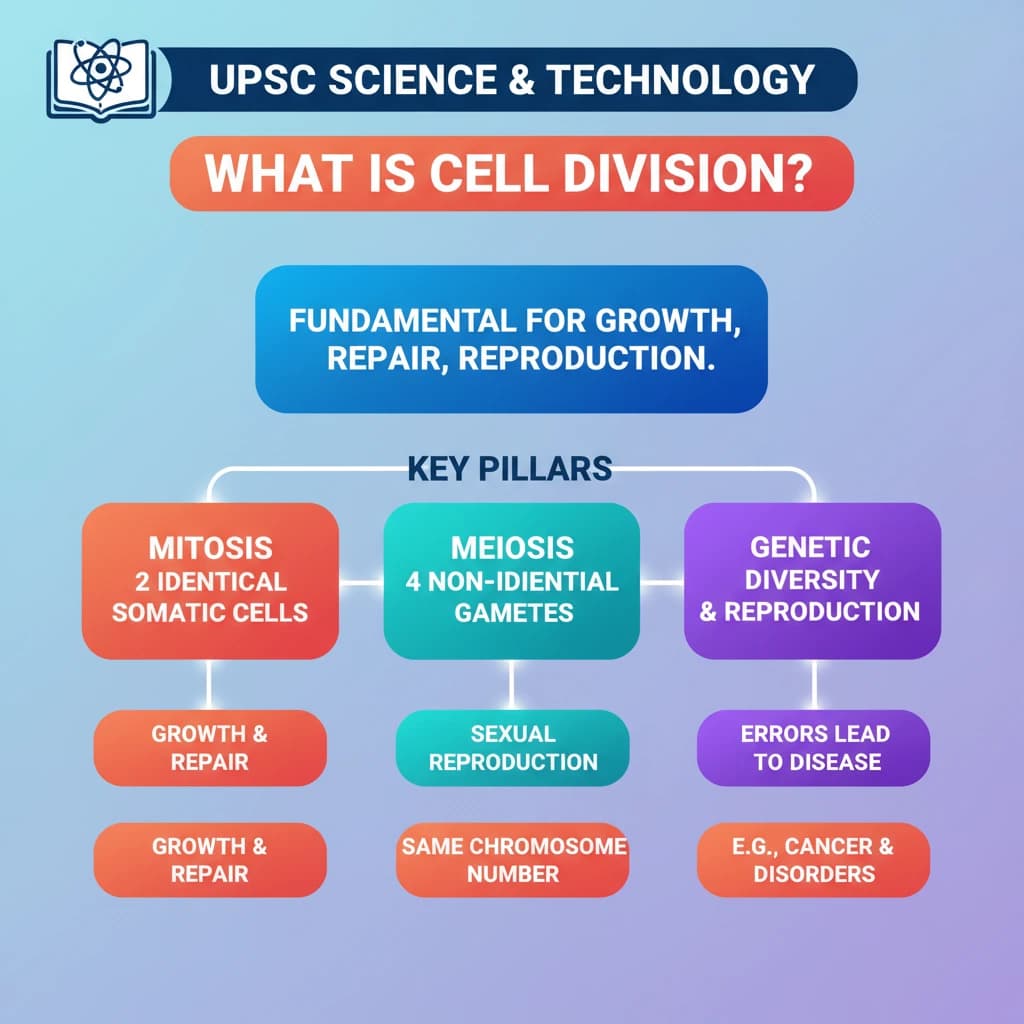
- Cell division is fundamental for growth, repair, and reproduction.
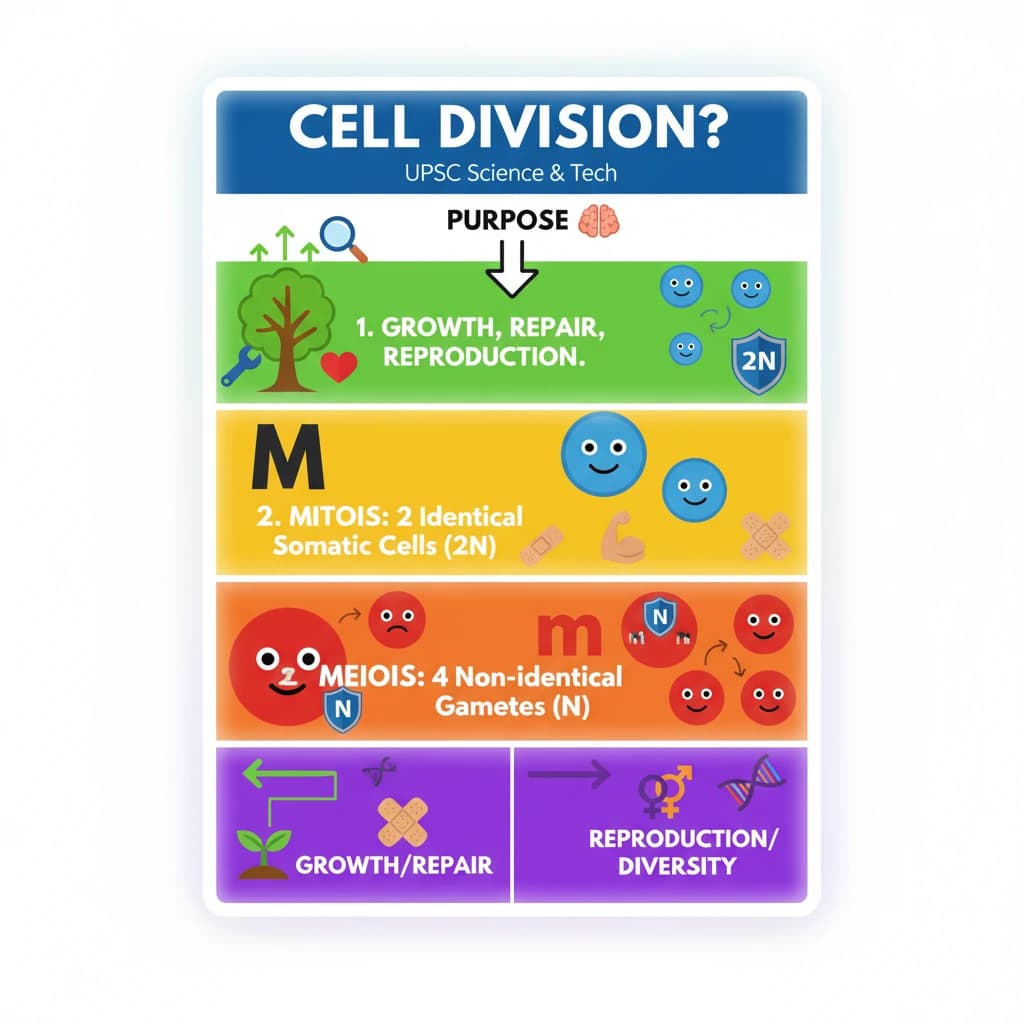
- Mitosis produces two identical somatic cells with the same chromosome number.
- Meiosis produces four non-identical gametes with half the chromosome number.
- Mitosis is for growth and repair; Meiosis is for sexual reproduction and genetic diversity.
- Errors in cell division can lead to diseases like cancer or genetic disorders.
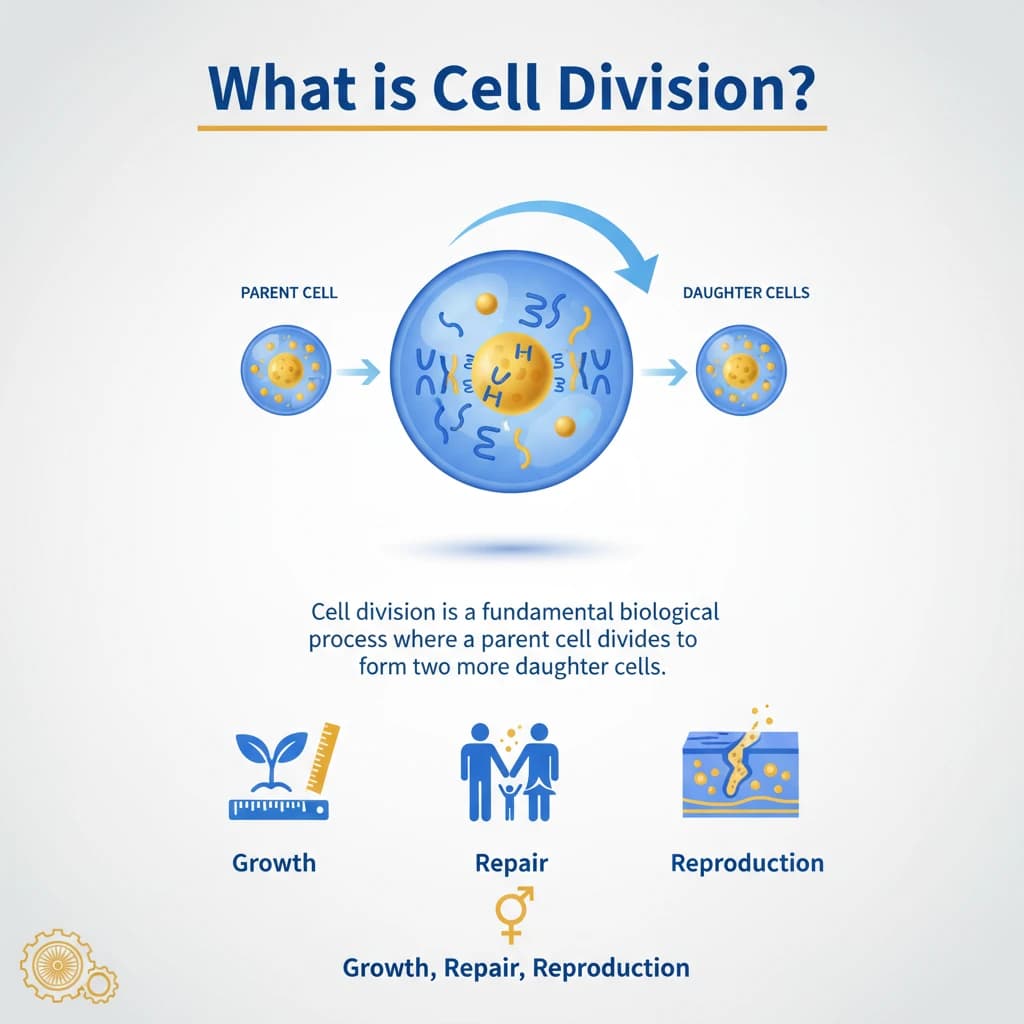
What is Cell Division?
Medium⏱️ 7 min read
science and technology
📖 Introduction
What is Cell Division?
Cell division is a fundamental biological process where a parent cell divides to form two or more daughter cells. This intricate mechanism is essential for the continuity of life.
It plays a critical role in various biological functions, including the growth of organisms, the repair of damaged tissues, and the reproduction of living beings.
In humans and many other multicellular organisms, cell division primarily occurs through two distinct processes: mitosis and meiosis.
Mitosis: Somatic Cell Division
Mitosis is the specific process through which somatic cells, which are all body cells except for reproductive cells, undergo division. It is a vital process for maintaining and repairing tissues.
This type of division results in the formation of two daughter cells. Each of these daughter cells is genetically identical to the original parent cell, possessing the same number of chromosomes.
Mitosis is crucial for several biological processes:
- Growth: Increases the number of cells, leading to organismal growth.
- Tissue Repair: Replaces damaged or worn-out cells, healing injuries.
- Asexual Reproduction: In unicellular organisms, it is the primary mode of reproduction.
It is a highly regulated process, ensuring genetic consistency across all somatic cells within an organism. This precision is key for normal development and function.
Meiosis: Reproductive Cell Division
Meiosis is a specialized type of cell division that is exclusively involved in the formation of gametes, which are the reproductive cells (sperm and egg cells) in sexually reproducing organisms.
Unlike mitosis, meiosis involves two rounds of division, ultimately reducing the chromosome number by half. This process creates four non-identical daughter cells, each containing 23 chromosomes in humans.
The reduction in chromosome number is essential for maintaining the species' characteristic chromosome count across successive generations following fertilization.
Meiosis also significantly contributes to genetic variation. This is achieved through mechanisms such as crossing over (exchange of genetic material between homologous chromosomes) and independent assortment (random orientation of homologous chromosomes during cell division).
Understanding the distinction between mitosis and meiosis is fundamental for UPSC Prelims (basic biology questions) and Mains (applications in health, genetics, and biotechnology in GS-III Science & Technology).
💡 Key Takeaways
- •Cell division is fundamental for growth, repair, and reproduction.
- •Mitosis produces two identical somatic cells with the same chromosome number.
- •Meiosis produces four non-identical gametes with half the chromosome number.
- •Mitosis is for growth and repair; Meiosis is for sexual reproduction and genetic diversity.
- •Errors in cell division can lead to diseases like cancer or genetic disorders.
🧠 Memory Techniques
98% Verified Content
📚 Reference Sources
•NCERT Biology Textbook (Class 11 & 12)
•Campbell Biology (11th Edition)
•Khan Academy Biology