Loading page, please wait…
What is Earth’s Magnetic Field? - UPSC Science And Technology
What is What is Earth’s Magnetic Field? in UPSC Science And Technology?
What is Earth’s Magnetic Field? is a key topic under Science And Technology for UPSC Civil Services Examination. Key points include: Earth's magnetic field, or geomagnetic field, originates in the planet's molten outer core.. It is generated by the geodynamo process, involving convection currents of molten iron and nickel.. The magnetic field creates the magnetosphere, which protects Earth from harmful solar wind and cosmic radiation.. Understanding this topic is essential for both UPSC Prelims and Mains preparation.
Why is What is Earth’s Magnetic Field? important for UPSC exam?
What is Earth’s Magnetic Field? is a Medium-level topic in UPSC Science And Technology. It is tested in both Prelims (factual MCQs) and Mains (analytical answer writing). Previous year UPSC questions have frequently covered aspects of What is Earth’s Magnetic Field?, making it essential for comprehensive IAS preparation.
How to prepare What is Earth’s Magnetic Field? for UPSC?
To prepare What is Earth’s Magnetic Field? for UPSC: (1) Study the comprehensive notes covering all key concepts on Vaidra. (2) Practice previous year questions on this topic. (3) Connect it with current affairs using daily updates. (4) Revise using key takeaways and mind maps available for Science And Technology. (5) Write practice answers linking What is Earth’s Magnetic Field? to related GS Paper topics.
Key takeaways of What is Earth’s Magnetic Field? for UPSC
- Earth's magnetic field, or geomagnetic field, originates in the planet's molten outer core.
- It is generated by the geodynamo process, involving convection currents of molten iron and nickel.
- The magnetic field creates the magnetosphere, which protects Earth from harmful solar wind and cosmic radiation.
- Other planets like Jupiter and Saturn have strong magnetic fields, while Mars and Venus do not due to different internal conditions.
- The field is dynamic, undergoing phenomena like magnetic reversals over geological timescales.
- It is vital for satellite operations, animal navigation, and the long-term habitability of Earth.
What is Earth’s Magnetic Field?
Medium⏱️ 7 min read
science and technology
📖 Introduction
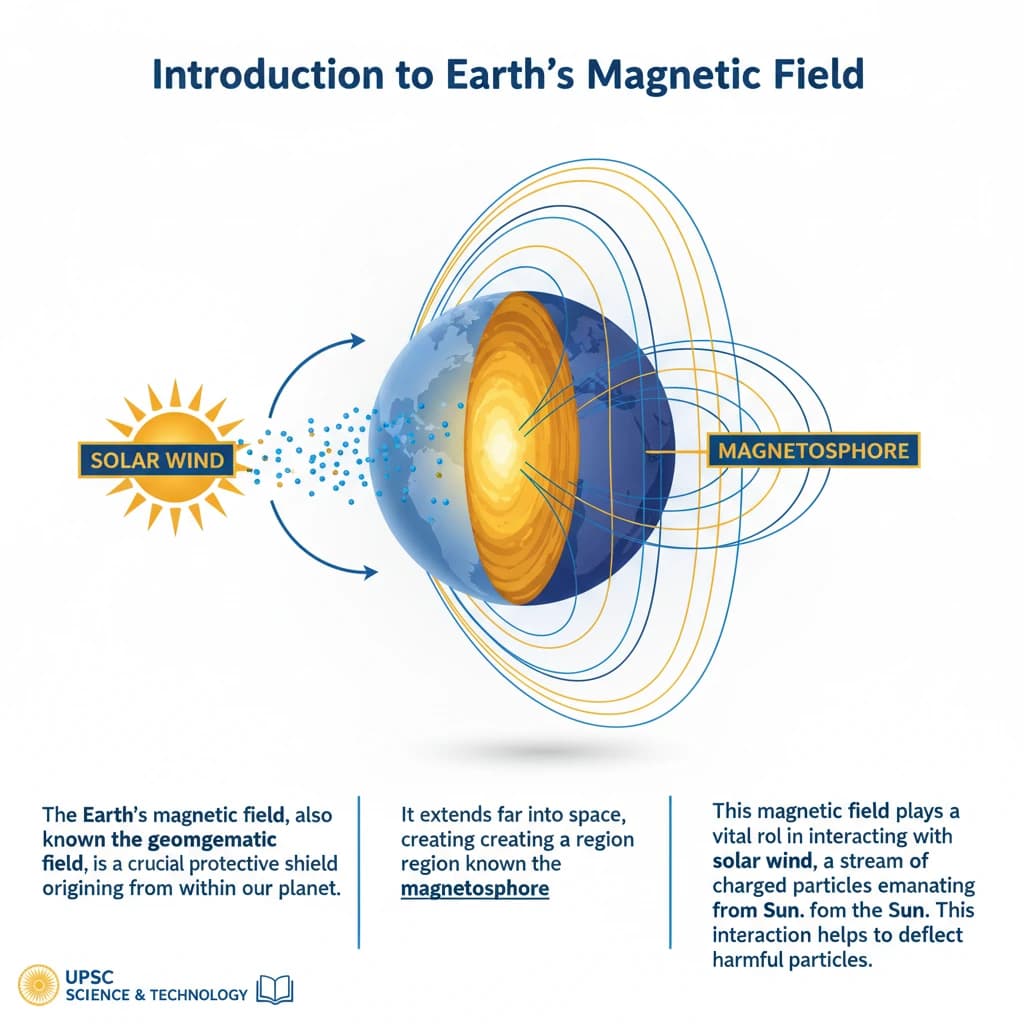
Introduction to Earth's Magnetic Field
The Earth's magnetic field, also known as the geomagnetic field, is a crucial protective shield originating from within our planet. It extends far into space, creating a region known as the magnetosphere.
This magnetic field plays a vital role in interacting with the solar wind, a stream of charged particles emanating from the Sun. This interaction helps to deflect harmful radiation away from Earth.
Definition: The geomagnetic field is the magnetic field that extends from the Earth's interior out into space, where it meets the solar wind.
Mechanism of Generation: The Geodynamo Process
The Earth's magnetic field is primarily generated by a complex process called the geodynamo process. This process occurs deep within the Earth's outer core.
The outer core is composed of highly conductive molten iron and nickel. These molten metals are in constant motion due to convection currents, driven by the Earth's internal heat.
As these molten metals move, they carry charged particles. The movement of these charged particles generates electrical currents, which in turn produce magnetic fields. This creates a self-sustaining loop.
The geodynamo process converts convective energy from the slow-moving molten iron in the outer core into electrical and magnetic energy, inducing a positive feedback loop that sustains the field.
Magnetic Fields on Other Planets
While Earth possesses a strong magnetic field, it is not unique. Other gas giants in our solar system, such as Jupiter, Saturn, Uranus, and Neptune, also exhibit strong magnetic fields.
The exact mechanisms for these planetary magnetic fields are still subjects of ongoing research and are not yet fully understood by scientists.
Planetary Comparisons:
- Mars: Lacks a magnetic field because it has lost most of its inner heat and does not possess a liquid interior necessary for a geodynamo.
- Venus: Possesses a liquid core but spins too slowly to generate the necessary convection currents and a strong magnetic field.
💡 Key Takeaways
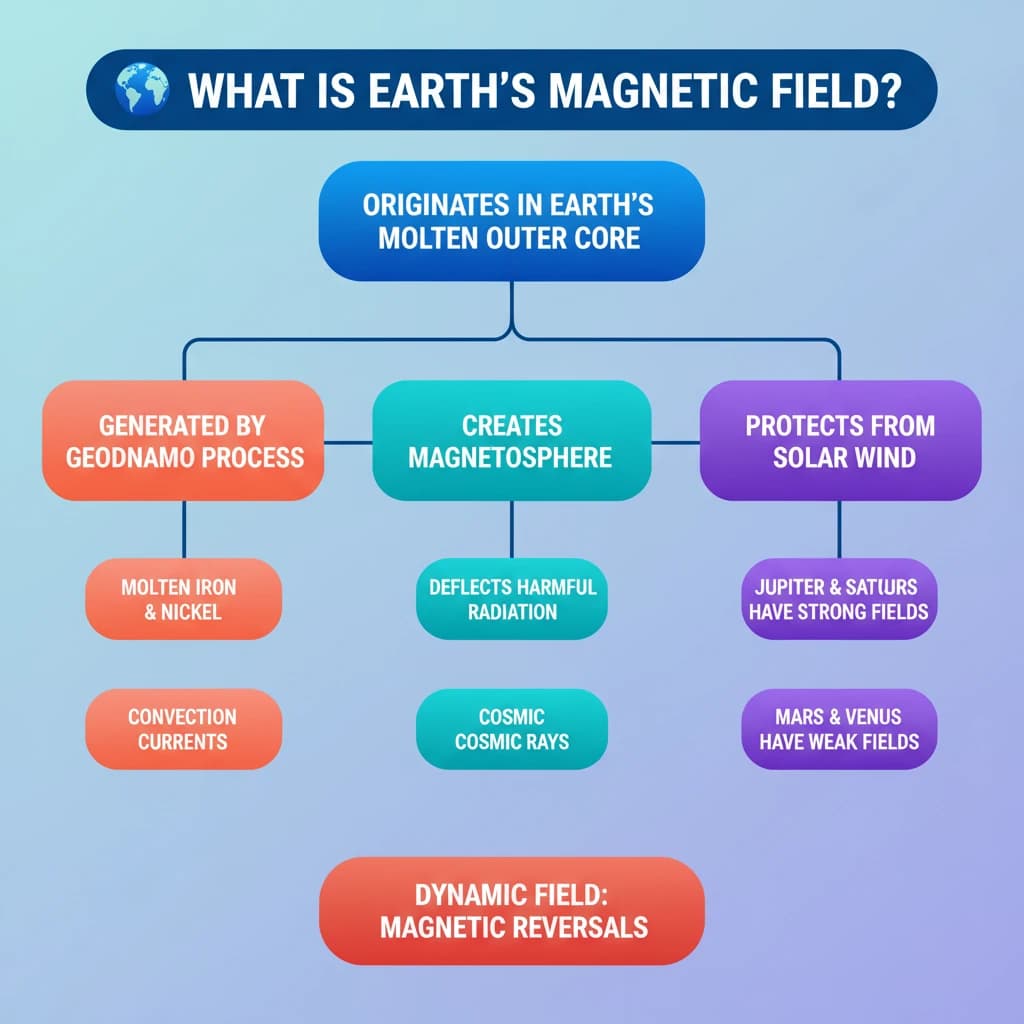
- •Earth's magnetic field, or geomagnetic field, originates in the planet's molten outer core.
- •It is generated by the geodynamo process, involving convection currents of molten iron and nickel.
- •The magnetic field creates the magnetosphere, which protects Earth from harmful solar wind and cosmic radiation.
- •Other planets like Jupiter and Saturn have strong magnetic fields, while Mars and Venus do not due to different internal conditions.
- •The field is dynamic, undergoing phenomena like magnetic reversals over geological timescales.
- •It is vital for satellite operations, animal navigation, and the long-term habitability of Earth.
🧠 Memory Techniques

98% Verified Content
📚 Reference Sources
•NASA Science: Earth's Magnetic Field
•National Geographic: Earth's Magnetic Field
•Encyclopaedia Britannica: Geomagnetism