Loading page, please wait…
What is the Impact on the Human Body in the ISS ? - UPSC Science And Technology
What is What is the Impact on the Human Body in the ISS ? in UPSC Science And Technology?
What is the Impact on the Human Body in the ISS ? is a key topic under Science And Technology for UPSC Civil Services Examination. Key points include: Microgravity significantly impacts bone density, muscle mass, vision, cardiovascular health, and psychological well-being.. Astronauts can lose up to 1% bone mass/month and experience muscle atrophy, requiring rigorous exercise.. Spaceflight Associated Neuro-ocular Syndrome (SANS) causes vision problems due to fluid shifts and increased intracranial pressure.. Understanding this topic is essential for both UPSC Prelims and Mains preparation.
Why is What is the Impact on the Human Body in the ISS ? important for UPSC exam?
What is the Impact on the Human Body in the ISS ? is a Medium-level topic in UPSC Science And Technology. It is tested in both Prelims (factual MCQs) and Mains (analytical answer writing). Previous year UPSC questions have frequently covered aspects of What is the Impact on the Human Body in the ISS ?, making it essential for comprehensive IAS preparation.
How to prepare What is the Impact on the Human Body in the ISS ? for UPSC?
To prepare What is the Impact on the Human Body in the ISS ? for UPSC: (1) Study the comprehensive notes covering all key concepts on Vaidra. (2) Practice previous year questions on this topic. (3) Connect it with current affairs using daily updates. (4) Revise using key takeaways and mind maps available for Science And Technology. (5) Write practice answers linking What is the Impact on the Human Body in the ISS ? to related GS Paper topics.
Key takeaways of What is the Impact on the Human Body in the ISS ? for UPSC
- Microgravity significantly impacts bone density, muscle mass, vision, cardiovascular health, and psychological well-being.
- Astronauts can lose up to 1% bone mass/month and experience muscle atrophy, requiring rigorous exercise.
- Spaceflight Associated Neuro-ocular Syndrome (SANS) causes vision problems due to fluid shifts and increased intracranial pressure.
- The heart adapts to reduced workload, potentially leading to deconditioning upon return to Earth.
- Extended isolation and confinement pose significant psychological challenges like stress and anxiety.
- Effective countermeasures and continuous research are crucial for sustaining long-duration human space missions to the Moon and Mars.
What is the Impact on the Human Body in the ISS ?
Medium⏱️ 9 min read
science and technology
📖 Introduction
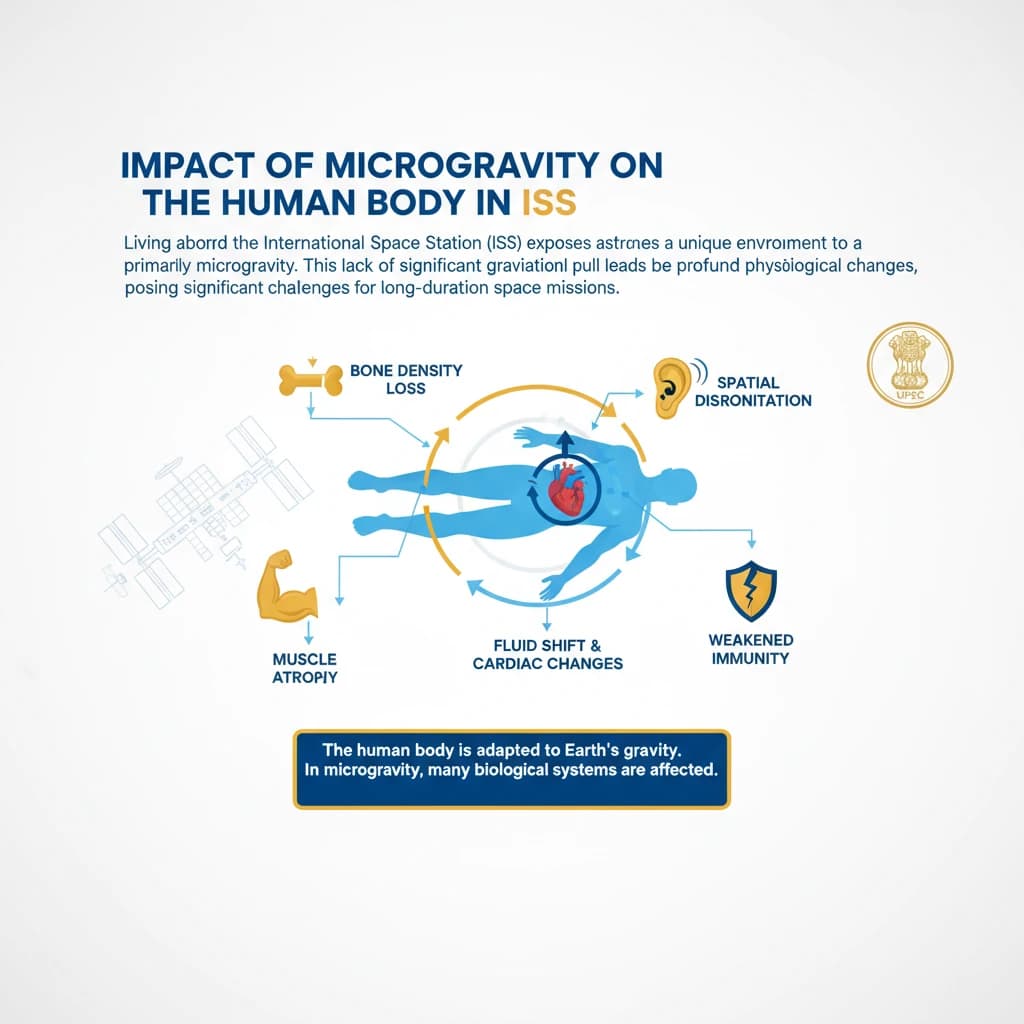
Impact of Microgravity on the Human Body in ISS
Living aboard the International Space Station (ISS) exposes astronauts to a unique environment, primarily microgravity. This lack of significant gravitational pull leads to profound physiological changes, posing significant challenges for long-duration space missions.
The human body is adapted to Earth's gravity. In microgravity, many biological systems behave differently, leading to a range of health issues that require continuous monitoring and countermeasures.
Bone Density Loss
One of the most significant impacts is the rapid loss of bone density. Without the constant stress of gravity, bones lose minerals, primarily calcium, at an accelerated rate.
Astronauts can lose up to 1% of bone mass per month while in microgravity. This rate is significantly higher than age-related bone loss on Earth.
This substantial loss increases the risk of developing conditions akin to osteoporosis and makes astronauts more susceptible to fractures, both during and after their missions.
Muscle Atrophy
Similar to bones, muscles also suffer in microgravity. The lack of gravitational resistance means muscles are not used as intensely as on Earth, leading to muscle atrophy.
Muscle mass and strength diminish significantly. This affects not only large skeletal muscles but also muscles vital for posture and movement.
To counteract these effects, astronauts must adhere to rigorous daily exercise routines, often involving specialized equipment like treadmills, cycle ergometers, and resistance devices, for several hours each day.
Vision Problems: Spaceflight Associated Neuro-ocular Syndrome (SANS)
A notable and concerning impact is on vision. In microgravity, fluids in the body tend to shift upwards towards the head, leading to increased intracranial pressure.
This elevated pressure can cause structural changes to the eyes, including flattening of the optic nerve head, choroidal folds, and cotton wool spots, resulting in vision-related issues.
These vision changes are collectively known as Spaceflight Associated Neuro-ocular Syndrome (SANS). It can lead to persistent vision impairment in some astronauts.
Cardiovascular Changes
The cardiovascular system also undergoes significant adaptation. The heart, accustomed to pumping against gravity, changes its workload and structure in space.
The initial fluid shift to the upper body can make the heart work harder, but over time, the heart can become smaller and less efficient due to reduced demand.
The heart can change shape and size in microgravity, potentially leading to reduced cardiac output and orthostatic intolerance upon return to Earth's gravity.
Psychological Effects
Beyond physiological changes, the mental well-being of astronauts is also profoundly affected. Extended periods of isolation and confinement in a small, enclosed environment can take a toll.
These psychological challenges can manifest as stress, anxiety, mood disturbances, and even cognitive impairments, impacting mission performance and overall health.
Understanding these impacts is crucial for UPSC aspirants, especially for General Studies Paper 3 (Science and Technology), as it highlights challenges and solutions in human spaceflight and future exploration missions.
💡 Key Takeaways
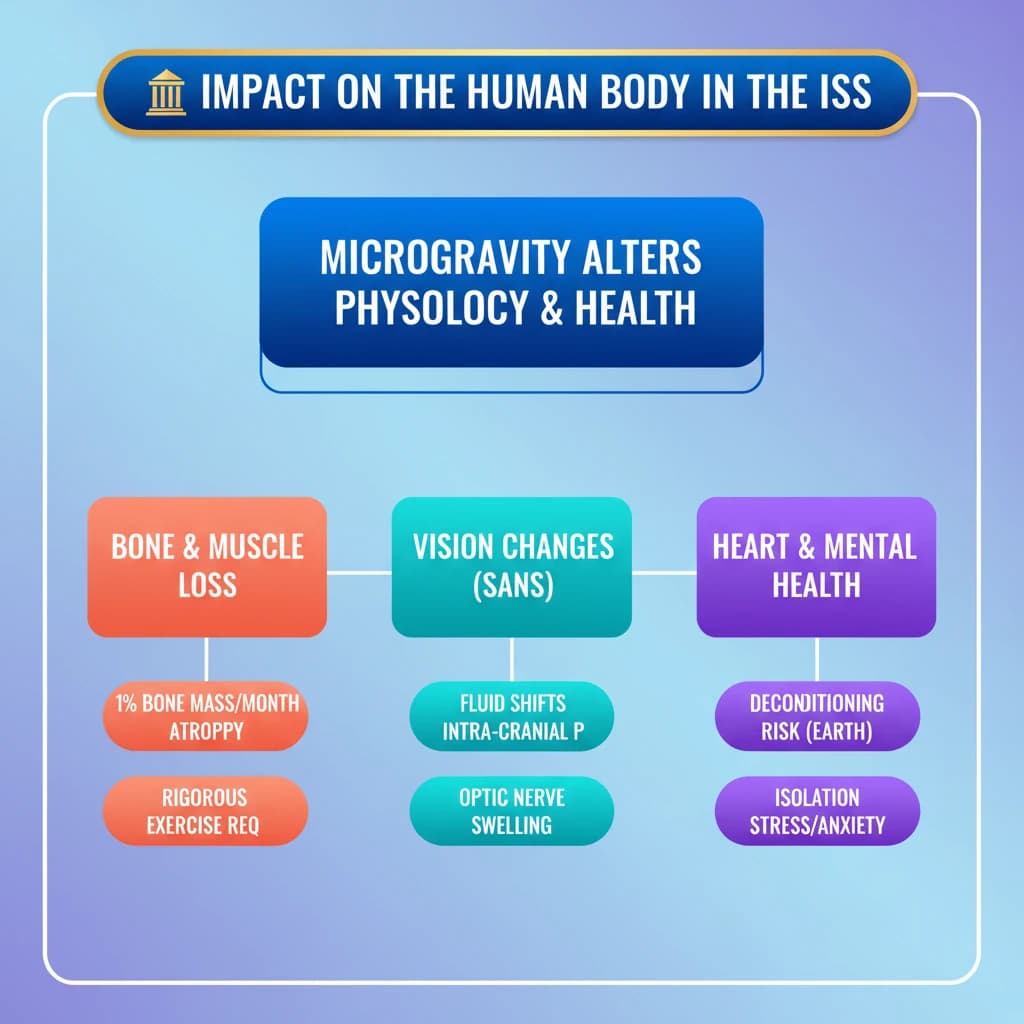
- •Microgravity significantly impacts bone density, muscle mass, vision, cardiovascular health, and psychological well-being.
- •Astronauts can lose up to 1% bone mass/month and experience muscle atrophy, requiring rigorous exercise.
- •Spaceflight Associated Neuro-ocular Syndrome (SANS) causes vision problems due to fluid shifts and increased intracranial pressure.
- •The heart adapts to reduced workload, potentially leading to deconditioning upon return to Earth.
- •Extended isolation and confinement pose significant psychological challenges like stress and anxiety.
- •Effective countermeasures and continuous research are crucial for sustaining long-duration human space missions to the Moon and Mars.
🧠 Memory Techniques

98% Verified Content
📚 Reference Sources
•European Space Agency (ESA) astronaut health and research articles
•Drishti IAS Summary (provided as source content)
•Peer-reviewed scientific literature on space medicine and physiology