Loading page, please wait…
What is the National Quantum Mission (NQM)? - UPSC Science And Technology
What is What is the National Quantum Mission (NQM)? in UPSC Science And Technology?
What is the National Quantum Mission (NQM)? is a key topic under Science And Technology for UPSC Civil Services Examination. Key points include: National Quantum Mission (NQM) aims to advance quantum technologies in India.. Quantum Key Distribution (QKD) provides 'unconditional security' through quantum mechanics.. Eavesdropping on QKD is detected because measuring photons alters their quantum state.. Understanding this topic is essential for both UPSC Prelims and Mains preparation.
Why is What is the National Quantum Mission (NQM)? important for UPSC exam?
What is the National Quantum Mission (NQM)? is a Medium-level topic in UPSC Science And Technology. It is tested in both Prelims (factual MCQs) and Mains (analytical answer writing). Previous year UPSC questions have frequently covered aspects of What is the National Quantum Mission (NQM)?, making it essential for comprehensive IAS preparation.
How to prepare What is the National Quantum Mission (NQM)? for UPSC?
To prepare What is the National Quantum Mission (NQM)? for UPSC: (1) Study the comprehensive notes covering all key concepts on Vaidra. (2) Practice previous year questions on this topic. (3) Connect it with current affairs using daily updates. (4) Revise using key takeaways and mind maps available for Science And Technology. (5) Write practice answers linking What is the National Quantum Mission (NQM)? to related GS Paper topics.
Key takeaways of What is the National Quantum Mission (NQM)? for UPSC
- National Quantum Mission (NQM) aims to advance quantum technologies in India.
- Quantum Key Distribution (QKD) provides 'unconditional security' through quantum mechanics.
- Eavesdropping on QKD is detected because measuring photons alters their quantum state.
- Quantum entanglement ensures any change to one photon instantly affects its entangled pair, preventing undetected alteration.
- China leads globally with a large satellite-based QKD network.
- India is developing its satellite-based QKD network, with ISRO demonstrating free-space quantum communication.
- The UN designated 2025 as the 'International Year of Quantum Science and Technology'.
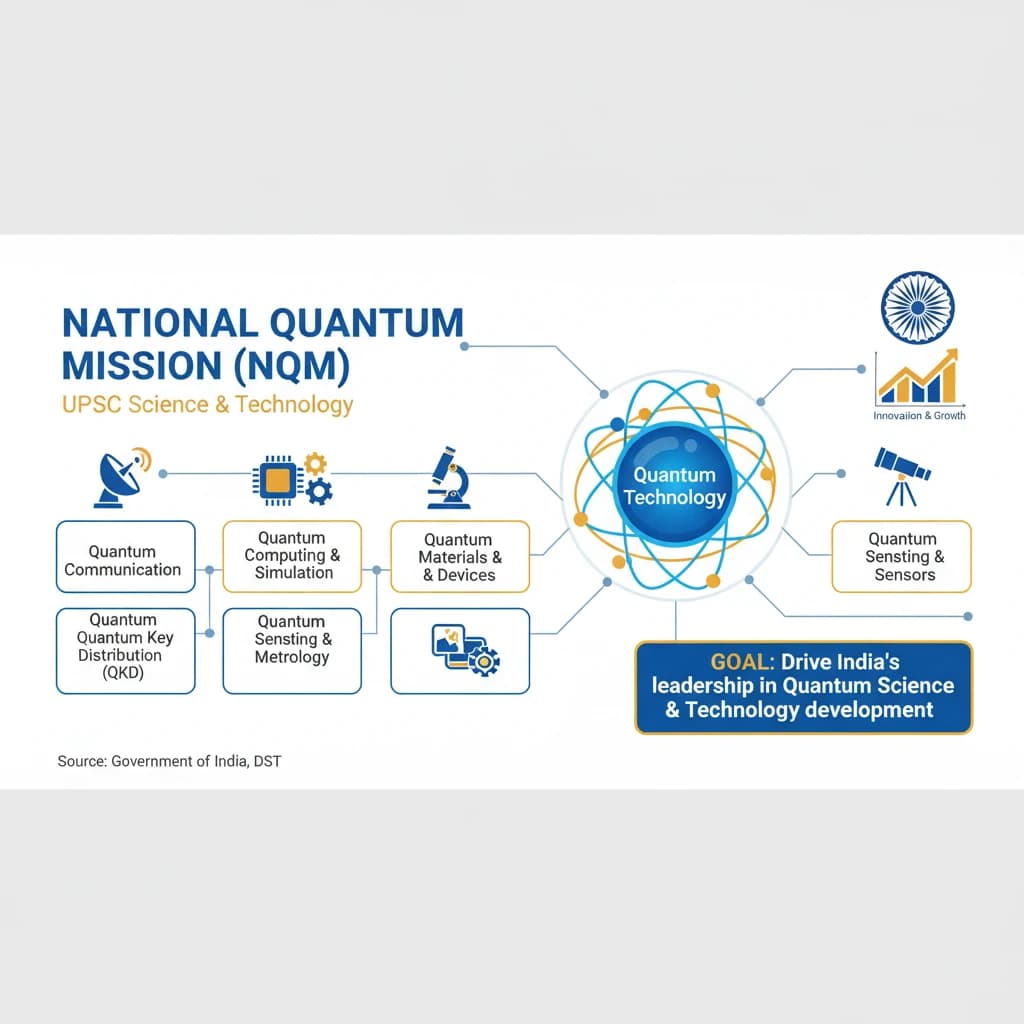
What is the National Quantum Mission (NQM)?
Medium⏱️ 8 min read
science and technology
📖 Introduction
Understanding Quantum Key Distribution (QKD) Security
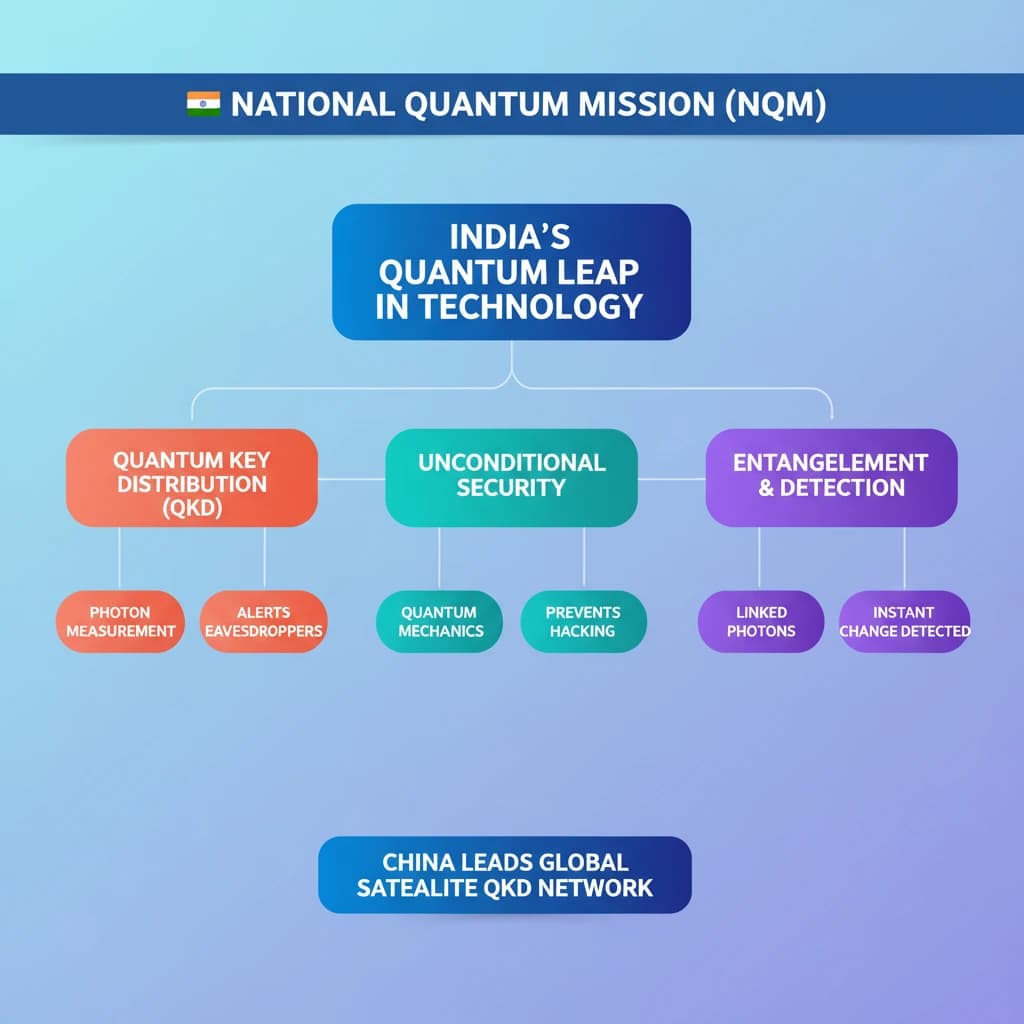
Quantum Key Distribution (QKD) offers an unparalleled level of security for communication by leveraging the fundamental principles of quantum mechanics.
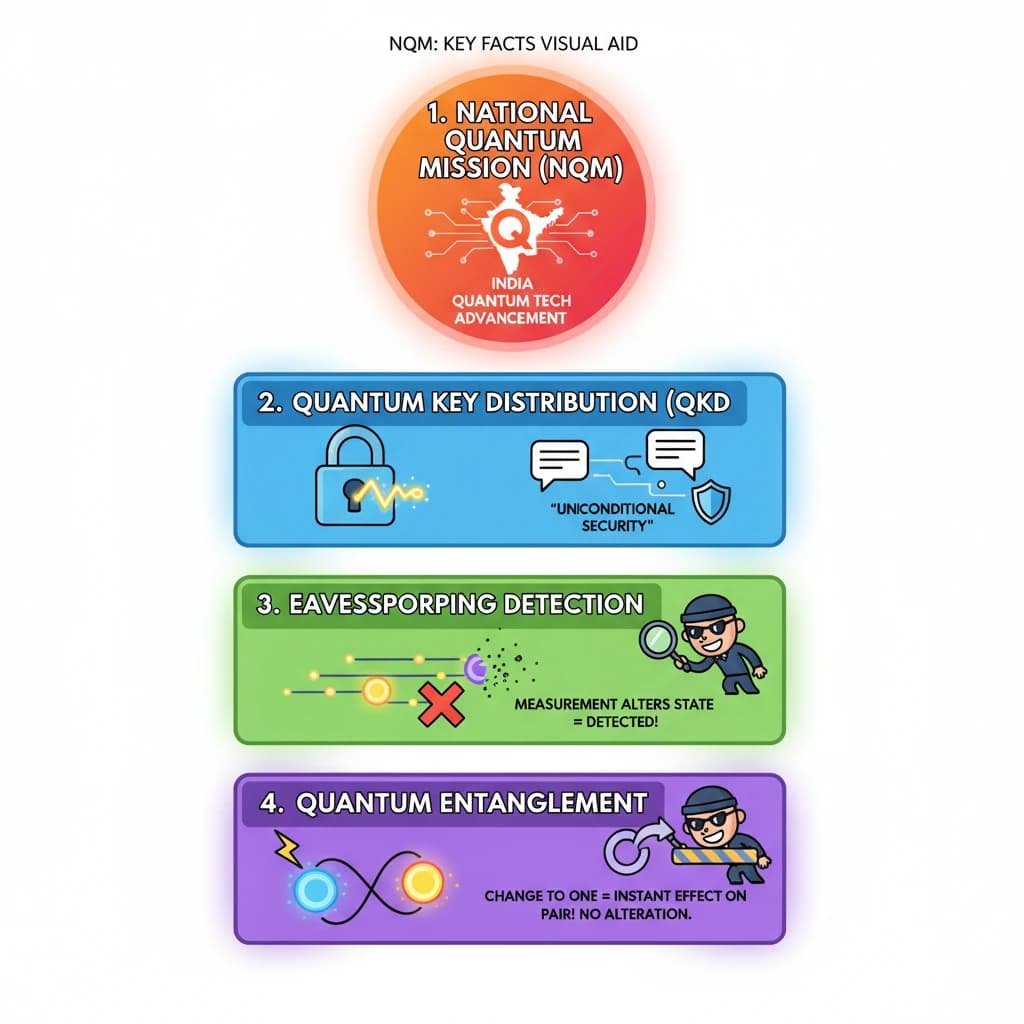
The core principle is that any measurement of a quantum state inevitably alters it. This forms the basis of its detection mechanism.
If an eavesdropper attempts to measure the photons carrying a cryptographic key, this interference immediately changes the state of these photons.
Consequently, the legitimate communicating parties will instantly detect that their key has been compromised, making interception futile.
Role of Quantum Entanglement in QKD
Beyond basic quantum properties, quantum entanglement provides an additional, robust layer of security in QKD systems.
Quantum entanglement is a phenomenon where two or more particles become linked, sharing the same fate regardless of the distance separating them.
Any alteration to one entangled photon instantaneously affects the other, making it impossible for an eavesdropper to modify the information without being detected by the legitimate users.
This inherent property allows QKD to offer “unconditional security”, as any interception is immediately revealed, ensuring truly secure communication.
Global Developments in Quantum Key Distribution
Several nations are actively pursuing advancements in quantum communication, recognizing its strategic importance.
China currently operates the world’s largest QKD network, which integrates three quantum satellites and approximately 70 ground stations, demonstrating significant progress in this field.
India's Progress in Quantum Communication
India is also making significant strides in its quantum communications experiments, aiming to establish a secure communication infrastructure.
India has ambitious plans for developing a satellite-based QKD network.
Studies conducted by the Raman Research Institute (RRI), located in Bengaluru, suggest that the Indian Astronomical Observatory in Hanle, Ladakh, offers ideal atmospheric conditions for such a system due to its clear skies and high altitude.
The Indian Space Research Organisation (ISRO) has successfully demonstrated free-space Quantum Communication over a distance of 300 meters, marking a crucial step towards practical implementation.
International Recognition of Quantum Science
The global scientific community acknowledges the transformative potential of quantum science and technology.
The United Nations (UN) has designated the year 2025 as the ‘International Year of Quantum Science and Technology’. This initiative aims to increase public awareness regarding the importance of quantum science and its diverse applications across various sectors.
💡 Key Takeaways
- •National Quantum Mission (NQM) aims to advance quantum technologies in India.
- •Quantum Key Distribution (QKD) provides 'unconditional security' through quantum mechanics.
- •Eavesdropping on QKD is detected because measuring photons alters their quantum state.
- •Quantum entanglement ensures any change to one photon instantly affects its entangled pair, preventing undetected alteration.
- •China leads globally with a large satellite-based QKD network.
- •India is developing its satellite-based QKD network, with ISRO demonstrating free-space quantum communication.
- •The UN designated 2025 as the 'International Year of Quantum Science and Technology'.
🧠 Memory Techniques
95% Verified Content