Loading page, please wait…
Global Tuberculosis Report 2024 - UPSC Social Issues
What is Global Tuberculosis Report 2024 in UPSC Social Issues?
Global Tuberculosis Report 2024 is a key topic under Social Issues for UPSC Civil Services Examination. Key points include: India achieved a 17.7% TB incidence decline (2015-2023), exceeding the global average.. Global new TB cases increased to 8.2 million in 2023, highest since 1995, though deaths slightly decreased.. 30 LMICs account for 87% of global TB burden; India, Indonesia, China, Philippines, Pakistan contribute 56%.. Understanding this topic is essential for both UPSC Prelims and Mains preparation.
Why is Global Tuberculosis Report 2024 important for UPSC exam?
Global Tuberculosis Report 2024 is a Medium-level topic in UPSC Social Issues. It is tested in both Prelims (factual MCQs) and Mains (analytical answer writing). Previous year UPSC questions have frequently covered aspects of Global Tuberculosis Report 2024, making it essential for comprehensive IAS preparation.
How to prepare Global Tuberculosis Report 2024 for UPSC?
To prepare Global Tuberculosis Report 2024 for UPSC: (1) Study the comprehensive notes covering all key concepts on Vaidra. (2) Practice previous year questions on this topic. (3) Connect it with current affairs using daily updates. (4) Revise using key takeaways and mind maps available for Social Issues. (5) Write practice answers linking Global Tuberculosis Report 2024 to related GS Paper topics.
Key takeaways of Global Tuberculosis Report 2024 for UPSC
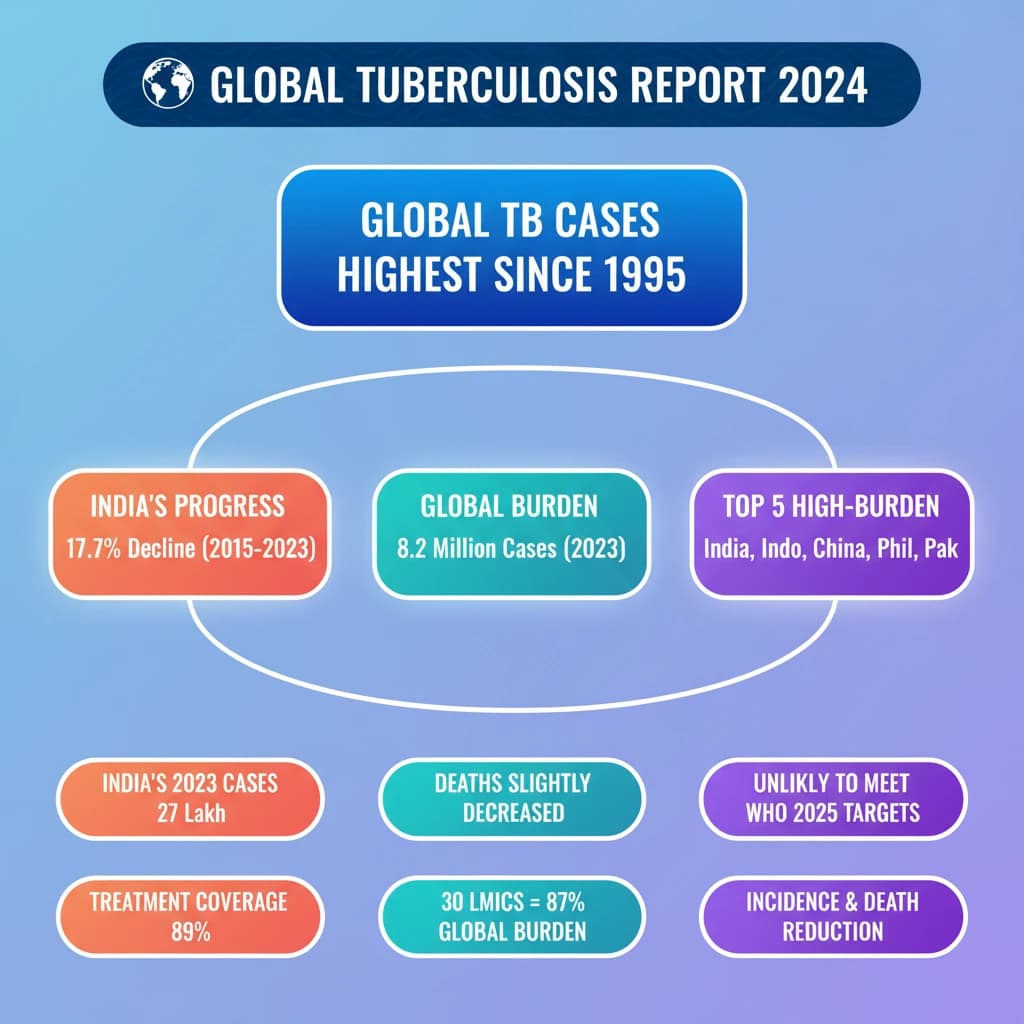
- India achieved a 17.7% TB incidence decline (2015-2023), exceeding the global average.
- Global new TB cases increased to 8.2 million in 2023, highest since 1995, though deaths slightly decreased.
- 30 LMICs account for 87% of global TB burden; India, Indonesia, China, Philippines, Pakistan contribute 56%.
- India recorded 27 lakh TB cases in 2023, with treatment coverage improving to 89%.
- India is unlikely to meet WHO's 2025 End TB Strategy milestones for incidence and death reduction.
- TB is caused by Mycobacterium tuberculosis, primarily affecting lungs, and is curable with a 6-month drug course.
- MDR-TB and XDR-TB are significant threats; India holds 27% of global MDR-TB burden.
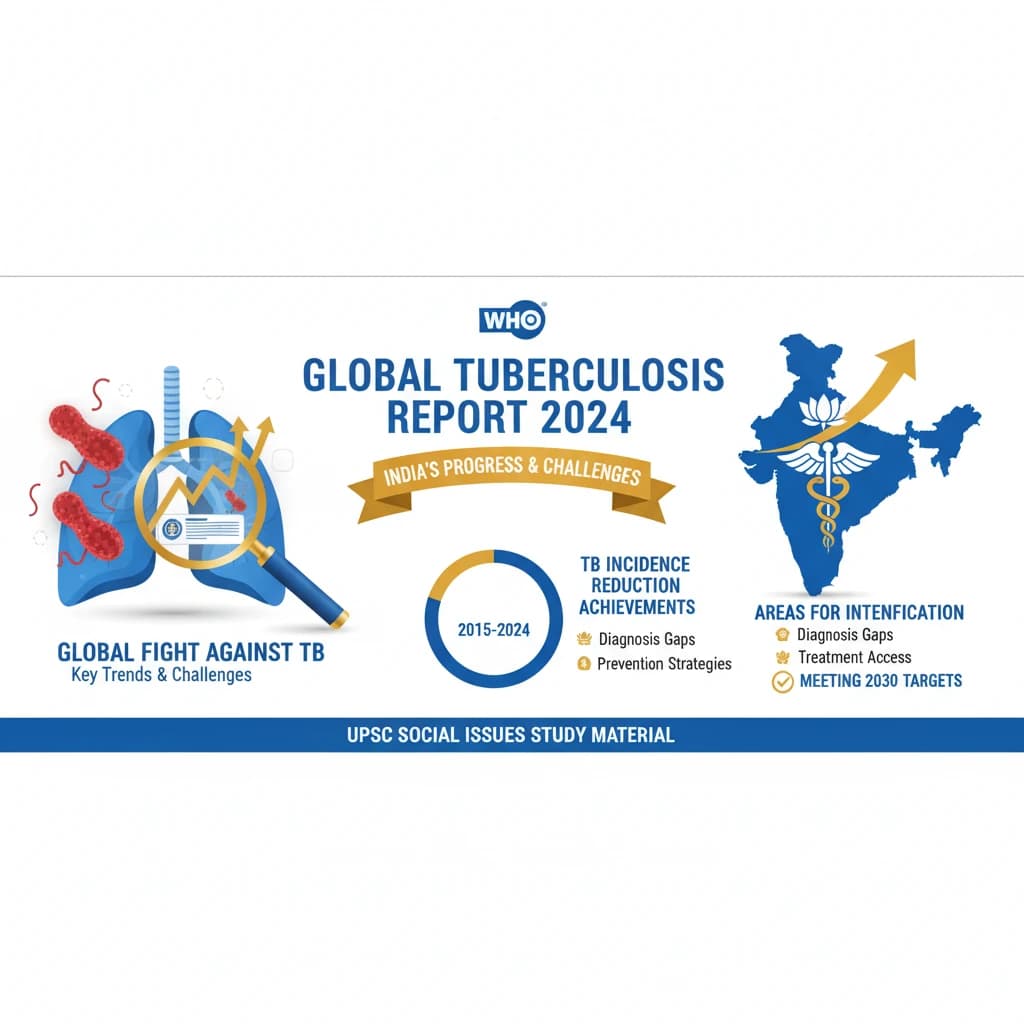
Global Tuberculosis Report 2024
Medium⏱️ 10 min read
social issues
📖 Introduction
Introduction to the Global Tuberculosis Report 2024
The WHO Global Tuberculosis Report 2024 provides a crucial update on the global and national fight against Tuberculosis (TB). This report highlights key trends, challenges, and progress in TB elimination efforts worldwide.
India's performance is a significant focus, showcasing both achievements and areas requiring intensified efforts to meet elimination targets.
India's Progress in TB Incidence Decline
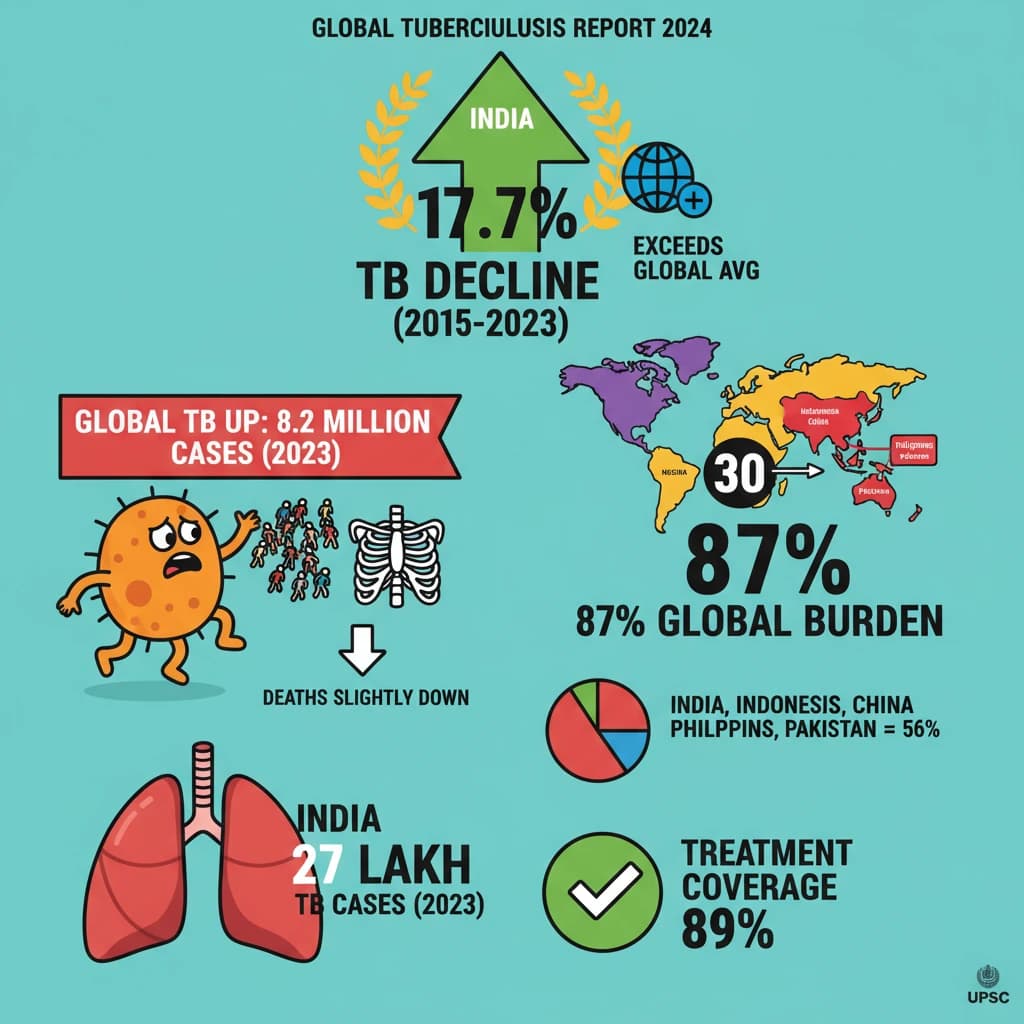
According to the WHO Global Tuberculosis Report 2024, India has demonstrated a remarkable decline in TB incidence. From 2015 to 2023, India achieved a 17.7% reduction in TB cases.
This decline significantly exceeds the global average of 8.3% for the same period. It underscores India's dedication to its National Tuberculosis Elimination Programme (NTEP) and the ambitious goal of eliminating TB by 2025.
Global TB Incidence Trends in 2023
The report reveals a concerning increase in new TB cases globally. In 2023, approximately 8.2 million new TB cases were reported, a rise from 7.5 million in 2022.
This figure marks the highest number recorded by WHO since 1995, indicating a persistent global challenge in controlling the disease.
Despite the rise in incidence, there was a slight decrease in TB-related deaths. An estimated 1.25 million TB deaths were recorded in 2023, a marginal reduction from 1.32 million in 2022.
Demographics of Global TB Cases
The burden of TB is disproportionately concentrated in certain regions and populations. Low- and middle-income countries (LMICs) bear the brunt, accounting for 87% of the global TB burden.
A significant portion of global TB cases originates from just a few countries:
- India: 26%
- Indonesia: 10%
- China: 6.8%
- Philippines: 6.8%
- Pakistan: 6.3%
These five nations collectively contribute 56% of the global TB burden.
The report also details the distribution of TB cases by gender and age: 55% of cases occurred in men, 33% in women, and 12% in children and young adolescents.
India's Specific TB Scenario in 2023
In 2023, India recorded an estimated 27 lakh TB cases. Out of these, 25.1 lakh individuals were successfully diagnosed and initiated treatment, reflecting improved case detection.
India's TB incidence rate saw a notable reduction from 237 cases per lakh population in 2015 to 195 per lakh in 2023, confirming the 17.7% decline over this period.
Treatment coverage in India significantly improved, rising from 72% in 2015 to 89% in 2023. This expansion has been crucial in reducing the number of undiagnosed or untreated cases.
WHO End TB Strategy Goals and India's Position
The WHO's End TB Strategy sets ambitious post-2015 milestones: a 75% reduction in TB deaths and a 50% reduction in incidence from 2015 levels by 2025.
The Global TB Report 2024 indicates that India is currently unlikely to eliminate TB by its 2025 target. The country is falling short of these critical WHO milestones.
Current progress suggests India will not achieve the specific targets of reducing TB deaths to 7 per 1,00,000 population and incidence to 118.5 per 1,00,000 population by 2025.
Understanding Tuberculosis (TB)
Tuberculosis (TB) is a serious infectious disease primarily caused by the bacterium Mycobacterium tuberculosis. It most commonly affects the lungs, but can also impact other parts of the body.
Transmission: TB spreads from person to person through the air. When individuals with lung TB cough, sneeze, or spit, they release tiny droplets containing TB germs, which can then be inhaled by others.
Symptoms: Common symptoms include a persistent cough with sputum (sometimes blood), chest pains, general weakness, unexplained weight loss, persistent fever, and drenching night sweats.
Treatment: TB is both a treatable and curable disease. The standard treatment involves a 6-month course of antimicrobial drugs. This treatment is typically provided with supervision and support from a health worker or trained volunteer to ensure adherence.
Drug-Resistant Tuberculosis
Over decades, strains of TB bacteria have developed resistance to one or more anti-TB medicines. This poses a significant challenge to global TB control.
Multidrug-resistant tuberculosis (MDR-TB): This form of TB is caused by bacteria that do not respond to the two most powerful first-line anti-TB drugs: isoniazid and rifampicin. MDR-TB is treatable and curable using second-line drugs.
India holds 27% of the global burden of MDR-TB, highlighting a critical area for intervention and advanced treatment strategies.
Extensively drug-resistant TB (XDR-TB): This is a more severe form of MDR-TB. It is caused by bacteria that are resistant not only to first-line drugs but also to the most effective second-line anti-TB drugs. XDR-TB often leaves patients with very limited or no further treatment options, making it extremely challenging to cure.
Initiatives Mentioned in Source Material (Note: These are Polio-related)
The provided source material, within the context of the Global Tuberculosis Report, also listed several initiatives related to Polio Eradication. While not directly pertaining to TB, they highlight India's broader public health efforts.
- Pulse Polio Programme
- Intensified Mission Indradhanush 2.0
- Polio Eradication and Endgame Strategic Plan 2013-2018
- World Polio Day (24th October)
- Global Polio Eradication Initiative (GPEI)
💡 Key Takeaways
- •India achieved a 17.7% TB incidence decline (2015-2023), exceeding the global average.
- •Global new TB cases increased to 8.2 million in 2023, highest since 1995, though deaths slightly decreased.
- •30 LMICs account for 87% of global TB burden; India, Indonesia, China, Philippines, Pakistan contribute 56%.
- •India recorded 27 lakh TB cases in 2023, with treatment coverage improving to 89%.
- •India is unlikely to meet WHO's 2025 End TB Strategy milestones for incidence and death reduction.
- •TB is caused by Mycobacterium tuberculosis, primarily affecting lungs, and is curable with a 6-month drug course.
- •MDR-TB and XDR-TB are significant threats; India holds 27% of global MDR-TB burden.
🧠 Memory Techniques
95% Verified Content
📚 Reference Sources
•National Tuberculosis Elimination Programme (NTEP) official documents (for context on India's initiatives)
•World Health Organization (WHO) official website (for general TB information and End TB Strategy details)