Loading page, please wait…
Immoral Traffic (Prevention) Act: Penalties Under Section 5 - UPSC Social Issues
What is Immoral Traffic (Prevention) Act: Penalties Under Section 5 in UPSC Social Issues?
Immoral Traffic (Prevention) Act: Penalties Under Section 5 is a key topic under Social Issues for UPSC Civil Services Examination. Key points include: Section 5 of ITPA penalizes procurement/inducement for prostitution.. Standard punishment: 3-7 years rigorous imprisonment + Rs 2,000 fine.. Aggravated offenses (against will or against a child) carry enhanced penalties.. Understanding this topic is essential for both UPSC Prelims and Mains preparation.
Why is Immoral Traffic (Prevention) Act: Penalties Under Section 5 important for UPSC exam?
Immoral Traffic (Prevention) Act: Penalties Under Section 5 is a Medium-level topic in UPSC Social Issues. It is tested in both Prelims (factual MCQs) and Mains (analytical answer writing). Previous year UPSC questions have frequently covered aspects of Immoral Traffic (Prevention) Act: Penalties Under Section 5, making it essential for comprehensive IAS preparation.
How to prepare Immoral Traffic (Prevention) Act: Penalties Under Section 5 for UPSC?
To prepare Immoral Traffic (Prevention) Act: Penalties Under Section 5 for UPSC: (1) Study the comprehensive notes covering all key concepts on Vaidra. (2) Practice previous year questions on this topic. (3) Connect it with current affairs using daily updates. (4) Revise using key takeaways and mind maps available for Social Issues. (5) Write practice answers linking Immoral Traffic (Prevention) Act: Penalties Under Section 5 to related GS Paper topics.
Key takeaways of Immoral Traffic (Prevention) Act: Penalties Under Section 5 for UPSC
- Section 5 of ITPA penalizes procurement/inducement for prostitution.
- Standard punishment: 3-7 years rigorous imprisonment + Rs 2,000 fine.
- Aggravated offenses (against will or against a child) carry enhanced penalties.
- Enhanced penalties can extend to 14 years or life imprisonment.
- A 'child' under ITPA is defined as a person below 16 years of age.
- The Act aims to protect vulnerable individuals and deter exploiters.
Immoral Traffic (Prevention) Act: Penalties Under Section 5
Medium⏱️ 8 min read
social issues
📖 Introduction
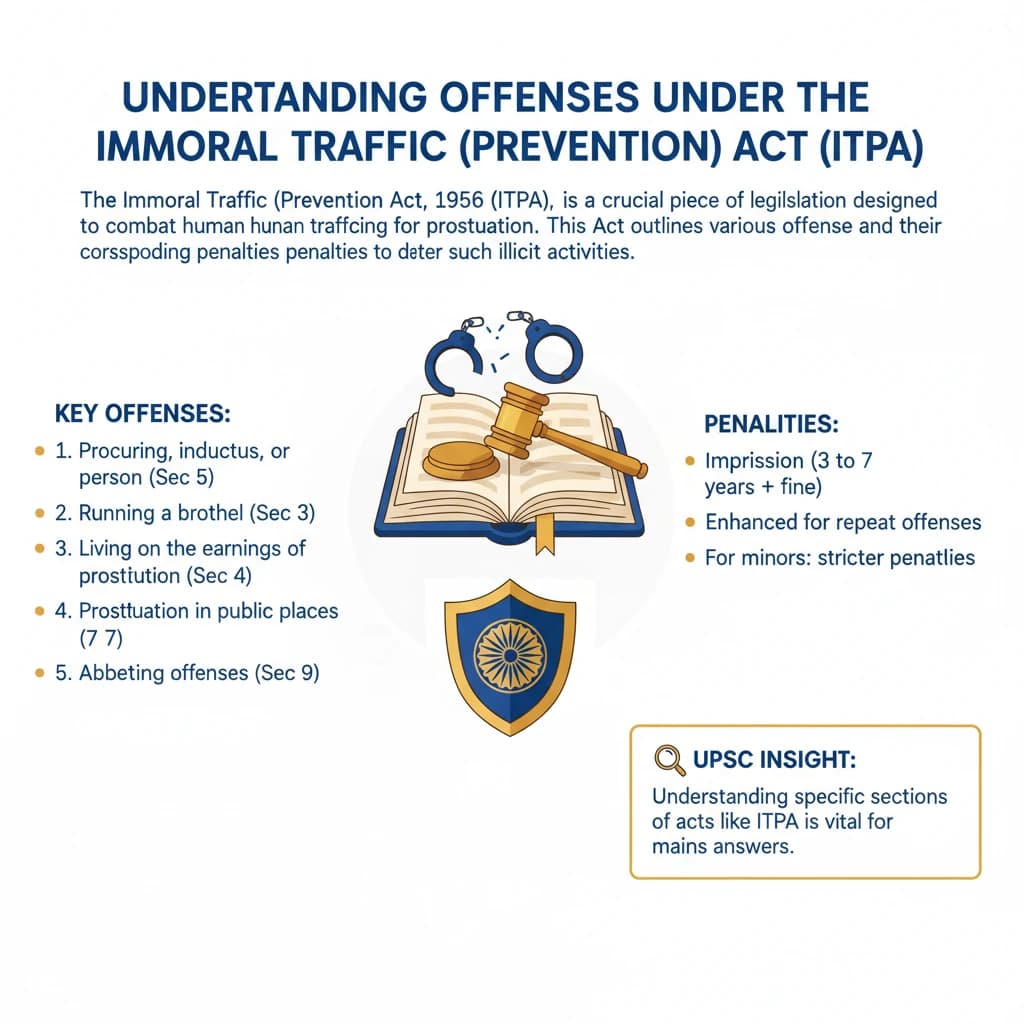
Understanding Offenses Under the Immoral Traffic (Prevention) Act (ITPA)
The Immoral Traffic (Prevention) Act, 1956 (ITPA), is a crucial piece of legislation designed to combat human trafficking for the purpose of prostitution. This Act outlines various offenses and their corresponding penalties to deter such illicit activities.
UPSC Insight: Understanding specific sections of acts like ITPA is vital for GS Paper I (Social Issues) and GS Paper II (Governance, Social Justice). Questions often test knowledge of legal provisions related to vulnerable sections.
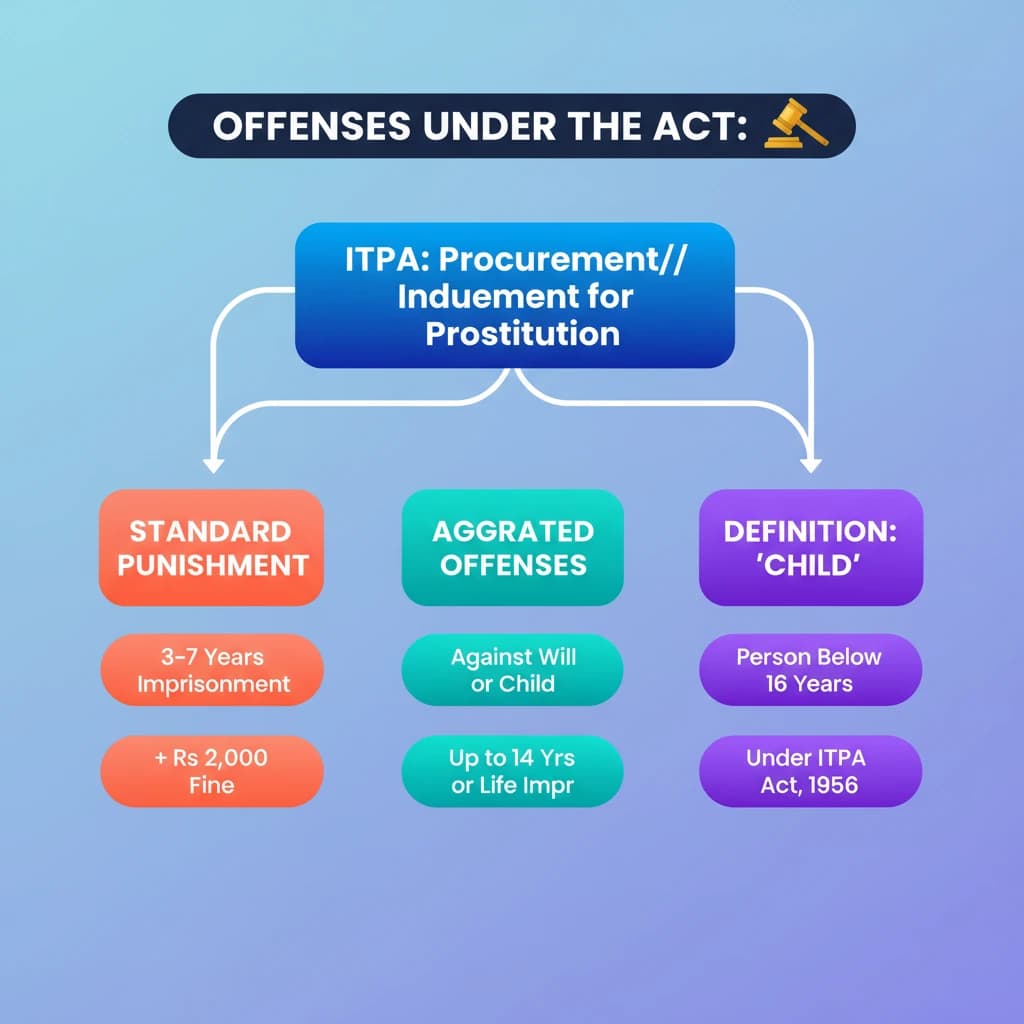
Penalties for Procurement and Inducement (Section 5)
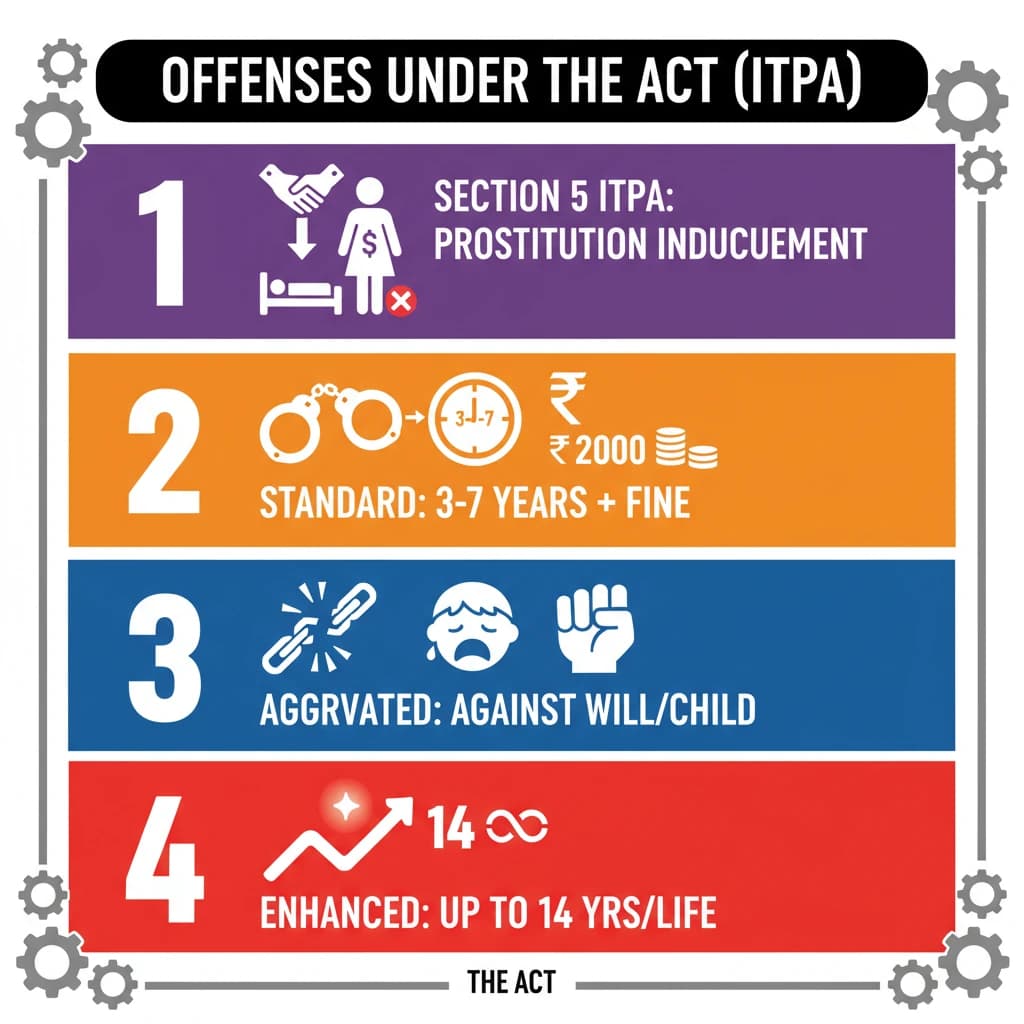
Section 5 of the ITPA specifically targets individuals who engage in the procurement, inducement, or taking of persons for prostitution. This includes any act that facilitates or forces someone into sex work.
Standard Punishment: For such offenses, the punishment prescribed is rigorous imprisonment ranging from three to seven years. Additionally, a fine of Rs 2,000 is also imposed.
Aggravated Offenses and Enhanced Penalties
The Act provides for significantly harsher penalties when offenses are committed under aggravating circumstances. These situations involve a higher degree of coercion or vulnerability.
- Against a Person's Will: If the procurement, inducement, or taking for prostitution is done against the will of the person, the punishment is substantially increased.
- Offenses Against a Child: Similarly, if the offense is committed against a child, the law imposes stricter penalties.
Enhanced Punishment: For offenses committed against a person's will or against a child, the maximum sentence can extend to fourteen years or even life imprisonment, depending on the severity and specific circumstances.
Definition of 'Child' Under the Act
The ITPA provides a clear definition of what constitutes a 'child' for the purposes of these offenses. This definition is critical in determining the applicability of enhanced penalties.
Definition of Child: Under the Act, a child is defined as a person who has not completed the age of sixteen years.
💡 Key Takeaways
- •Section 5 of ITPA penalizes procurement/inducement for prostitution.
- •Standard punishment: 3-7 years rigorous imprisonment + Rs 2,000 fine.
- •Aggravated offenses (against will or against a child) carry enhanced penalties.
- •Enhanced penalties can extend to 14 years or life imprisonment.
- •A 'child' under ITPA is defined as a person below 16 years of age.
- •The Act aims to protect vulnerable individuals and deter exploiters.
🧠 Memory Techniques
98% Verified Content
📚 Reference Sources
•The Immoral Traffic (Prevention) Act, 1956 (ITPA), Section 5
•International Convention for the Suppression of Immoral Traffic in Persons and of the Exploitation of the Prostitution of Others, 1950