Loading page, please wait…
Inheritance Norms in Hindu Succession Act, 1956 - UPSC Social Issues
What is Inheritance Norms in Hindu Succession Act, 1956 in UPSC Social Issues?
Inheritance Norms in Hindu Succession Act, 1956 is a key topic under Social Issues for UPSC Civil Services Examination. Key points include: Supreme Court upheld Hindu Succession Act, 1956 (HSA) inheritance provisions, emphasizing cultural norms.. Court clarified inheritance laws are not solely a gender equality issue but reflect deep cultural values.. HSA's framework ensures property inherited by a woman from parents/in-laws returns to source family if no direct heirs.. Understanding this topic is essential for both UPSC Prelims and Mains preparation.
Why is Inheritance Norms in Hindu Succession Act, 1956 important for UPSC exam?
Inheritance Norms in Hindu Succession Act, 1956 is a Medium-level topic in UPSC Social Issues. It is tested in both Prelims (factual MCQs) and Mains (analytical answer writing). Previous year UPSC questions have frequently covered aspects of Inheritance Norms in Hindu Succession Act, 1956, making it essential for comprehensive IAS preparation.
How to prepare Inheritance Norms in Hindu Succession Act, 1956 for UPSC?
To prepare Inheritance Norms in Hindu Succession Act, 1956 for UPSC: (1) Study the comprehensive notes covering all key concepts on Vaidra. (2) Practice previous year questions on this topic. (3) Connect it with current affairs using daily updates. (4) Revise using key takeaways and mind maps available for Social Issues. (5) Write practice answers linking Inheritance Norms in Hindu Succession Act, 1956 to related GS Paper topics.
Key takeaways of Inheritance Norms in Hindu Succession Act, 1956 for UPSC
- Supreme Court upheld Hindu Succession Act, 1956 (HSA) inheritance provisions, emphasizing cultural norms.
- Court clarified inheritance laws are not solely a gender equality issue but reflect deep cultural values.
- HSA's framework ensures property inherited by a woman from parents/in-laws returns to source family if no direct heirs.
- Legislative changes to inheritance laws are Parliament's domain, not the judiciary's, due to societal impact.
- The ruling highlights the balance between legal reform, cultural sentiments, and democratic legislative processes.
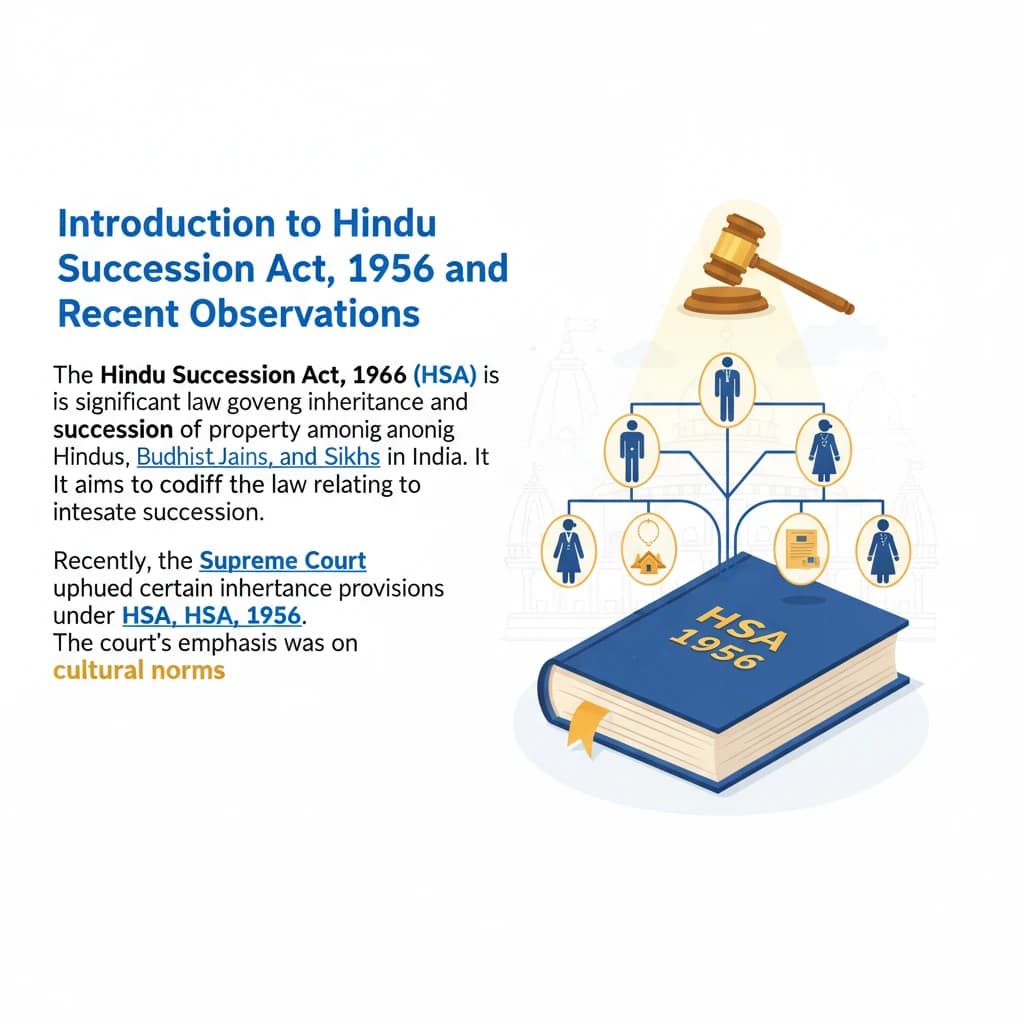
Inheritance Norms in Hindu Succession Act, 1956
Medium⏱️ 10 min read
social issues
📖 Introduction
Supreme Court's Stance on Inheritance Norms
The Supreme Court of India recently upheld the existing inheritance provisions under the Hindu Succession Act, 1956 (HSA). This ruling emphasized the importance of cultural norms and legislative consistency.
The court clarified that inheritance should not be viewed solely through the lens of gender inequality. This stance came in response to several petitions challenging the Act's validity, which argued for more equitable treatment of men and women in inheritance matters.
The Supreme Court affirmed that inheritance laws reflect broader societal values and should not be framed exclusively as a gender equality issue, considering the deeply rooted cultural context.
Cultural Context of Hindu Inheritance Practices
The court highlighted that Hindu inheritance practices are deeply intertwined with cultural values. These values have traditionally influenced how property is inherited and devolved within families.
A significant aspect of these traditional sentiments is the notion that a married woman's parents typically do not interfere with or claim rights over her inherited properties. This reflects a specific societal understanding of marital and familial ties.
Scientific and Logical Lineage Framework
The Hindu Succession Act was upheld for its 'scientific and logical' framework regarding property devolution. This framework ensures that property acquired by a woman from her parents or in-laws returns to the original source family.
HSA's Devolution Principle: In the absence of direct heirs (children, husband), property inherited by a woman from her parents or in-laws reverts to the respective source family. This maintains an ancestral lineage-based approach.
Need for Legislative Change by Parliament
The Supreme Court reiterated that any modifications to inheritance laws must be initiated and enacted by Parliament, the legislative body. Judicial decisions are not the appropriate mechanism for such widespread societal changes.
This is because inheritance laws profoundly affect the entire society. Therefore, any amendments must reflect a broad societal agreement and collective values, rather than being influenced by the concerns of a few individuals or specific disputes.
UPSC Insight: This ruling underscores the principle of separation of powers, particularly the distinction between the roles of the judiciary and the legislature in enacting social reforms. It's crucial for GS-II (Polity & Governance).
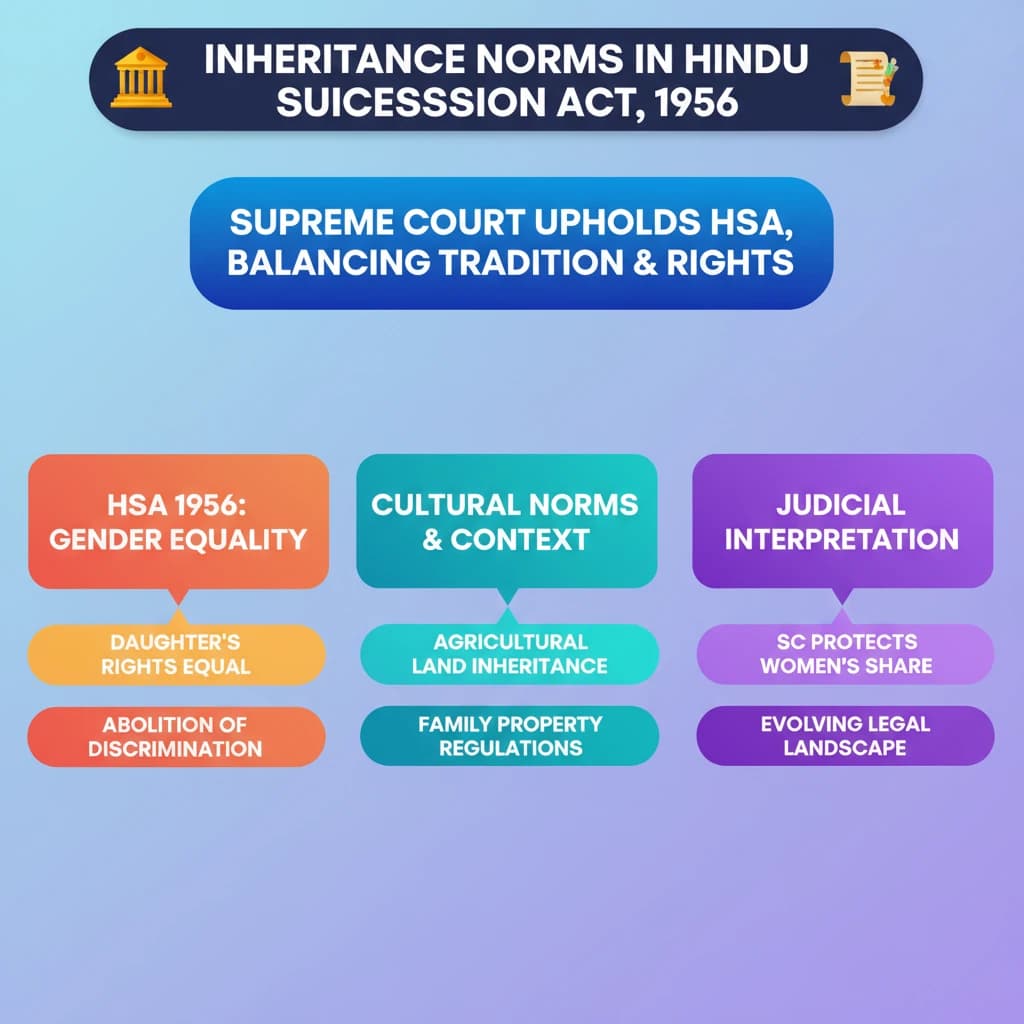
💡 Key Takeaways
- •Supreme Court upheld Hindu Succession Act, 1956 (HSA) inheritance provisions, emphasizing cultural norms.
- •Court clarified inheritance laws are not solely a gender equality issue but reflect deep cultural values.
- •HSA's framework ensures property inherited by a woman from parents/in-laws returns to source family if no direct heirs.
- •Legislative changes to inheritance laws are Parliament's domain, not the judiciary's, due to societal impact.
- •The ruling highlights the balance between legal reform, cultural sentiments, and democratic legislative processes.
🧠 Memory Techniques
98% Verified Content
📚 Reference Sources
•Hindu Succession Act, 1956 (as amended)
•Supreme Court of India judgments (general understanding of recent pronouncements)