Loading page, please wait…
Offence of ‘Abetment of Suicide’ - UPSC Social Issues
What is Offence of ‘Abetment of Suicide’ in UPSC Social Issues?
Offence of ‘Abetment of Suicide’ is a key topic under Social Issues for UPSC Civil Services Examination. Key points include: Abetment of Suicide is an offense under Section 306 IPC (now Section 108 BNS).. Punishment includes up to 10 years imprisonment and a fine.. BNS Section 45 defines abetment as instigation, conspiracy, or intentional aid.. Understanding this topic is essential for both UPSC Prelims and Mains preparation.
Why is Offence of ‘Abetment of Suicide’ important for UPSC exam?
Offence of ‘Abetment of Suicide’ is a Medium-level topic in UPSC Social Issues. It is tested in both Prelims (factual MCQs) and Mains (analytical answer writing). Previous year UPSC questions have frequently covered aspects of Offence of ‘Abetment of Suicide’, making it essential for comprehensive IAS preparation.
How to prepare Offence of ‘Abetment of Suicide’ for UPSC?
To prepare Offence of ‘Abetment of Suicide’ for UPSC: (1) Study the comprehensive notes covering all key concepts on Vaidra. (2) Practice previous year questions on this topic. (3) Connect it with current affairs using daily updates. (4) Revise using key takeaways and mind maps available for Social Issues. (5) Write practice answers linking Offence of ‘Abetment of Suicide’ to related GS Paper topics.
Key takeaways of Offence of ‘Abetment of Suicide’ for UPSC
- Abetment of Suicide is an offense under Section 306 IPC (now Section 108 BNS).
- Punishment includes up to 10 years imprisonment and a fine.
- BNS Section 45 defines abetment as instigation, conspiracy, or intentional aid.
- Supreme Court requires 'direct and alarming encouragement or incitement' leaving 'no option but fatal step'.
- Guidelines focus on 'unbearable harassment' or 'emotional exploitation' as direct drivers.
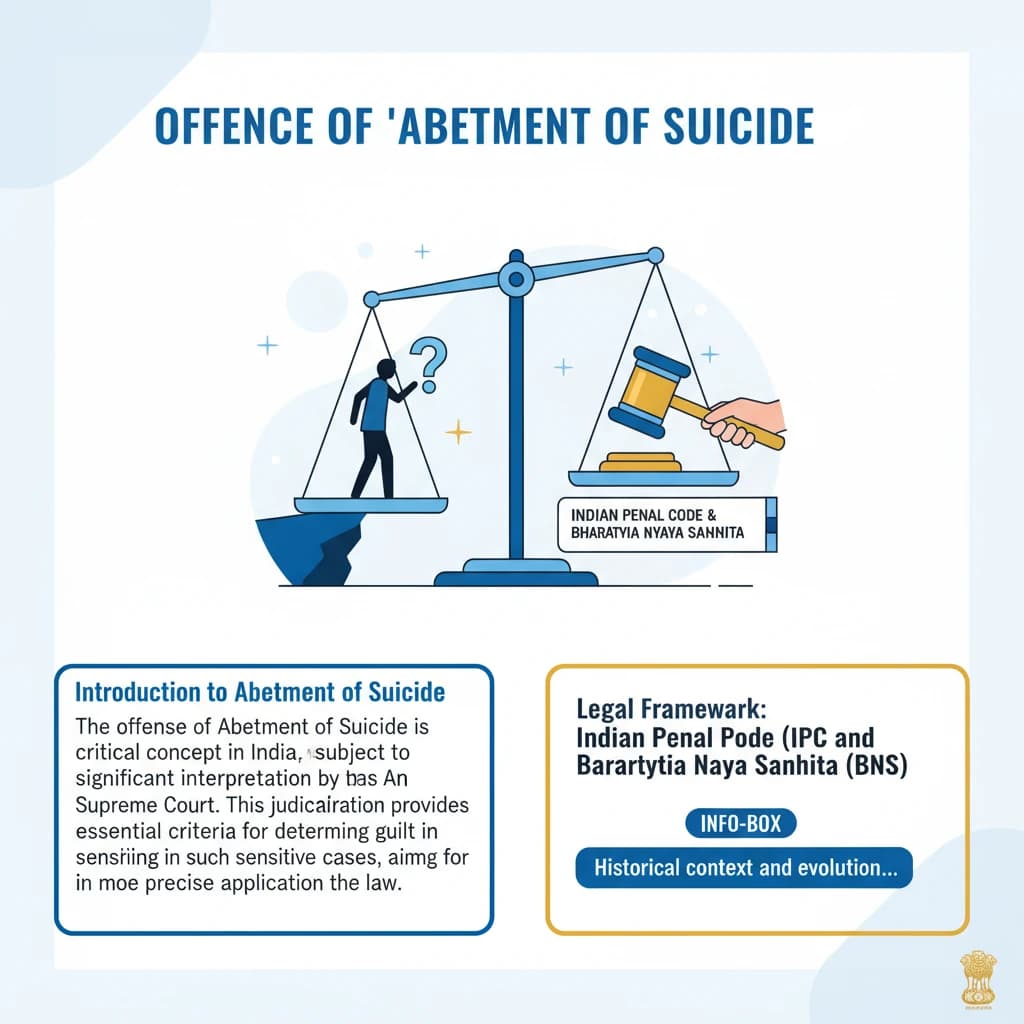
Offence of ‘Abetment of Suicide’
Medium⏱️ 6 min read
social issues
📖 Introduction
Introduction to Abetment of Suicide
The offense of Abetment of Suicide is a critical legal concept in India, recently subject to significant interpretation by the Supreme Court.
This judicial clarification provides essential criteria for determining guilt in such sensitive cases, aiming for a more precise application of the law.
Legal Framework: Indian Penal Code (IPC) and Bharatiya Nyaya Sanhita (BNS)
Historically, Abetment of Suicide has been codified as an offense under Section 306 of the Indian Penal Code (IPC).
With the recent overhaul of criminal laws, this offense is now designated under Section 108 of the newly enacted Bharatiya Nyaya Sanhita (BNS).
The law prescribes stringent penalties for individuals found guilty of instigating or aiding someone to commit suicide.
The punishment for this crime can extend up to 10 years of imprisonment and also includes the imposition of a fine.
Defining Abetment under Bharatiya Nyaya Sanhita (BNS)
The Bharatiya Nyaya Sanhita (BNS), specifically in Section 45, offers a detailed definition of what constitutes abetment.
It outlines three primary modes through which a person can be deemed to have abetted the commission of an act, including suicide:
- Instigation: When a person actively instigates or provokes another to commit suicide.
- Conspiracy: When a person conspires with others to engage in an act or omission that leads to the illegal act of suicide.
- Intentional Aid: When a person intentionally aids, by any act or illegal omission, in the commission of suicide.
Supreme Court's Interpretation of Abetment of Suicide
The Supreme Court has provided a crucial interpretation, emphasizing the high threshold required to establish the offense of abetment of suicide.
The Court stated that the offense necessitates “direct and alarming encouragement or incitement” that is so overwhelming it leaves the victim with “no option but fatal step”.
This interpretation underscores that mere harassment or emotional distress, without a direct and proximate link to the deceased's decision, may not automatically constitute abetment.
Guidelines for Determining Guilt
To ensure fair judgment, the Supreme Court has laid down specific guidelines for assessing cases of alleged abetment.
These guidelines focus on identifying situations that involve unbearable harassment or profound emotional exploitation, directly compelling the deceased to take their own life.
UPSC Insight: Understanding the Supreme Court's nuanced interpretation is vital for Mains answers, particularly in GS Paper II (Polity & Governance) and GS Paper IV (Ethics), where judicial precedents and their societal implications are discussed.
💡 Key Takeaways
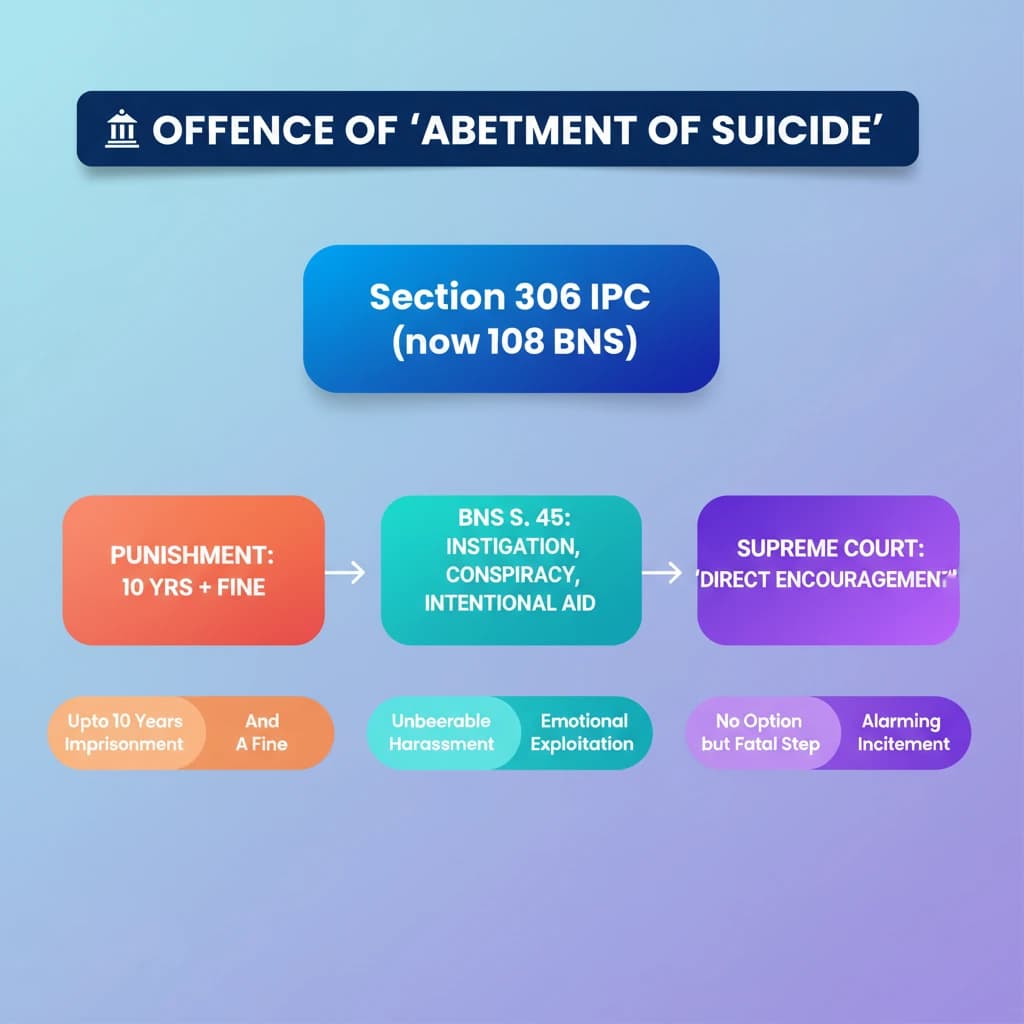
- •Abetment of Suicide is an offense under Section 306 IPC (now Section 108 BNS).
- •Punishment includes up to 10 years imprisonment and a fine.
- •BNS Section 45 defines abetment as instigation, conspiracy, or intentional aid.
- •Supreme Court requires 'direct and alarming encouragement or incitement' leaving 'no option but fatal step'.
- •Guidelines focus on 'unbearable harassment' or 'emotional exploitation' as direct drivers.
🧠 Memory Techniques
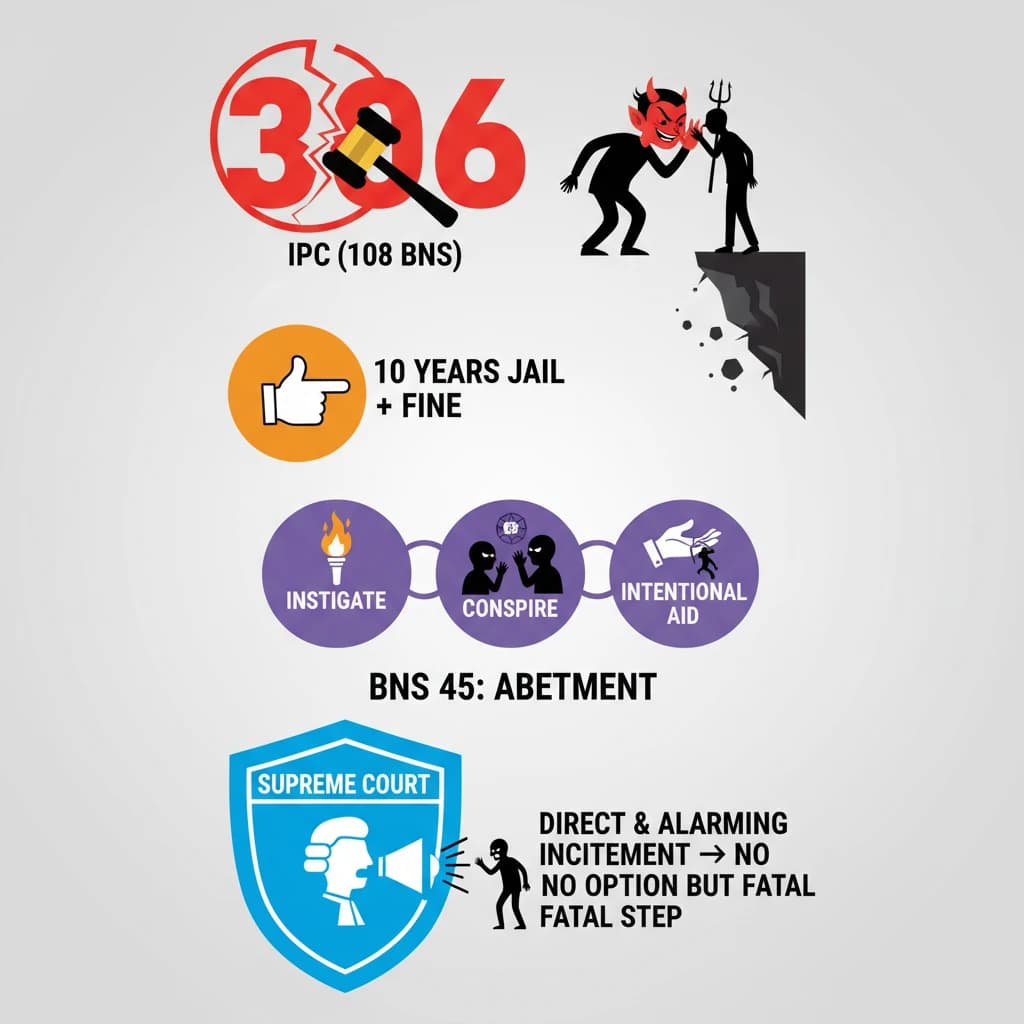
98% Verified Content
📚 Reference Sources
•The Indian Penal Code, 1860 (IPC)
•The Bharatiya Nyaya Sanhita, 2023 (BNS)
•Supreme Court of India judgments (general interpretation principles)