Loading page, please wait…
SBM Reduced Infant and Child Mortality - UPSC Social Issues
What is SBM Reduced Infant and Child Mortality in UPSC Social Issues?
SBM Reduced Infant and Child Mortality is a key topic under Social Issues for UPSC Civil Services Examination. Key points include: The Swachh Bharat Mission (SBM) potentially averted 60,000-70,000 infant deaths annually between 2011-2020.. A study in 'Nature' journal confirmed SBM's significant positive impact on Infant Mortality Rate (IMR) and Under-Five Mortality Rate (U5MR).. Post-SBM, India witnessed an accelerated IMR decline of 8-9% annually, compared to 3% pre-SBM.. Understanding this topic is essential for both UPSC Prelims and Mains preparation.
Why is SBM Reduced Infant and Child Mortality important for UPSC exam?
SBM Reduced Infant and Child Mortality is a Medium-level topic in UPSC Social Issues. It is tested in both Prelims (factual MCQs) and Mains (analytical answer writing). Previous year UPSC questions have frequently covered aspects of SBM Reduced Infant and Child Mortality, making it essential for comprehensive IAS preparation.
How to prepare SBM Reduced Infant and Child Mortality for UPSC?
To prepare SBM Reduced Infant and Child Mortality for UPSC: (1) Study the comprehensive notes covering all key concepts on Vaidra. (2) Practice previous year questions on this topic. (3) Connect it with current affairs using daily updates. (4) Revise using key takeaways and mind maps available for Social Issues. (5) Write practice answers linking SBM Reduced Infant and Child Mortality to related GS Paper topics.
Key takeaways of SBM Reduced Infant and Child Mortality for UPSC
- The Swachh Bharat Mission (SBM) potentially averted 60,000-70,000 infant deaths annually between 2011-2020.
- A study in 'Nature' journal confirmed SBM's significant positive impact on Infant Mortality Rate (IMR) and Under-Five Mortality Rate (U5MR).
- Post-SBM, India witnessed an accelerated IMR decline of 8-9% annually, compared to 3% pre-SBM.
- Every 10% increase in toilet access correlated with a reduction of 0.9 points in IMR and 1.1 points in U5MR.
- SBM's success was driven by a comprehensive approach combining toilet construction (109 million) with Information, Education, and Communication (IEC) and community engagement.
- Open defecation significantly declined from 60% to 19% in the first five years of SBM.
SBM Reduced Infant and Child Mortality
Medium⏱️ 5 min read
social issues
📖 Introduction
Introduction to the Study
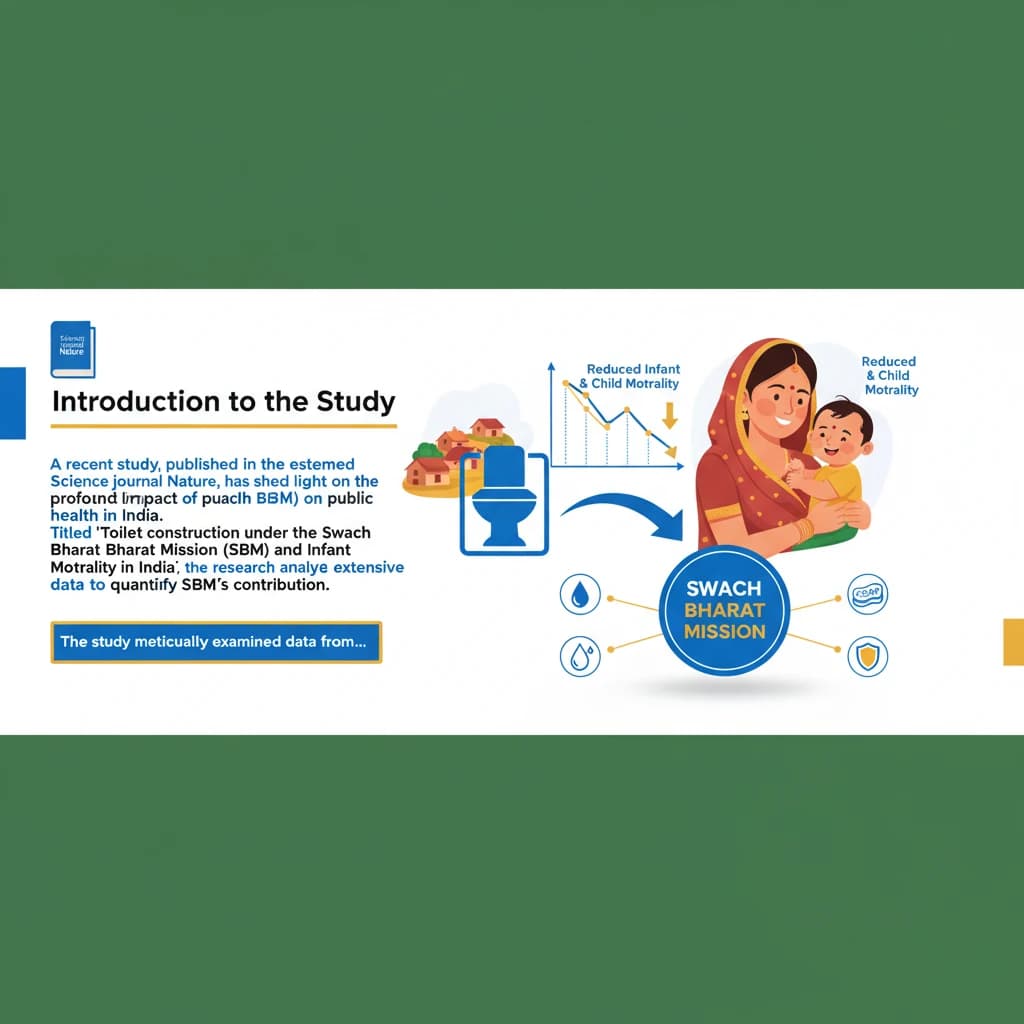
A recent study, published in the esteemed Science journal Nature, has shed light on the profound impact of the Swachh Bharat Mission (SBM) on public health in India.
Titled 'Toilet construction under the Swachh Bharat Mission (SBM) and Infant Mortality in India', the research analyzed extensive data to quantify SBM's contribution.
The study meticulously examined data from 35 states/Union territories and over 600 districts across India, covering the period between 2011 and 2020.
Significant Reduction in Infant and Child Mortality
The findings indicate a substantial positive correlation between SBM's initiatives and a reduction in mortality rates among infants and young children.
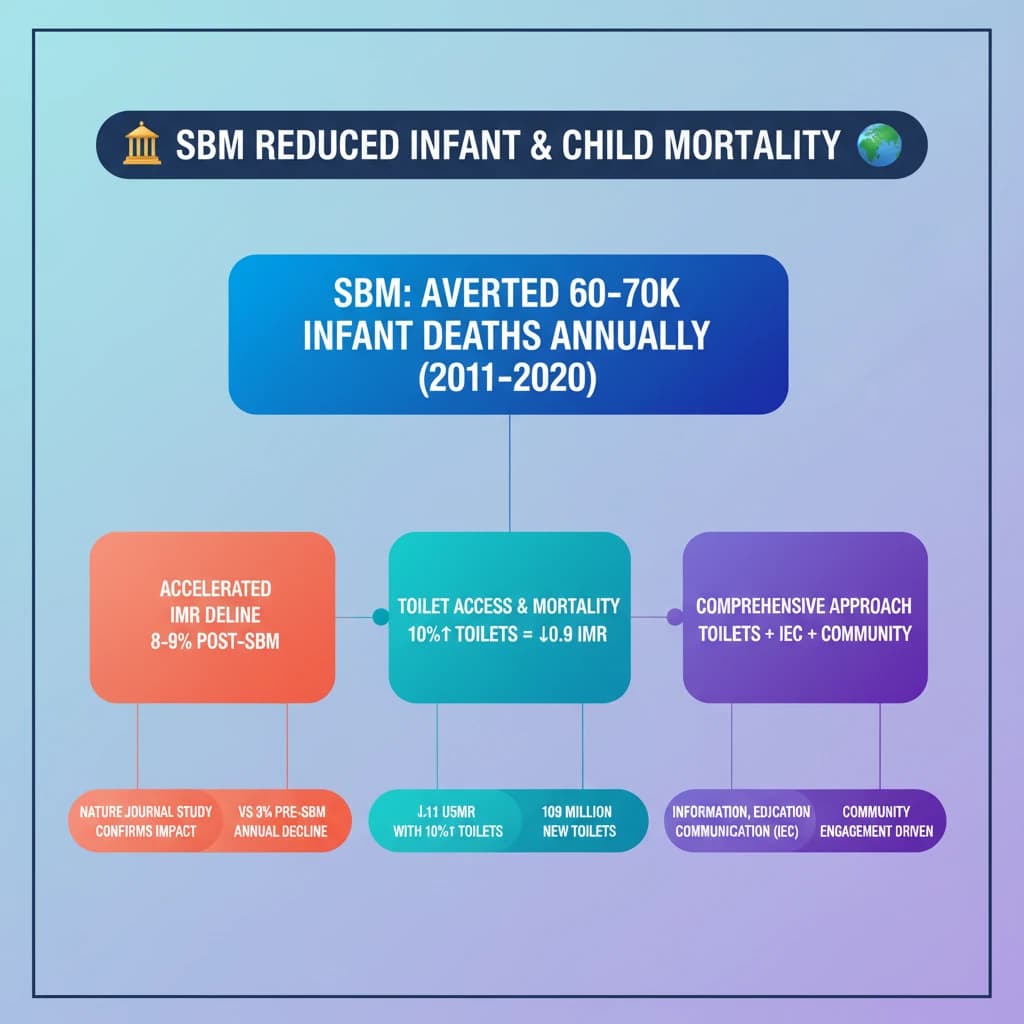
The Swachh Bharat Mission (SBM) is estimated to have potentially averted between 60,000–70,000 infant deaths annually during the 2011–2020 period.
Impact in High-Access Districts
Specific areas that saw greater implementation of SBM's toilet construction efforts demonstrated even more pronounced health improvements.
Districts where over 30% of toilets were constructed under SBM experienced 5.3 fewer infant deaths and 6.8 fewer child deaths per 1,000 live births.
Correlation with Increased Toilet Access
The study also established a clear quantitative relationship between improved toilet access and declining mortality rates.
Every 10% increase in district-level toilet access post-SBM correlated with a reduction in the Infant Mortality Rate (IMR) by 0.9 points and the Under-Five Mortality Rate (U5MR) by 1.1 points on average.
Accelerated Decline in Infant Mortality Rate (IMR)
The period following the launch of SBM witnessed a significant acceleration in the rate of IMR reduction compared to previous years.
During the post-SBM period, IMR reductions accelerated to an 8–9% annual decline, a stark contrast to the 3% annual decline observed in the pre-SBM period (2000–2014).
Expansion of Toilet Availability and ODF Status
The mission achieved remarkable success in expanding sanitation infrastructure across the country.
The availability of toilets increased twofold, and the practice of open defecation declined dramatically from 60% to 19% within the first five years of SBM's implementation.
From 2014 to 2020, the government constructed a staggering 109 million household toilets and declared that more than 600,000 villages are Open Defecation Free (ODF).
Swachh Bharat Mission's Holistic Approach
The success of SBM is attributed not just to infrastructure development but also to its comprehensive strategy.
SBM's unique approach combined large-scale toilet construction with substantial investments in IEC (Information, Education, and Communication) and robust community engagement, representing a holistic strategy to combat open defecation.
💡 Key Takeaways
- •The Swachh Bharat Mission (SBM) potentially averted 60,000-70,000 infant deaths annually between 2011-2020.
- •A study in 'Nature' journal confirmed SBM's significant positive impact on Infant Mortality Rate (IMR) and Under-Five Mortality Rate (U5MR).
- •Post-SBM, India witnessed an accelerated IMR decline of 8-9% annually, compared to 3% pre-SBM.
- •Every 10% increase in toilet access correlated with a reduction of 0.9 points in IMR and 1.1 points in U5MR.
- •SBM's success was driven by a comprehensive approach combining toilet construction (109 million) with Information, Education, and Communication (IEC) and community engagement.
- •Open defecation significantly declined from 60% to 19% in the first five years of SBM.
🧠 Memory Techniques

95% Verified Content
📚 Reference Sources
•Nature journal study: 'Toilet construction under the Swachh Bharat Mission (SBM) and Infant Mortality in India'