Loading page, please wait…
What are the Constitutional Provisions Related to Reservations in India? - UPSC Social Issues
What is What are the Constitutional Provisions Related to Reservations in India? in UPSC Social Issues?
What are the Constitutional Provisions Related to Reservations in India? is a key topic under Social Issues for UPSC Civil Services Examination. Key points include: Part XVI deals with SC/ST reservation in Central and State legislatures.. Article 15 empowers the State to make special provisions to prevent discrimination and promote advancement.. Article 15(3) allows special provisions for women and children.. Understanding this topic is essential for both UPSC Prelims and Mains preparation.
Why is What are the Constitutional Provisions Related to Reservations in India? important for UPSC exam?
What are the Constitutional Provisions Related to Reservations in India? is a Medium-level topic in UPSC Social Issues. It is tested in both Prelims (factual MCQs) and Mains (analytical answer writing). Previous year UPSC questions have frequently covered aspects of What are the Constitutional Provisions Related to Reservations in India?, making it essential for comprehensive IAS preparation.
How to prepare What are the Constitutional Provisions Related to Reservations in India? for UPSC?
To prepare What are the Constitutional Provisions Related to Reservations in India? for UPSC: (1) Study the comprehensive notes covering all key concepts on Vaidra. (2) Practice previous year questions on this topic. (3) Connect it with current affairs using daily updates. (4) Revise using key takeaways and mind maps available for Social Issues. (5) Write practice answers linking What are the Constitutional Provisions Related to Reservations in India? to related GS Paper topics.
Key takeaways of What are the Constitutional Provisions Related to Reservations in India? for UPSC
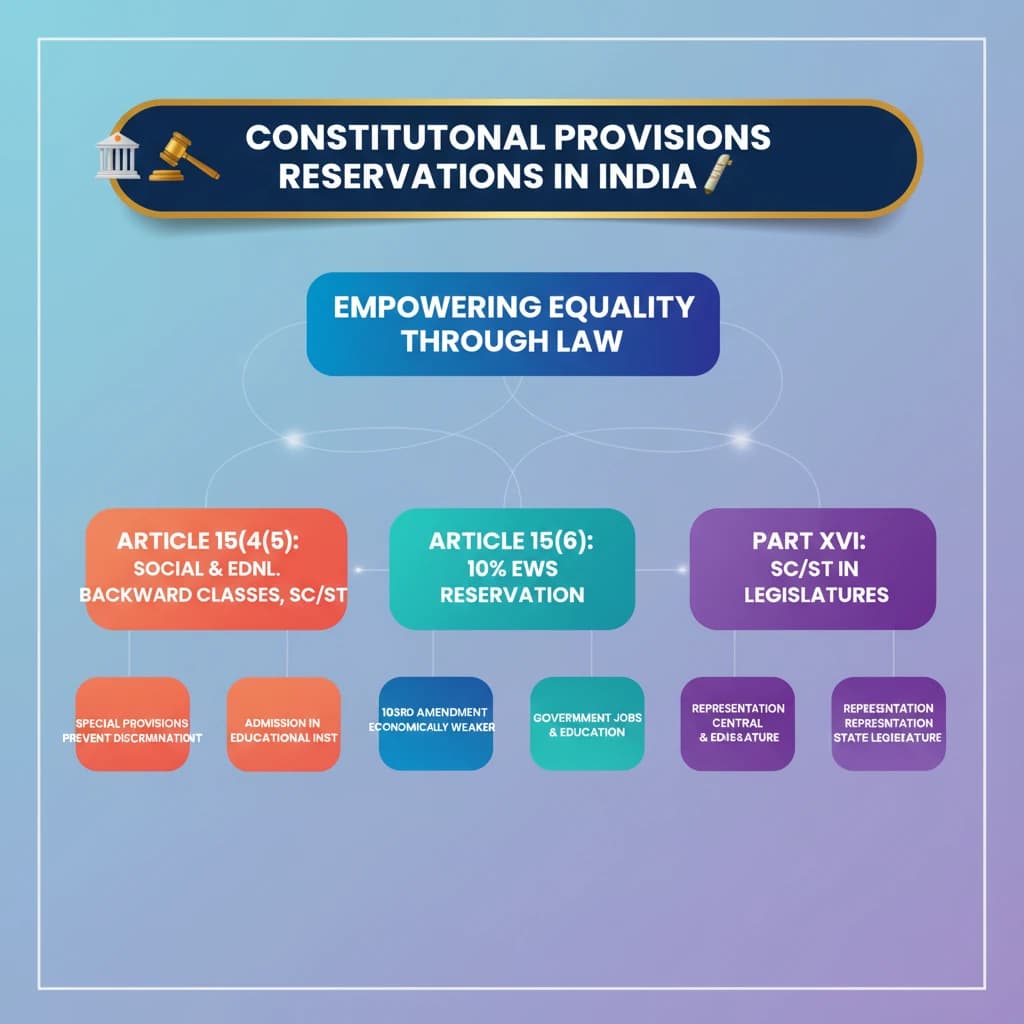
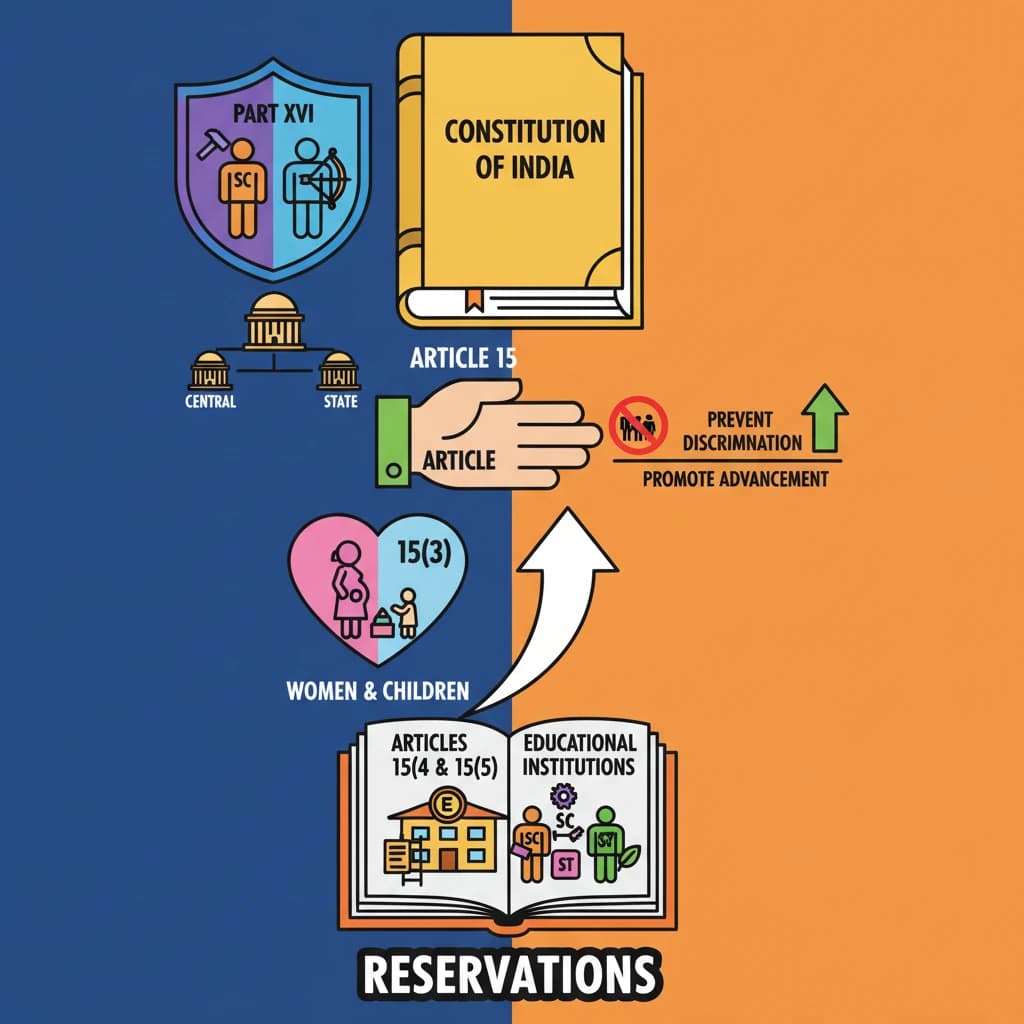
- Part XVI deals with SC/ST reservation in Central and State legislatures.
- Article 15 empowers the State to make special provisions to prevent discrimination and promote advancement.
- Article 15(3) allows special provisions for women and children.
- Articles 15(4) and 15(5) enable reservations for socially and educationally backward classes, SCs, and STs in educational institutions.
- Article 15(6) provides for 10% reservation for Economically Weaker Sections (EWS), introduced by the 103rd Amendment.
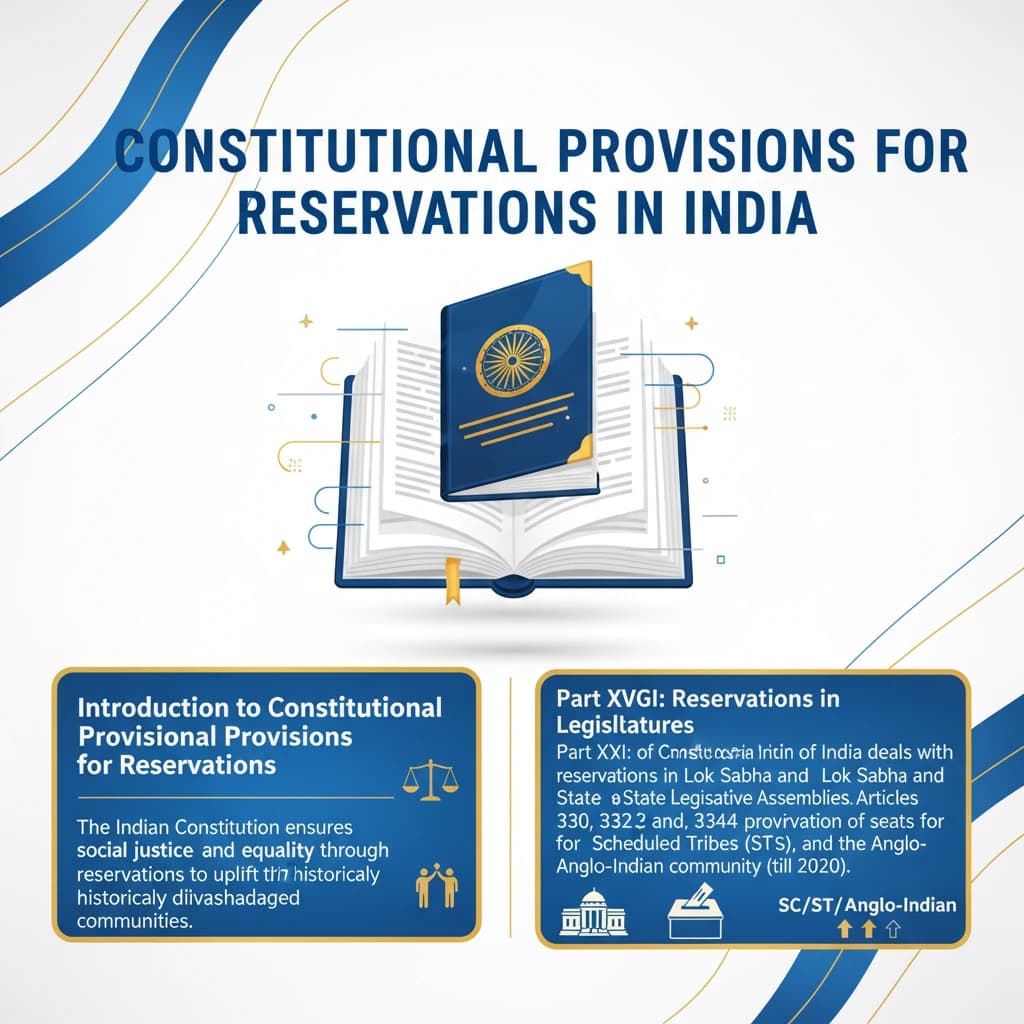
What are the Constitutional Provisions Related to Reservations in India?
Medium⏱️ 7 min read
social issues
📖 Introduction
Introduction to Constitutional Provisions for Reservations
The Indian Constitution includes specific provisions to ensure social justice and equality through the mechanism of reservations. These provisions are designed to uplift historically disadvantaged communities and ensure their representation in various spheres.
Part XVI: Reservations in Legislatures
Part XVI of the Constitution of India is dedicated to addressing the reservation of seats for Scheduled Castes (SC) and Scheduled Tribes (ST). This applies to both the Central (Parliament) and State legislatures (Vidhan Sabhas).
These provisions aim to ensure adequate political representation for these communities, allowing their voices to be heard in the law-making process.
Article 15: State's Power to Make Special Provisions
Article 15 of the Constitution is a fundamental right that prohibits discrimination on grounds of religion, race, caste, sex, or place of birth. However, it also empowers the State to make certain special provisions.
This empowerment allows the State to implement policies of affirmative action, ensuring that the principle of equality is not merely formal but substantive.
Article 15(3): Special Provisions for Women and Children
Article 15(3) specifically permits the State to make special provisions for the welfare and advancement of women and children. This clause recognizes their unique vulnerabilities and needs.
Examples include reservations in local bodies for women or special educational schemes for children.
Articles 15(4) & 15(5): Advancement of Backward Classes, SCs, and STs
Article 15(4) and Article 15(5) are crucial for the advancement of socially and educationally backward classes of citizens, as well as for Scheduled Castes (SCs) and Scheduled Tribes (STs).
These clauses enable the State to make special provisions, including those related to their admission to educational institutions. This power extends to admissions in private educational institutions, whether aided or unaided by the State, except for minority educational institutions.
Article 15(4) was added by the First Constitutional Amendment Act, 1951, in response to the Champakam Dorairajan case, highlighting the dynamic nature of constitutional interpretation.
Article 15(6): Provisions for Economically Weaker Sections (EWS)
Introduced by the 103rd Constitutional Amendment Act, 2019, Article 15(6) allows the State to make special provisions for the advancement of Economically Weaker Sections (EWS) of citizens.
This provision applies to sections other than those already covered under clauses (4) and (5). It allows for reservations based purely on economic criteria, typically up to 10% in educational institutions and public employment.
💡 Key Takeaways
- •Part XVI deals with SC/ST reservation in Central and State legislatures.
- •Article 15 empowers the State to make special provisions to prevent discrimination and promote advancement.
- •Article 15(3) allows special provisions for women and children.
- •Articles 15(4) and 15(5) enable reservations for socially and educationally backward classes, SCs, and STs in educational institutions.
- •Article 15(6) provides for 10% reservation for Economically Weaker Sections (EWS), introduced by the 103rd Amendment.
🧠 Memory Techniques
98% Verified Content
📚 Reference Sources
•Ministry of Law and Justice, Government of India publications
•Reports of the Law Commission of India
•Supreme Court of India judgments on reservation cases