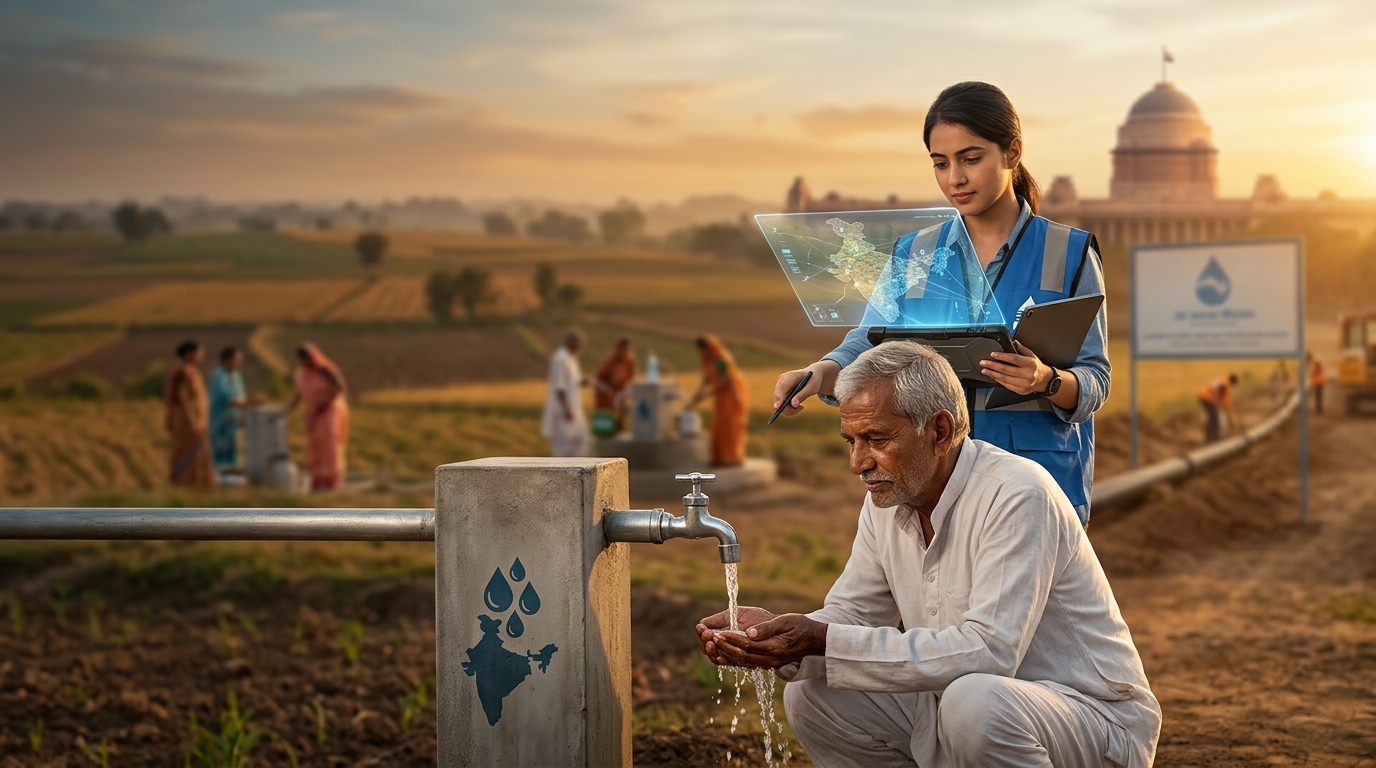
Centre Tightens Oversight of Jal Jeevan Mission 2.0 with Rs 1.51 Lakh Crore Allocation and Digital Mapping — UPSC Current Affairs | March 25, 2026
Centre Tightens Oversight of Jal Jeevan Mission 2.0 with Rs 1.51 Lakh Crore Allocation and Digital Mapping
The Union government is tightening oversight of the <span class="key-term" data-definition="Jal Jeevan Mission (JJM) — a flagship water‑sector scheme launched on 15 August 2019 to provide every rural household with at least 55 litres of safe drinking water per day through tap connections (GS3: Water Resources, Rural Development).">Jal Jeevan Mission</span> 2.0 by scrutinising projects above Rs 100 crore, linking central funds to four compliance conditions, and allocating an additional Rs 1.51 lakh crore with a nationwide digital mapping framework called <span class="key-term" data-definition="Sujal Bharat — a uniform national digital platform that assigns a unique Sujal Gaon ID to each village, mapping the entire rural water supply chain from source to tap (GS3: Water Resources, Governance).">Sujal Bharat</span>. These steps aim to curb cost overruns, improve transparency, and ensure sustainable rural drinking water supply, a key topic for UPSC aspirants.
Overview Amid rising concerns over cost escalations in the first phase of the Jal Jeevan Mission (JJM), the Union government has introduced a stricter compliance regime for the revamped JJM 2.0 . The move, announced on World Water Day (22 March), couples an extra allocation of Rs 1.51 lakh crore with a digital mapping system called Sujal Bharat . The objective is to ensure transparency, curb irregularities, and meet the extended 2028 deadline for universal rural tap water. Key Developments (March 2026) The Centre will scrutinise any JJM project costing more than Rs 100 crore before releasing central funds to states. Four mandatory compliance conditions have been framed: signing a MoU , creation of Sujal Gaon ID , timely financial reconciliation, and notification of state operation & maintenance (O&M) policies. By 20 March, eight states—including Uttar Pradesh, Madhya Pradesh, Rajasthan, Maharashtra, and Gujarat —had signed the required MoUs. The Union Cabinet approved an additional Rs 1.51 lakh crore for JJM 2.0, earmarked for digital mapping, structural reforms, and capacity building. A national digital framework, Sujal Bharat , will be set up to monitor the supply system “from source to tap”. Important Structural Reforms The MoUs cover eleven reform areas aimed at strengthening governance and sustainability of rural drinking water systems. Highlights include: Institutional architecture for drinking‑water governance. Service‑utility framework for rural water supply. Citizen‑centric water‑quality monitoring. Source‑sustainability and water‑security framework. Digital data governance and participatory “Jan Bhagidari” mechanisms. Capacity‑building, human‑resource skilling, and research‑innovation ecosystems. Constitutional Context (GS1 & GS3) Water‑related rights and governance have constitutional underpinnings: Article 21 has been read to encompass the right to safe water, as affirmed in cases like Narmada Bachao Andolan v. Union of India (2000). Article 262 provides the legal basis for resolving inter‑state water conflicts. Entry 17 of the State List (List II) places water‑supply, irrigation, and canals under state jurisdiction, while Entry 56 of the Union List (List I) reserves regulation of inter‑state rivers for the Centre. UPSC Relevance Understanding JJM 2.0 is crucial for several UPSC topics: GS‑3 (Water Resources & Rural Development): Scheme objectives, funding patterns, and digital governance mechanisms. GS‑2 (Polity): Centre‑state financial relations, MoU‑based compliance, and the role of the Ministry of Jal Shakti . GS‑1 (Constitution): Articles 21, 262 and the division of powers on water between Union and states. GS‑4 (Ethics & Governance): Transparency, accountability, and citizen participation through “Jan Bhagidari”. Way Forward For effective implementation, aspirants should monitor: State‑wise progress on MoU signing and Sujal Gaon ID generation. Utilisation of the additional Rs 1.51 lakh crore and its impact on cost overruns. Integration of Inter‑State River Water Disputes Act mechanisms with JJM’s source‑sustainability goals. Feedback loops from Gram Panchayats and Village Water & Sanitation Committees on scheme completion and “Har Ghar Jal” certification. By linking financial disbursement to concrete compliance metrics and a robust digital platform, the Centre aims to achieve the mission’s 2028 target of universal rural tap water, a benchmark that will feature prominently in future UPSC examinations.
Login to bookmark articles
Login to mark articles as complete
Overview
JJM 2.0’s Rs 1.51 Lakh Crore boost ties funds to digital compliance, tightening Centre‑State oversight
Key Facts
22 Mar 2026 (World Water Day): Union Cabinet approved an additional Rs 1.51 lakh crore for Jal Jeevan Mission 2.0.
Any JJM project exceeding Rs 100 crore will be cleared by the Centre before central funds are released to states.
Four mandatory compliance conditions for states: signing a MoU, creation of Sujal Gaon ID, timely financial reconciliation, and notification of O&M policies.
By 20 Mar 2026, eight states – Uttar Pradesh, Madhya Pradesh, Rajasthan, Maharashtra, Gujarat, Karnataka, Tamil Nadu and West Bengal – had signed the required MoUs.
Sujal Bharat, a national digital platform, will assign a unique Sujal Gaon ID to every village for end‑to‑end mapping of rural piped‑water assets.
MoUs encompass 11 reform areas such as institutional architecture, citizen‑centric water‑quality monitoring, source‑sustainability, digital data governance and Jan Bhagidari.
Constitutional anchors: Article 21 (right to safe water), Article 262 (inter‑state river disputes), State List Entry 17 (water‑supply) and Union List Entry 56 (inter‑state rivers).
Background & Context
The enhanced funding and digital oversight aim to curb cost overruns witnessed in JJM’s first phase and to ensure transparent, accountable delivery of safe drinking water to every rural household by 2028. This aligns with GS‑3 themes of water security, rural development, and the use of technology in governance, while also touching upon GS‑2 centre‑state fiscal relations and GS‑1 constitutional provisions on the right to water.
UPSC Syllabus Connections
Prelims_GS•Constitution and Political SystemPrelims_GS•National Current AffairsGS2•Government policies and interventions for developmentEssay•Environment and SustainabilityEssay•Economy, Development and InequalityGS2•Functions and responsibilities of Union and StatesGS1•Poverty and Developmental IssuesGS4•Accountability, ethical governance and strengthening moral valuesGS4•Dimensions of ethics - private and public relationshipsPrelims_GS•Public Policy and Rights Issues
Mains Answer Angle
In a Mains answer, JJM 2.0 can be examined as a case of integrated water‑security policy where financial incentives are linked to compliance mechanisms and digital monitoring, testing the candidate’s grasp of governance reforms, fiscal federalism and constitutional dimensions (GS‑3, GS‑2, GS‑1).