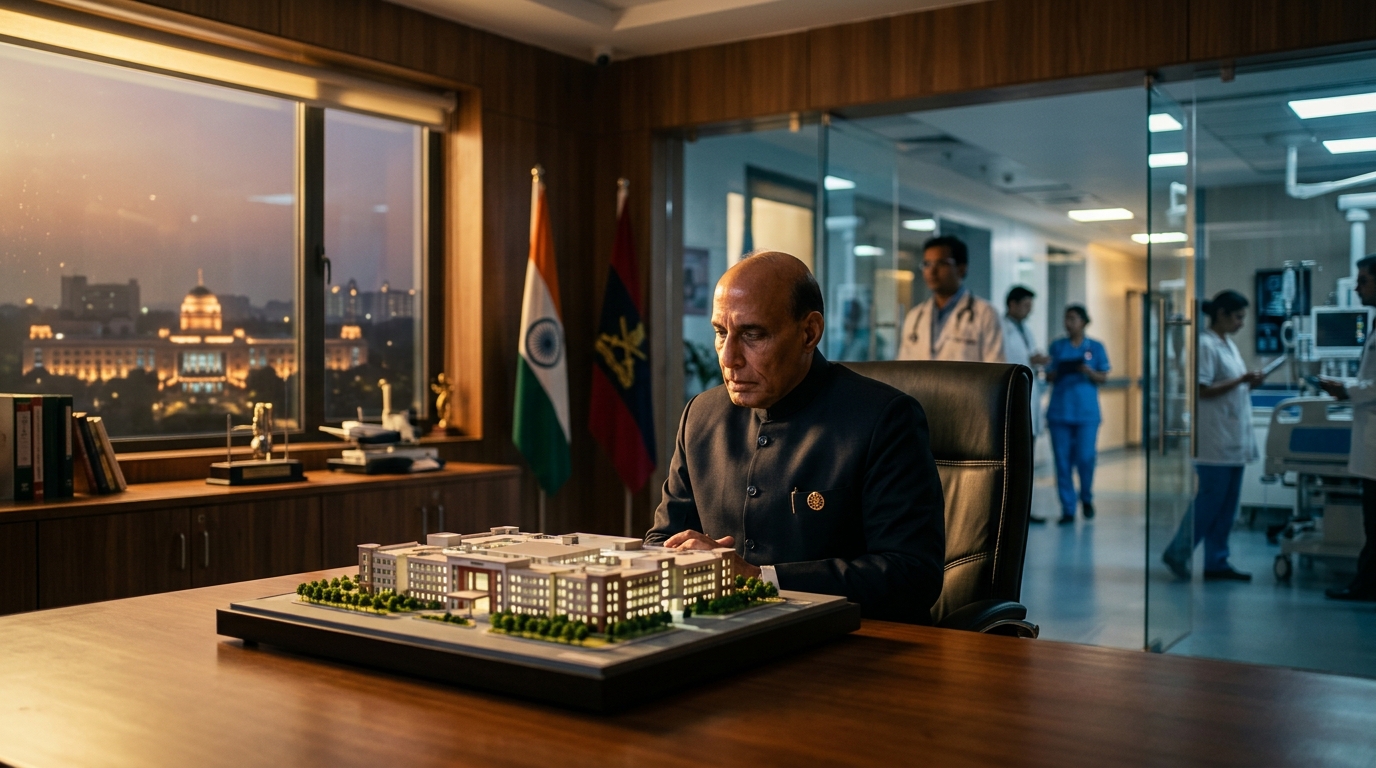
Ministry of DefenceThe new facilities, equipped with latest technologies, to provide quality medical care to serving personnel, veterans & their dependentsInnovation, capacity building & integration of advanced tech must to meet emerging military medicine challenges: Shri Rajnath Singh“Military medical services within the country & neighboring nations have emerged as a powerful testament to India’s soft power”“AFMS must focus on research, achieving self-reliance in pharmaceuticals & reforms within clinical trial framework”Posted On:06 APR 2026 3:24PM by PIB DelhiRaksha Mantri Shri Rajnath Singh, on April 06, 2026, laid the foundation stones of Ophthalmology, Oncology and Joint Replacement Centres at Army Hospital (Research & Referral) and new infrastructure at Base Hospital, Delhi Cantt as part of the 262nd Army Medical Corps Raising Day celebrations. The state-of-the-art facilities at Army Hospital (Research & Referral) are envisaged to significantly enhance the tertiary care capabilities of the Armed Forces Medical Services (AFMS), particularly in the domains of advanced eye care, cancer treatment, and complex joint replacement surgeries, while the new hospital infrastructure at Base Hospital is being developed with a capacity of 998 beds along with an additional 100 crisis expansion beds, to address routine and emergency healthcare requirements of the Defence Forces personnel .In his address, Raksha Mantri underlined the importance of continued innovation, capacity building, and integration of modern technologies to meet the emerging challenges in military medicine. He exuded confidence that the new facilities, equipped with modern technologies and infrastructure, will provide quality medical care to the serving personnel, veterans & their dependents.Shri Rajnath Singh commended the dedication, professionalism, and compassion of the AFMS personnel for rendering services to every nook and corner of the country, from towering mountains to inaccessible forests, from times of peace to moments of disaster. He appreciated them for organising medical camps across the country and neighboring nations, including Nepal, while specially mentioning the successful conduct of Cataract and Glaucoma surgeries and eye care services. “Such initiatives strengthen our ties with friendly nations while simultaneously bringing about positive transformations in the lives of people. Your services have emerged as a powerful testament to India's 'soft power’,” he said.While Raksha Mantri reiterated the Government’s commitment to providing world-class healthcare facilities for the soldiers & their families, and termed it as top priority, he exhorted AFMS to lay special emphasis on ‘research’, stressing on the integration of modern medical science with ancient philosophy to present a truly effective healthcare model to the public. “Under the leadership of Prime Minister Shri Narendra Modi, the nation has made significant strides in the medical domain, from continuous expansion of healthcare infrastructure, increase in the number of institutions such as AIIMS to the access of healthcare facilities to everyone through the Ayushman Card, and advancements in fields such as cancer treatment, bypass surgery, and critical care. However, when it comes to frontier technologies and deep research, we still have a long journey ahead. For instance, in cancer research, specifically early detection technologies and personalised medicine, several countries are currently ahead of us. We also must further strengthen our capabilities in developing advanced predictive models for cardiovascular diseases, as well as in neuro-research related to mental health,” he said.Underscoring the importance of achieving self-reliance in the pharmaceuticals sector, Shri Rajnath Singh asserted that while India is a major global supplier of medicines, dependency on external sources remains evident in the fields of high-end drug innovation and original research. He highlighted the need to move beyond generic production and focus on fostering an innovation-driven pharmaceutical ecosystem. He added that concurrently, priority must be given to the discovery of new drugs, strengthening of clinical research, and adoption of global quality standards. He endorsed the integration of MSMEs and start-ups into the pharmaceutical innovation landscape, development of robust testing infrastructure, and cultivation of a skilled workforce. This approach will not only fulfill domestic requirements but also enable India to emerge as a global leader in these sectors, he said.Drawing attention on the crucial subject of clinical trials, Raksha Mantri said that clinical trials are industry-sponsored in many advanced nations, and equal emphasis is placed on research, treatment & innovation. He pointed out that while efforts in this direction are being made in India, there is a need for reforms within the clinical trial framework. “We must explore how AFMS can make a meaningful contribution in this domain, ensuring that our medical capabilities extend beyond mere curative treatment to encompass the creation of new knowledge,” he said.Shri Rajnath Singh also pitched for creating robust Standard Operating Procedures and standardised protocols for dissemination of clinical experience regarding a specific disease to other doctors and hospitals through systemic channels. “This would render faster, more efficient, and evidence-based treatment, enhancing not only individual capability but overall system efficiency. Establishing a national-level data pool would be a monumental step in this direction. It would provide better inputs for policy formulation, aid in validating new medical practices, and enable large-scale replication of effective treatments, thereby gradually transforming our healthcare system from a reactive into a proactive model,” he said.On the heavy workload in hospitals, Raksha Mantri stated that doctors remain constantly occupied with providing treatment & performing surgeries, and crucial aspects such as research, training, and teaching tend to take a backseat. This is a practical challenge that needs to be acknowledged, urging AFMS to explore ways to effectively balance the immense workload.Shri Rajnath Singh also urged AFMS to examine the feasibility of setting up institutions at par with Army Hospital (R&R) in all four corners of the country with the aim to provide the soldiers at every region and location, superior medical facilities. “It is not strictly necessary to establish a greenfield project or construct an entirely new institution. There are immense possibilities within brownfield projects. Command Hospitals or Base Hospitals at various locations can be upgraded with modern facilities and elevated to this very same standard,” he suggested.Raksha Mantri emphasised that in today’s context, ‘security’ encompasses far more than merely safeguarding borders, with health security holding equal significance. “Health security plays a pivotal role when we successfully execute major operations like Operation Sindoor. When our soldiers possess the confidence that superior medical support is available to them, they accomplish their missions without apprehension. Therefore, it is imperative to adopt a consistently proactive and positive approach toward health security,” he said.Shri Rajnath Singh stressed that the parameters of growth of a nation are not solely economic, but encompasses other significant dimensions; the most critical being the health of the people. “The medical sector needs to continuously understand these evolving challenges, address them effectively, and constantly update itself in sync with the changing times. We must move forward with a vision where progress is not confined merely to economic growth but is holistic in nature, where health is recognised as a central pillar of that development,” he said.Raksha Mantri concluded his address by acknowledging the services rendered by the nurses of the Military Nursing Service, who, he said, serve as the bedrock of the medical forces. He stated that the recent decision to grant them the status of ‘ex-servicemen’ upon retirement underlines the Government’s commitment towards the welfare of the defence forces personnel as well as medical professionals.As part of the visit, Shri Rajnath Singh witnessed a live demonstration and toured the Technology Exhibition area, where cutting-edge innovations and advancements in combat medical care were showcased. These included developments in trauma management, battlefield evacuation systems, prosthetics, telemedicine, and critical care technologies, reflecting AFMS’s sustained efforts towards modernisation and self-reliance.Shri Rajnath Singh also presented the Raksha Mantri trophy of the Best Hospital of AFMS to Command Hospital (Southern Command), Pune, while the award for the Second Best Hospital went to Indian Naval Hospital Ship (INHS) Asvini, Mumbai. The awards recognise the two hospitals’ outstanding performance, excellence in patient care, innovation, and administrative efficiency within the network of Defence Forces hospitals. Raksha Mantri termed these accolades as a testament to their collective dedication and tireless efforts.Raksha Mantri also released a book titled ‘Precision Protocols in Early Neurodevelopmental Intervention’, a significant academic contribution aimed at standardising and improving early diagnosis & intervention strategies for neurodevelopmental conditions. The publication underscores the growing focus of AFMS on research-driven, evidence-based medical practices.Chief of Defence Staff General Anil Chauhan, Chief of the Naval Staff Admiral Dinesh K Tripathi, Chief of the Army Staff General Upendra Dwivedi, Defence Secretary Shri Rajesh Kumar Singh, DG AFMS Surgeon Vice Admiral Arti Sarin, Vice Chief of the Air Staff Air Marshal Nagesh Kapoor, and other senior officers attended the event.VK/SavvyVisitor Counter : 966
Loading page, please wait…