Loading page, please wait…
HomeCurrent AffairsEditorialsGovt SchemesLearning ResourcesUPSC SyllabusPricingAboutBest UPSC AIUPSC AI ToolAI for UPSCUPSC ChatGPT

© 2026 Vaidra. All rights reserved.

PrivacyTerms
Vaidra Logo
Vaidra

Top 4 items + smart groups

UPSC GPT
New
Current Affairs
Daily Solutions
Daily Puzzle
Mains Evaluator

Version 2.0.0 • Built with ❤️ for UPSC aspirants

Economic Fallout of the Russia-Ukraine War: Post‑War Reconstruction Costs, Inflation Surge & Defence Spending — UPSC Current Affairs | February 26, 2026
Economic Fallout of the Russia-Ukraine War: Post‑War Reconstruction Costs, Inflation Surge & Defence Spending
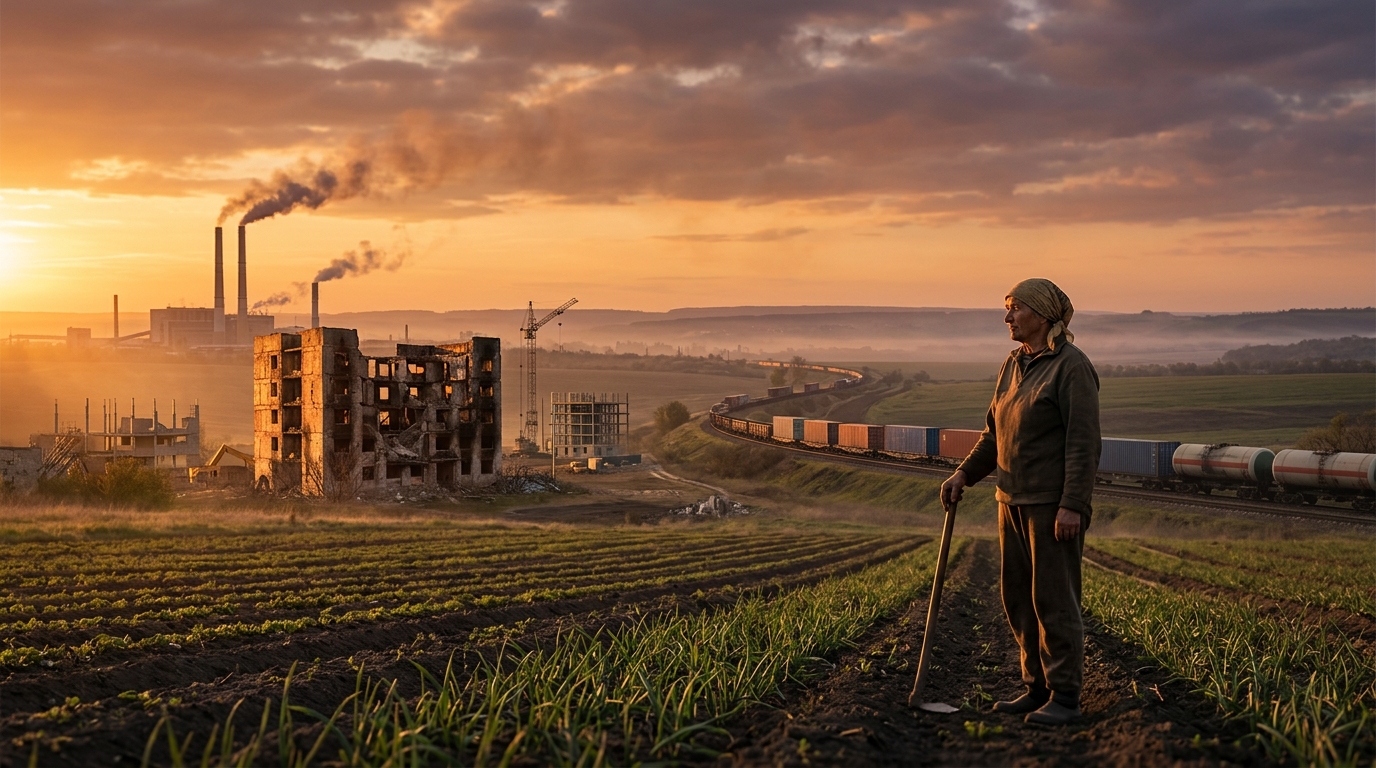
The Russia‑Ukraine war has imposed a $558 billion reconstruction burden on Ukraine, while both economies face sluggish growth, high inflation, and soaring defence spending that crowds out social sectors. For UPSC, the conflict illustrates the interplay of geopolitics, fiscal stress, and humanitarian impact, underscoring the need to study post‑conflict economic recovery and policy trade‑offs.
Overview The Russia-Ukraine war has entered its fifth year, leaving both nations grappling with massive economic dislocation. A joint report by the World Bank , the EU , the United Nations and Ukraine estimates that rebuilding Ukraine will cost **$558 billion** over the next decade – almost three times its projected 2025 GDP. Key Developments Russia’s economy grew less than 1 % in 2023 and is projected to grow another 1 % in 2026, reflecting the impact of Western sanctions. Ukraine’s GDP contracted by ≈30 % in 2022; after a modest 2 % rise in 2023, growth is expected to reach 4.5 % by 2026. Consumer‑price inflation peaked at a six‑year high in 2022 (Russia 14 %, Ukraine similar) and remains elevated, with Russia at **9 %** in the latest year. Food prices surged: Russian bread up **13 %** YoY, rice up **40 %**; Ukrainian wheat flour rose from **12,633 UAH/tonne** (Feb 2022) to **14,700 UAH/tonne** (2026). Defence spending now dominates budgets: Russia allocates ~ 30 % of total expenditure; Ukraine exceeds 20 % of GDP in 2022, projected to hit **26 %** by 2025. Ukraine’s public debt reached **109 %** of GDP in 2025, widening fiscal deficits. Important Facts Data sources include the IMF , Food and Agriculture Organization’s Food Price Index, World Bank, OECD Economic Survey and the SIPRI . Human cost estimates by the Centre for Strategic and International Studies (CSIS) put Russian casualties at **1.2 million** (2022‑2025) and Ukrainian casualties at **5‑6 lakh**. UPSC Relevance Understanding the war’s economic dimensions is crucial for GS 3 (Economy) – topics such as post‑conflict reconstruction financing, inflation dynamics, fiscal stress, and the trade‑off between defence and social spending. The involvement of multilateral bodies (World Bank, IMF, EU, UN) links to GS 2 (Polity) and international relations, while the humanitarian toll touches GS 4 (Ethics) concerning human security and state responsibility. Way Forward Strengthen multilateral financing mechanisms to bridge the **$558 billion** reconstruction gap, possibly via concessional loans and donor coordination. Implement targeted inflation‑containment measures – stabilising food supply chains and subsidising staple commodities. Re‑balance fiscal priorities in Ukraine to gradually reduce the defence‑spending share, freeing resources for health, education and social protection. Enhance transparency in Russia’s defence budgeting to allow accurate assessment of non‑defence expenditures. Promote regional cooperation for refugee integration and labour market absorption to mitigate demographic shocks.
  1. Home
  2. Prepare
  3. Current Affairs
  4. Economic Fallout of the Russia-Ukraine War: Post‑War Reconstruction Costs, Inflation Surge & Defence Spending
Login to bookmark articles
Login to mark articles as complete

Overview

War‑induced economic shock forces Russia and Ukraine into fiscal strain and massive reconstruction costs

Key Facts

  1. Rebuilding Ukraine is estimated at $558 billion over the next decade – almost three times its projected 2025 GDP (World Bank/EU/UN).
  2. Russia’s economy grew less than 1 % in 2023 and is projected to grow only 1 % in 2026 under Western sanctions.
  3. Ukraine’s GDP contracted about 30 % in 2022; after a 2 % rise in 2023, growth is expected to reach 4.5 % by 2026.
  4. Inflation peaked at 14 % in 2022 in both Russia and Ukraine; Russia’s inflation remains at 9 % in the latest year.
  5. Food price spikes: Russian bread up 13 % YoY, rice up 40 %; Ukrainian wheat flour rose from 12,633 UAH/tonne (Feb 2022) to 14,700 UAH/tonne (2026).
  6. Defence spending now accounts for ~30 % of Russia’s total expenditure and >20 % of Ukraine’s GDP in 2022, projected to hit 26 % by 2025.
  7. Ukraine’s public debt reached 109 % of GDP in 2025, widening fiscal deficits.

Background & Context

The Russia‑Ukraine war has transformed a geopolitical conflict into a massive economic crisis, testing fiscal resilience, inflation control and post‑conflict reconstruction financing. It links GS‑3 (macroeconomic stability, fiscal stress) with GS‑2 (role of multilateral institutions, international sanctions) and underscores the trade‑off between defence outlays and social spending.

UPSC Syllabus Connections

Essay•International Relations and GeopoliticsEssay•Economy, Development and InequalityGS2•Important international institutions and agenciesGS3•Government BudgetingPrelims_GS•National Current AffairsPrelims_GS•International Current AffairsGS3•Major crops, cropping patterns, irrigation and agricultural produceGS3•Indian Economy - Planning, mobilization of resources, growth, development and employment

Mains Answer Angle

In a GS‑2 or GS‑3 answer, discuss how post‑war reconstruction financing, soaring inflation and defence‑driven budgetary pressures shape policy choices for Ukraine and Russia, and evaluate the role of multilateral agencies in mitigating the economic fallout.

Full Article

Read Original on hindu

Analysis

Practice Questions

Prelims
Easy
Prelims MCQ

Post‑war reconstruction cost

2 marks
6 keywords
GS3
Medium
Mains Short Answer

Inflation surge

10 marks
7 keywords
GS2
Hard
Mains Essay

International financial assistance and aid

25 marks
8 keywords
Related:Daily•Weekly

Loading related articles...

Loading related articles...

Tip: Click articles above to read more from the same date, or use the back button to see all articles.

Explore:Current Affairs·Editorial Analysis·Govt Schemes·Study Materials·Previous Year Questions·UPSC GPT