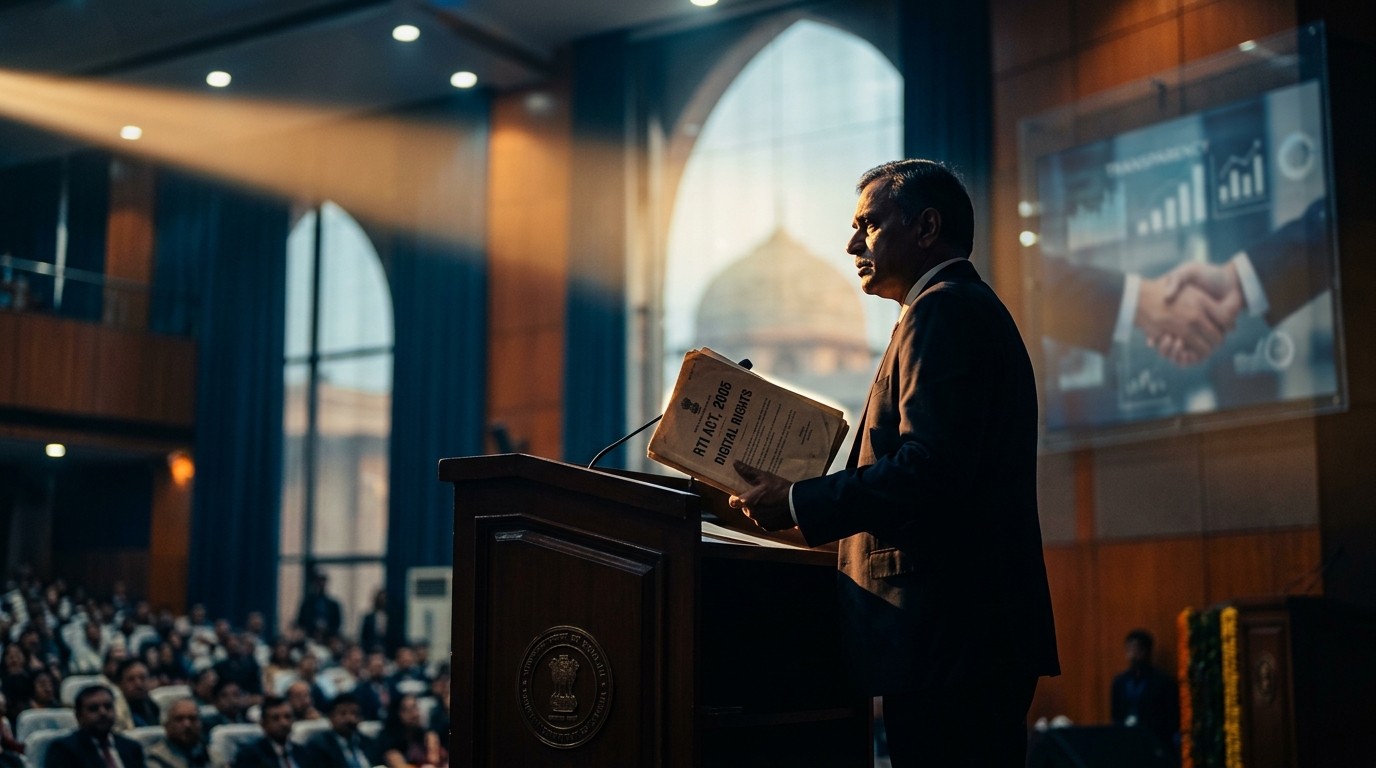
Experts Warn Dilution of RTI Act and Digital Rights Issues at VIT Law Conclave 2026 — UPSC Current Affairs | March 1, 2026
Experts Warn Dilution of RTI Act and Digital Rights Issues at VIT Law Conclave 2026
At a VIT Law conclave on 28 February 2026, senior advocates warned that the <span class="key-term" data-definition="RTI Act — a law enabling citizens to obtain information from public authorities (GS2: Polity)">RTI Act</span> is increasingly ineffective and that existing statutes like the <span class="key-term" data-definition="IT Act — governs cyber‑crimes and digital transactions (GS3: Technology)">IT Act</span> already address online obscenity, negating the need for new laws. They also rejected a blanket “right to be forgotten,” emphasizing the importance of preserving public judicial records while urging enhanced digital literacy for citizens.
Overview At the Justice Unplugged: Shaping the Future law conclave organised by the VIT School of Law, VIT Chennai, senior advocates Gopal Sankaranarayanan and Shadan Farasat , along with Professor M.S. Sharmila , highlighted a growing erosion of the RTI Act . They discussed how digital‑era challenges, such as the “right to be forgotten” and online obscenity, are being addressed within existing legal frameworks. Key Developments Panelists described the RTI Act as being in a “dead phase” over the past decade, with central agencies rarely complying. Judicial transparency through live‑streamed hearings was praised, but speakers warned judges and lawyers must avoid sensational remarks that could jeopardise the integrity of proceedings. The need for new legislation on online obscenity was rejected; existing provisions under the IT Act and criminal law were deemed sufficient. When asked about the “right to be forgotten,” the panel rejected the notion of erasing public records of criminal charges once a person is discharged, emphasizing the importance of preserving historical truth. Professor Sharmila called for enhanced digital literacy and training in AI to empower citizens against emerging digital power structures. Important Facts The conclave, held on 28 February 2026 in Delhi, featured a dialogue between senior advocates of the Supreme Court and a law professor. The discussion covered fundamental rights in the digital age, the adequacy of existing statutes to curb obscene content, and the limits of the “right to be forgotten” doctrine. UPSC Relevance Understanding the current status of the RTI Act is essential for GS2 (Polity) and GS3 (Governance) topics. The panel’s view that the IT Act already covers obscenity helps aspirants answer questions on cyber‑law without assuming new legislation. The debate on the “right to be forgotten” ties into discussions on privacy, data protection, and the balance between individual rights and public interest—key themes in GS2 and GS4 (Ethics). Finally, the emphasis on digital literacy aligns with the UPSC focus on citizen empowerment and governance reforms. Way Forward Panelists suggested the following steps: Strengthen enforcement mechanisms of the RTI Act to revive its transformative impact. Promote responsible courtroom communication, encouraging judges to embed observations in formal orders rather than media‑friendly remarks. Leverage existing provisions of the IT Act while updating guidelines to keep pace with evolving digital platforms. Integrate digital‑literacy curricula at school and higher‑education levels, with specific modules on AI ethics and data privacy. Maintain a balanced approach to the “right to be forgotten,” preserving public records of judicial outcomes while protecting genuine privacy concerns. These recommendations aim to safeguard constitutional guarantees, ensure transparent governance, and equip citizens to navigate the digital future.
Must Review
Login to bookmark articles
Login to mark articles as complete
Overview
Eroding RTI undermines transparency in India's digital governance
Key Facts
The VIT Law Conclave “Justice Unplugged” was held on 28 February 2026 in Delhi.
Senior advocates Gopal Sankaranarayanan, Shadan Farasat and Prof. M.S. Sharmila warned that the RTI Act is in a “dead phase” with central agencies rarely complying over the past decade.
Panel rejected the need for new legislation on online obscenity, stating the Information Technology Act, 2000 suffices.
The “right to be forgotten” was dismissed for criminal records, emphasizing preservation of public judicial history.
Calls were made to strengthen enforcement mechanisms of the RTI Act and embed digital‑literacy and AI ethics in curricula.
Live‑streamed court hearings were praised, but judges and lawyers were cautioned against sensational remarks that could jeopardise procedural integrity.
Background & Context
The Right to Information Act, 2005 is a cornerstone of transparency and citizen‑state accountability under GS‑2. Recent expert commentary highlights its gradual dilution amid digital‑era challenges such as online obscenity, data privacy and the contested ‘right to be forgotten’, raising concerns for governance, e‑governance and fundamental rights.
UPSC Syllabus Connections
Essay•Media, Communication and InformationGS4•Information sharing, transparency, RTI, codes of ethics and conductGS2•Governance, transparency, accountability and e-governanceGS4•Dimensions of ethics - private and public relationshipsPrelims_GS•Public Policy and Rights IssuesEssay•Democracy, Governance and Public AdministrationPrelims_GS•National Current AffairsPrelims_GS•Constitution and Political SystemEssay•Science, Technology and SocietyGS4•Integrity, impartiality, non-partisanship, objectivity and dedication to public service
Mains Answer Angle
In GS‑2, candidates can address the erosion of RTI’s efficacy and propose reforms to align transparency mechanisms with digital governance. A likely Mains question may ask to evaluate the balance between privacy, public interest and accountability in the digital age.