Loading page, please wait…
HomeCurrent AffairsEditorialsGovt SchemesLearning ResourcesUPSC SyllabusPricingAboutBest UPSC AIUPSC AI ToolAI for UPSCUPSC ChatGPT

© 2026 Vaidra. All rights reserved.

PrivacyTerms
Vaidra Logo
Vaidra

Top 4 items + smart groups

UPSC GPT
New
Current Affairs
Daily Solutions
Daily Puzzle
Mains Evaluator

Version 2.0.0 • Built with ❤️ for UPSC aspirants

External Affairs Minister S Jaishankar Joins G7 Foreign Ministers’ Meeting in France on West Asia Crisis & Strait of Hormuz — UPSC Current Affairs | March 26, 2026
External Affairs Minister S Jaishankar Joins G7 Foreign Ministers’ Meeting in France on West Asia Crisis & Strait of Hormuz
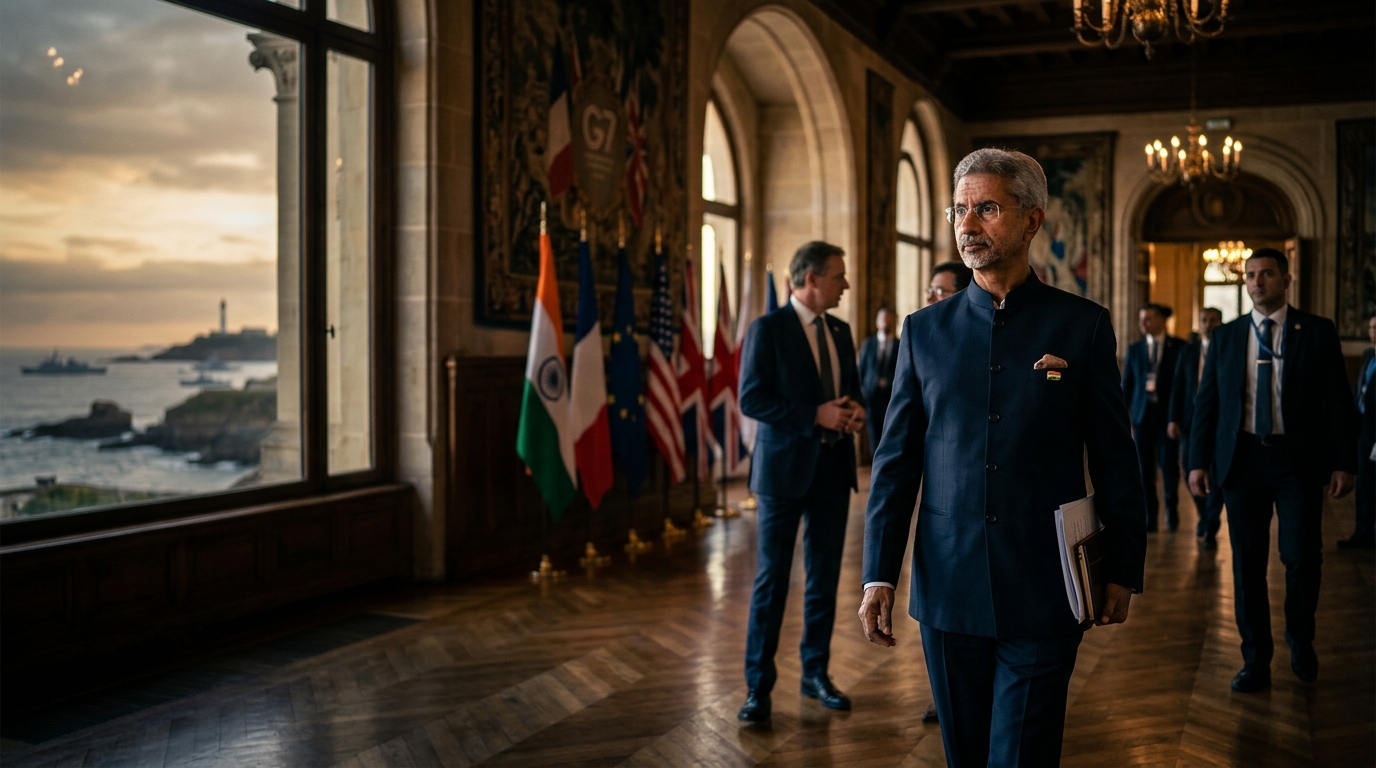
External Affairs Minister S Jaishankar attended the G7 Foreign Ministers’ meeting in France on 26‑27 March 2026 as a partner country, focusing on the West Asia crisis and keeping the Strait of Hormuz open for oil and LNG shipments. The summit aims to de‑escalate regional tensions, address Iran’s nuclear programme, and ensure energy security vital for India’s economy.
Overview On 26 March 2026 , S Jaishankar travelled to France to attend the G7 Foreign Ministers’ meeting, chaired by France. India, though not a member, was invited as a partner country . The agenda centres on the escalating West Asia crisis and the security of the Strait of Hormuz . Key Developments India participates as a partner country alongside Saudi Arabia, South Korea and Brazil. Jaishankar will hold bilateral talks with other foreign ministers on the sidelines of the G7 summit. A dedicated session will examine de‑escalation pathways in West Asia and the reopening of maritime routes. Discussions will also focus on countering Iran’s nuclear and ballistic programme . Important Facts The G7 comprises Canada, France, Germany, Italy, Japan, United Kingdom and United States , with the EU represented as a collective member. The meeting is being held at the Abbaye des‑Vaux‑de‑Cernay on 26‑27 March 2026 . Global oil and gas prices have surged after Iran effectively blocked the Strait of Hormuz, threatening the flow of roughly 20% of world oil and LNG . West Asia supplies a significant share of India’s energy imports, making the shipping lane vital for Indian energy security and, by extension, its fertiliser security . UPSC Relevance Understanding India’s role in multilateral forums like the G7 helps answer questions on India’s foreign policy strategy (GS2). The focus on the Strait of Hormuz links to topics on global energy markets, oil price volatility and their impact on the Indian economy (GS3). The discussion on Iran’s nuclear programme ties into India’s stance on non‑proliferation and regional security (GS2, GS3). Moreover, the concept of partner country illustrates how India leverages diplomatic platforms beyond traditional alliances. Way Forward India is likely to push for a diplomatic resolution that restores free navigation through the Strait of Hormuz, thereby stabilising global oil prices and safeguarding its own energy and fertiliser imports. Continued engagement with G7 members and other partner nations can help build a coalition for pressure on Iran to reopen the lane. Simultaneously, New Delhi may explore alternative energy routes and diversify its import basket to mitigate future disruptions.
  1. Home
  2. Prepare
  3. Current Affairs
  4. External Affairs Minister S Jaishankar Joins G7 Foreign Ministers’ Meeting in France on West Asia Crisis & Strait of Hormuz
Must Review
Login to bookmark articles
Login to mark articles as complete

Overview

India leverages G7 platform to safeguard Strait of Hormuz, crucial for energy security

Key Facts

  1. 26 March 2026: External Affairs Minister S Jaishankar attended the G7 Foreign Ministers’ meeting in France (Abbaye des‑Vaux‑de‑Cernay) as a partner country.
  2. G7 members are Canada, France, Germany, Italy, Japan, United Kingdom and United States; the European Union participates as a collective member.
  3. Partner countries invited to the meeting were India, Saudi Arabia, South Korea and Brazil.
  4. Approximately 20% of global oil and LNG passes through the Strait of Hormuz; the route is vital for India’s energy and fertiliser security.
  5. Iran’s effective blockage of the Strait in March 2026 triggered a sharp rise in global oil and gas prices.
  6. The summit agenda included de‑escalation of the West Asia crisis, reopening maritime routes, and countering Iran’s nuclear and ballistic programme.
  7. India is expected to push for a diplomatic resolution, diversify its energy import basket and build a coalition to pressure Iran.

Background & Context

India’s participation as a G7 partner underscores its strategy of engaging beyond traditional alliances to protect vital economic interests. The Strait of Hormuz issue links directly to energy security, a key component of India’s macro‑economic stability and foreign policy, while discussions on Iran’s nuclear programme tie into non‑proliferation and regional security concerns.

UPSC Syllabus Connections

GS2•Bilateral, regional and global groupings involving IndiaPrelims_GS•International Current AffairsPrelims_CSAT•Interpersonal Skills and Communication

Mains Answer Angle

GS2 – The topic can be framed as a question on India’s use of multilateral forums to safeguard energy security and its diplomatic stance on the West Asia crisis, assessing both strategic intent and policy outcomes.

Full Article

Read Original on hindu

Analysis

Practice Questions

GS1
Easy
Prelims MCQ

India’s role in multilateral groupings

1 marks
5 keywords
GS2
Medium
Mains Short Answer

Energy security and multilateral diplomacy

5 marks
5 keywords
GS2
Hard
Mains Essay

Multilateral engagement, energy security, West Asia crisis

20 marks
7 keywords
Related:Daily•Weekly

Loading related articles...

Loading related articles...

Tip: Click articles above to read more from the same date, or use the back button to see all articles.

Explore:Current Affairs·Editorial Analysis·Govt Schemes·Study Materials·Previous Year Questions·UPSC GPT