Loading page, please wait…
HomeCurrent AffairsEditorialsGovt SchemesLearning ResourcesUPSC SyllabusPricingAboutBest UPSC AIUPSC AI ToolAI for UPSCUPSC ChatGPT

© 2026 Vaidra. All rights reserved.

PrivacyTerms
Vaidra Logo
Vaidra

Top 4 items + smart groups

UPSC GPT
New
Current Affairs
Daily Solutions
Daily Puzzle
Mains Evaluator

Version 2.0.0 • Built with ❤️ for UPSC aspirants

Four‑Line Coastal Odisha Corridor & Rail Modernisation – DFCs, Kavach 4.0, Net‑Zero Goal

Four‑Line Coastal Odisha Corridor & Rail Modernisation – DFCs, Kavach 4.0, Net‑Zero Goal
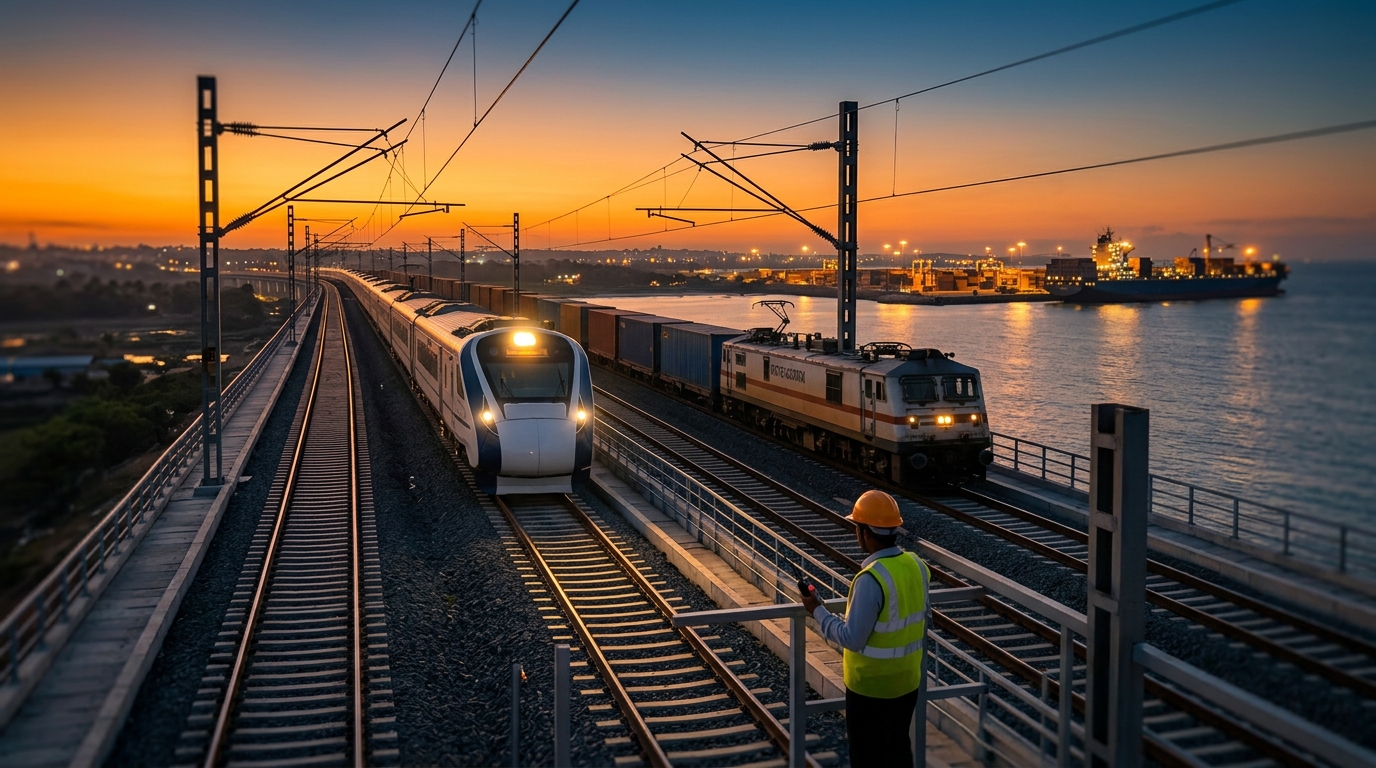
The Ministry of Railways approved a four‑line Balasore‑Brahmapur corridor to decongest the Howrah‑Chennai route, complementing the rollout of Dedicated Freight Corridors, Kavach 4.0 safety system, and a net‑zero by 2030 agenda. These measures aim to cut logistics costs, boost freight speed, and position India as a technology exporter under the Make in India drive, all of which are pivotal for UPSC economics and infrastructure topics.
The Ministry of Railways has approved a four‑line corridor from Balasore to Brahmapur in coastal Odisha to decongest the heavily‑used Howrah‑Chennai route. The move is part of a broader three‑pillar strategy— DFCs , Kavach 4.0 and a net‑zero agenda. These reforms aim to boost regional connectivity, cut logistics costs and position India as a technology exporter under the Make in India vision. Key Developments Construction of a four‑line Balasore‑Brahmapur corridor to ease congestion on the Howrah‑Chennai line. Operationalisation of the Western DFC (1,506 km) in March 2026 and the Eastern DFC (1,337 km) to segregate freight traffic. Nationwide rollout of Kavach 4.0 , enabling reduced headways and higher track utilisation. Implementation of Gati Shakti cargo terminals for seamless multimodal freight movement. Commitment to achieve net‑zero emissions by 2030 via electrification, solar rooftops and hydrogen‑powered trains. Important Facts • Freight speed on shared tracks averages ~25 km/h ; on DFCs it will rise to 75–100 km/h , a 3–4‑fold increase. • The National Logistics Policy targets logistics cost reduction from the current 14 % to 8 % of GDP. • Vande Bharat trains exemplify the shift from import‑reliant to export‑ready railway technology. UPSC Relevance The reforms illustrate the interplay of infrastructure, economic efficiency and environmental sustainability—core themes in GS III (Economy) and GS II (Polity) regarding policy implementation. Understanding DFCs helps answer questions on logistics cost reduction, while Kavach 4.0 showcases technology‑driven safety measures. The net‑zero target aligns with India’s climate commitments, relevant for questions on sustainable development. Way Forward To fully realise the benefits, the Railways must (i) accelerate the migration of bulk freight to DFCs, (ii) ensure seamless integration of Gati Shakti cargo hubs with industrial clusters, (iii) expand solar and hydrogen projects to meet the net‑zero timeline, and (iv) promote export of indigenous technologies like Vande Bharat and Kavach 4.0 to friendly nations. Successful execution will transform Indian Railways from a legacy carrier into a high‑speed, low‑carbon logistics backbone for the nation.
  1. Home
  2. Prepare
  3. Current Affairs
  4. Four‑Line Coastal Odisha Corridor & Rail Modernisation – DFCs, Kavach 4.0, Net‑Zero Goal
Must Review
Login to bookmark articles
Login to mark articles as complete

Overview

gs.gs385% UPSC Relevance

Four‑line Odisha corridor and rail modernisation aim to cut logistics costs and meet net‑zero by 2030.

Key Facts

  1. The Ministry of Railways approved a four‑line Balasore‑Brahmapur corridor in coastal Odisha to decongest the Howrah‑Chennai route.
  2. Western Dedicated Freight Corridor (1,506 km) will be operational by March 2026; Eastern DFC (1,337 km) slated for 2026‑27.
  3. Kavach 4.0, an indigenously developed SIL‑4 Automatic Train Protection system, is being rolled out nationwide to cut headways.
  4. Indian Railways aims for net‑zero carbon emissions by 2030 through full electrification, solar rooftops and hydrogen‑powered trains.
  5. Freight speed on shared tracks averages ~25 km/h; on DFCs it will rise to 75‑100 km/h, a 3‑4× increase.
  6. National Logistics Policy targets reduction of logistics cost from 14 % to 8 % of GDP.

Background & Context

These reforms align with the three‑pillar strategy of dedicated freight corridors, advanced safety tech, and a net‑zero agenda, addressing infrastructure bottlenecks, logistics cost inflation and climate commitments—core themes of GS III (Economy) and GS II (Polity). The corridor also dovetails with the National Infrastructure Pipeline and Make‑in‑India drive.

UPSC Syllabus Connections

Essay•Economy, Development and InequalityGS3•Infrastructure - Energy, Ports, Roads, Airports, RailwaysGS2•Government policies and interventions for developmentPrelims_GS•National Current AffairsEssay•Science, Technology and SocietyPrelims_GS•Social and Economic Geography of IndiaGS3•Effects of liberalization on economy, industrial policy and growthGS3•Indian Economy - Planning, mobilization of resources, growth, development and employmentEssay•Education, Knowledge and CulturePrelims_CSAT•Basic Numeracy

Mains Answer Angle

In a GS III answer, discuss how the four‑line coastal corridor, DFCs and Kavach 4.0 together enhance regional connectivity, reduce logistics costs and advance sustainable transport, linking infrastructure development with climate goals.

Full Article

<p>The Ministry of Railways has approved a <strong>four‑line corridor</strong> from Balasore to Brahmapur in coastal Odisha to decongest the heavily‑used Howrah‑Chennai route. The move is part of a broader three‑pillar strategy—<span class="key-term" data-definition="Dedicated Freight Corridors (DFCs) – exclusive railway tracks for freight traffic that free up shared lines for faster passenger services; crucial for logistics cost reduction (GS3: Economy)">DFCs</span>, <span class="key-term" data-definition="Kavach 4.0 – an indigenously developed Automatic Train Protection system meeting the highest SIL‑4 safety standard, which automatically applies brakes to avoid collisions (GS3: Economy)">Kavach 4.0</span> and a <span class="key-term" data-definition="Net‑zero by 2030 – Indian Railways’ target to achieve zero carbon emissions by 2030 through full electrification, solar installations and hydrogen‑powered trains (GS3: Economy)">net‑zero</span> agenda. These reforms aim to boost regional connectivity, cut logistics costs and position India as a technology exporter under the <span class="key-term" data-definition="Make in India – a government programme encouraging domestic manufacturing and export of Indian products, including railway technology (GS3: Economy)">Make in India</span> vision.</p> <h3>Key Developments</h3> <ul> <li>Construction of a <strong>four‑line Balasore‑Brahmapur corridor</strong> to ease congestion on the Howrah‑Chennai line.</li> <li>Operationalisation of the <strong>Western DFC (1,506 km)</strong> in March 2026 and the Eastern DFC (1,337 km) to segregate freight traffic.</li> <li>Nationwide rollout of <span class="key-term" data-definition="Kavach 4.0 – an indigenously developed Automatic Train Protection system meeting the highest SIL‑4 safety standard, which automatically applies brakes to avoid collisions (GS3: Economy)">Kavach 4.0</span>, enabling reduced headways and higher track utilisation.</li> <li>Implementation of <span class="key-term" data-definition="Gati Shakti – the Prime Minister’s integrated infrastructure plan that creates multimodal cargo terminals linking rail, road, ports and airports to improve last‑mile logistics (GS3: Economy)">Gati Shakti</span> cargo terminals for seamless multimodal freight movement.</li> <li>Commitment to achieve <span class="key-term" data-definition="Net‑zero by 2030 – Indian Railways’ target to achieve zero carbon emissions by 2030 through full electrification, solar installations and hydrogen‑powered trains (GS3: Economy)">net‑zero</span> emissions by 2030 via electrification, solar rooftops and hydrogen‑powered trains.</li> </ul> <h3>Important Facts</h3> <p>• Freight speed on shared tracks averages <strong>~25 km/h</strong>; on DFCs it will rise to <strong>75–100 km/h</strong>, a 3–4‑fold increase.<br> • The <span class="key-term" data-definition="National Logistics Policy – a policy framework aiming to bring India’s logistics cost down to 8 % of GDP, close to global benchmarks (GS3: Economy)">National Logistics Policy</span> targets logistics cost reduction from the current 14 % to 8 % of GDP.<br> • <span class="key-term" data-definition="Vande Bharat – India’s domestically designed semi‑high‑speed train, showcasing indigenous capability and supporting the Make in India agenda (GS3: Economy)">Vande Bharat</span> trains exemplify the shift from import‑reliant to export‑ready railway technology.</p> <h3>UPSC Relevance</h3> <p>The reforms illustrate the interplay of infrastructure, economic efficiency and environmental sustainability—core themes in GS III (Economy) and GS II (Polity) regarding policy implementation. Understanding DFCs helps answer questions on logistics cost reduction, while Kavach 4.0 showcases technology‑driven safety measures. The net‑zero target aligns with India’s climate commitments, relevant for questions on sustainable development.</p> <h3>Way Forward</h3> <p>To fully realise the benefits, the Railways must (i) accelerate the migration of bulk freight to DFCs, (ii) ensure seamless integration of <span class="key-term" data-definition="Gati Shakti – the Prime Minister’s integrated infrastructure plan that creates multimodal cargo terminals linking rail, road, ports and airports to improve last‑mile logistics (GS3: Economy)">Gati Shakti</span> cargo hubs with industrial clusters, (iii) expand solar and hydrogen projects to meet the net‑zero timeline, and (iv) promote export of indigenous technologies like <span class="key-term" data-definition="Vande Bharat – India’s domestically designed semi‑high‑speed train, showcasing indigenous capability and supporting the Make in India agenda (GS3: Economy)">Vande Bharat</span> and <span class="key-term" data-definition="Kavach 4.0 – an indigenously developed Automatic Train Protection system meeting the highest SIL‑4 safety standard, which automatically applies brakes to avoid collisions (GS3: Economy)">Kavach 4.0</span> to friendly nations. Successful execution will transform Indian Railways from a legacy carrier into a high‑speed, low‑carbon logistics backbone for the nation.</p>
Read Original on indianexpress

Analysis

Practice Questions

GS3
Easy
Prelims MCQ

Infrastructure – Railways

1 marks
3 keywords
GS3
Medium
Mains Short Answer

Regional connectivity and economic development

5 marks
4 keywords
GS3
Hard
Mains Essay

Sustainable infrastructure and climate policy

20 marks
6 keywords
Related:Daily•Weekly

Loading related articles...

Loading related articles...

Tip: Click articles above to read more from the same date, or use the back button to see all articles.

Quick Reference

Key Insight

Four‑line Odisha corridor and rail modernisation aim to cut logistics costs and meet net‑zero by 2030.

Key Facts

  1. The Ministry of Railways approved a four‑line Balasore‑Brahmapur corridor in coastal Odisha to decongest the Howrah‑Chennai route.
  2. Western Dedicated Freight Corridor (1,506 km) will be operational by March 2026; Eastern DFC (1,337 km) slated for 2026‑27.
  3. Kavach 4.0, an indigenously developed SIL‑4 Automatic Train Protection system, is being rolled out nationwide to cut headways.
  4. Indian Railways aims for net‑zero carbon emissions by 2030 through full electrification, solar rooftops and hydrogen‑powered trains.
  5. Freight speed on shared tracks averages ~25 km/h; on DFCs it will rise to 75‑100 km/h, a 3‑4× increase.
  6. National Logistics Policy targets reduction of logistics cost from 14 % to 8 % of GDP.

Background

These reforms align with the three‑pillar strategy of dedicated freight corridors, advanced safety tech, and a net‑zero agenda, addressing infrastructure bottlenecks, logistics cost inflation and climate commitments—core themes of GS III (Economy) and GS II (Polity). The corridor also dovetails with the National Infrastructure Pipeline and Make‑in‑India drive.

UPSC Syllabus

  • Essay — Economy, Development and Inequality
  • GS3 — Infrastructure - Energy, Ports, Roads, Airports, Railways
  • GS2 — Government policies and interventions for development
  • Prelims_GS — National Current Affairs
  • Essay — Science, Technology and Society
  • Prelims_GS — Social and Economic Geography of India
  • GS3 — Effects of liberalization on economy, industrial policy and growth
  • GS3 — Indian Economy - Planning, mobilization of resources, growth, development and employment
  • Essay — Education, Knowledge and Culture
  • Prelims_CSAT — Basic Numeracy

Mains Angle

In a GS III answer, discuss how the four‑line coastal corridor, DFCs and Kavach 4.0 together enhance regional connectivity, reduce logistics costs and advance sustainable transport, linking infrastructure development with climate goals.

Explore:Current Affairs·Editorial Analysis·Govt Schemes·Study Materials·Previous Year Questions·UPSC GPT

Related Topics

  • 📖Glossary TermGDP
Four‑Line Coastal Odisha Corridor & Rail M... | UPSC Current Affairs