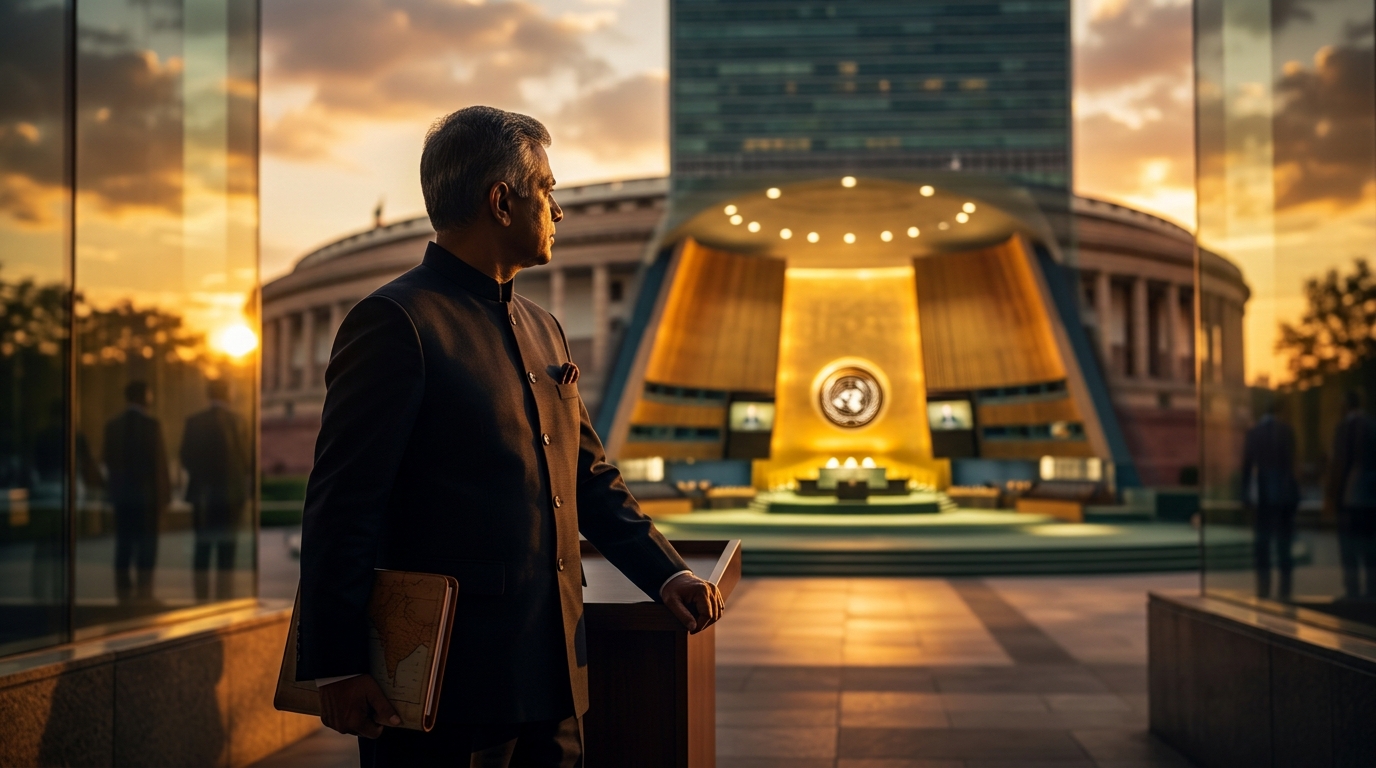
<p><strong>India</strong> has reiterated its call for a more inclusive and representative <span class="key-term" data-definition="United Nations Security Council — the primary organ of the UN responsible for maintaining international peace and security; its permanent members hold veto power (GS2: Polity)">UN Security Council</span>, emphasizing the need to expand <span class="key-term" data-definition="permanent membership — the five founding members (China, France, Russia, United Kingdom, United States) that have permanent seats and veto rights in the UN Security Council (GS2: Polity)">permanent membership</span> to include nations from the <span class="key-term" data-definition="Global South — a collective term for developing nations, primarily in Asia, Africa, and Latin America, often emphasizing shared economic and political interests (GS1: History, GS3: Economy)">Global South</span>. The statement was delivered by <strong>Sibi George</strong>, <span class="key-term" data-definition="Secretary (West) — senior official in the Ministry of External Affairs responsible for overseeing diplomatic engagements with Western nations (GS2: Polity)">Secretary (West)</span> of the <span class="key-term" data-definition="Ministry of External Affairs — India's cabinet-level ministry handling foreign relations, diplomacy, and international negotiations (GS2: Polity)">Ministry of External Affairs</span>, at key United Nations meetings in 2026.</p>
<h3>Key Developments</h3>
<ul>
<li>India urged the UN to reconsider the composition of the <span class="key-term" data-definition="UN Security Council — the primary organ of the UN responsible for maintaining international peace and security; its permanent members hold veto power (GS2: Polity)">Security Council</span> to reflect contemporary geopolitical realities.</li>
<li>The emphasis was on granting permanent seats to deserving countries from the <span class="key-term" data-definition="Global South — a collective term for developing nations, primarily in Asia, Africa, and Latin America, often emphasizing shared economic and political interests (GS1: History, GS3: Economy)">Global South</span>, thereby enhancing their voice in global security decisions.</li>
<li>India also called for reforms in the <span class="key-term" data-definition="global financial system — the worldwide network of institutions, markets, and regulations that facilitate cross-border capital flows and monetary stability (GS3: Economy)">global financial system</span> to make it fairer and more inclusive.</li>
</ul>
<h3>Important Facts</h3>
<p>The current permanent members of the <span class="key-term" data-definition="UN Security Council — the primary organ of the UN responsible for maintaining international peace and security; its permanent members hold veto power (GS2: Polity)">Security Council</span> are the United States, United Kingdom, France, Russia, and China. No other nation holds a permanent seat, and any change requires a two‑thirds majority in the UN General Assembly plus ratification by the permanent members. India, a major contributor to UN peacekeeping missions, has long advocated for a permanent seat, arguing that its economic stature and diplomatic outreach merit such status.</p>
<h3>UPSC Relevance</h3>
<p>Understanding the dynamics of the <span class="key-term" data-definition="UN Security Council — the primary organ of the UN responsible for maintaining international peace and security; its permanent members hold veto power (GS2: Polity)">Security Council</span> is essential for GS2 (Polity) as it reflects power structures in international relations. The demand for greater <span class="key-term" data-definition="permanent membership — the five founding members (China, France, Russia, United Kingdom, United States) that have permanent seats and veto rights in the UN Security Council (GS2: Polity)">permanent membership</span> by the <span class="key-term" data-definition="Global South — a collective term for developing nations, primarily in Asia, Africa, and Latin America, often emphasizing shared economic and political interests (GS1: History, GS3: Economy)">Global South</span> ties into themes of decolonisation, equity, and reform of global governance (GS1, GS2). The call for an inclusive <span class="key-term" data-definition="global financial system — the worldwide network of institutions, markets, and regulations that facilitate cross-border capital flows and monetary stability (GS3: Economy)">global financial system</span> links to GS3 (Economy) topics such as international monetary reforms and the role of emerging economies.</p>
<h3>Way Forward</h3>
<p>India is likely to pursue a two‑track strategy: diplomatic lobbying within the UN General Assembly to build a coalition of supportive nations, and domestic consensus building to showcase its contributions to peacekeeping and development. Continued engagement by officials like <strong>Sibi George</strong> will aim to keep the issue on the agenda of multilateral forums, while parallel efforts to reform the <span class="key-term" data-definition="global financial system — the worldwide network of institutions, markets, and regulations that facilitate cross-border capital flows and monetary stability (GS3: Economy)">global financial system</span> may involve advocating for greater representation in institutions such as the IMF and World Bank. Aspirants should monitor upcoming UN sessions and India's diplomatic outreach for evolving positions.</p>