Loading page, please wait…
HomeCurrent AffairsEditorialsGovt SchemesLearning ResourcesUPSC SyllabusPricingAboutBest UPSC AIUPSC AI ToolAI for UPSCUPSC ChatGPT

© 2026 Vaidra. All rights reserved.

PrivacyTerms
Vaidra Logo
Vaidra

Top 4 items + smart groups

UPSC GPT
New
Current Affairs
Daily Solutions
Daily Puzzle
Mains Evaluator

Version 2.0.0 • Built with ❤️ for UPSC aspirants

India Launches Amaravati Quantum Reference Facility – Boost to National Quantum Mission

India Launches Amaravati Quantum Reference Facility – Boost to National Quantum Mission
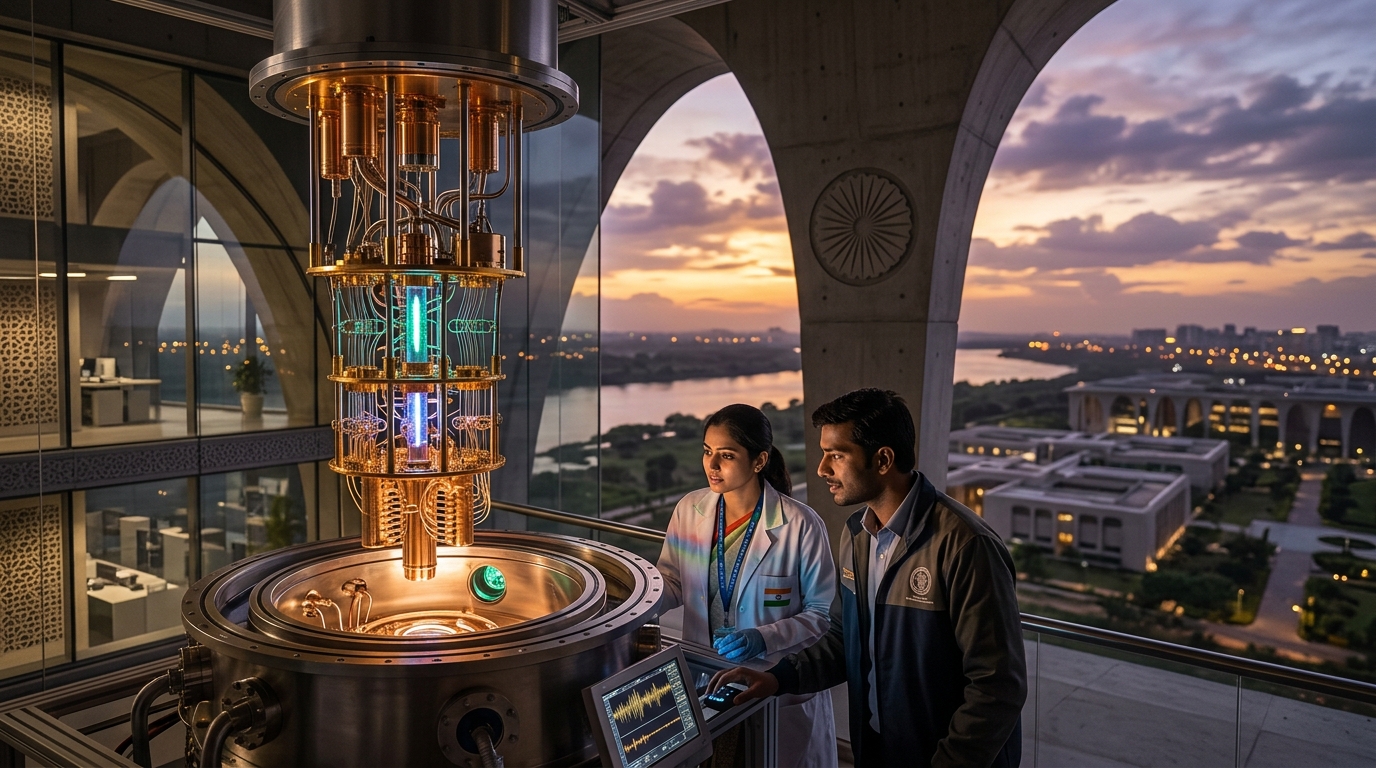
On 14 April 2026, India inaugurated the Amaravati Quantum Reference Facility (AQRA) at SRM University, a key component of the National Quantum Mission. The initiative aims to develop quantum computers, secure communication, sensing, and materials, positioning India as a future leader in quantum technology.
Quantum Initiative Highlights On 14 April 2026 , the AQRA was inaugurated by Andhra Pradesh Chief Minister N. Chandrababu Naidu . The launch, timed with World Quantum Day, marks the creation of an open, sovereign quantum infrastructure and signals the emergence of an Amaravati Quantum Valley as an international hub for quantum research. Key Developments The facility comprises two testbeds: 1Q at Medha Towers and 1S at SRM University. It is part of the state’s flagship quantum‑technology hub, operating under the National Quantum Mission (NQM) . Four thematic pillars have been created at premier institutions: Computing (IISc Bengaluru), Communication (IIT Madras), Sensing (IIT Bombay) and Materials (IIT Delhi). Target outcomes include intermediate‑scale quantum computers (50‑1000 qubits), satellite‑based secure quantum communication over 2000 km, high‑sensitivity magnetometers, and novel quantum materials. Important Facts & Concepts The quantum ecosystem rests on several core principles: Qubit replaces the classical bit, allowing simultaneous processing of multiple states. Superposition underpins the power of quantum algorithms. Entanglement enables protocols like quantum key distribution. QKD is being trialled for inter‑city links via satellite and optical fibre. BEC research at institutions like TIFR underpins quantum simulators and precision metrology. UPSC Relevance The quantum push aligns with several UPSC syllabus points: emerging technologies (GS3), science‑policy interface (GS2), and strategic autonomy in high‑technology sectors (GS3). Understanding the mission’s objectives helps answer questions on India’s R&D strategy, defence‑related quantum communication, and the role of public‑private partnerships in technology development. Way Forward To translate research into applications, the government must: Strengthen industry linkages for scaling quantum hardware and software. Facilitate skill development through specialised curricula in universities and IITs. Ensure robust regulatory frameworks for quantum cryptography and data privacy. Promote international collaborations while safeguarding sovereign quantum assets. Continued investment and coordinated governance will be critical for India to become a global quantum leader by the end of the decade.
  1. Home
  2. Prepare
  3. Current Affairs
  4. India Launches Amaravati Quantum Reference Facility – Boost to National Quantum Mission
Must Review
Login to bookmark articles
Login to mark articles as complete

Overview

gs.gs381% UPSC Relevance

AQRA launch propels India's sovereign quantum ecosystem, bolstering strategic tech autonomy.

Key Facts

  1. 14 April 2026: Amaravati Quantum Reference Facility (AQRA) inaugurated by Andhra Pradesh CM N. Chandrababu Naidu.
  2. AQRA, India's first indigenous quantum‑computing testing centre, is set up at SRM University, Amaravati, with two testbeds – 1Q (Medha Towers) and 1S (SRM University).
  3. AQRA operates under the National Quantum Mission (NQM), a 2023‑24 to 2030‑31 programme with a budget of Rs 6,003.65 crore.
  4. Four thematic pillars of NQM are hosted at premier institutes: Computing – IISc Bengaluru; Communication – IIT Madras; Sensing – IIT Bombay; Materials – IIT Delhi.
  5. NQM aims for intermediate‑scale quantum computers (50‑1000 qubits), satellite‑based quantum key distribution over 2000 km, high‑sensitivity magnetometers, and novel quantum materials.
  6. Quantum concepts central to the mission – qubit, superposition, entanglement, and quantum key distribution (QKD) – underpin secure communication and high‑performance computing.

Background & Context

The launch of AQRA marks India's strategic push to build a sovereign quantum ecosystem, aligning with GS‑3 themes of emerging technologies, science‑policy interface, and defence‑related quantum communication. It reflects the government's intent to achieve technological self‑reliance and to position India as a global quantum hub by the end of the decade.

UPSC Syllabus Connections

GS3•Developments in science and technology and their applicationsEssay•Science, Technology and SocietyPrelims_GS•Physics and Chemistry in Everyday LifePrelims_GS•National Current AffairsGS3•IT, Space, Computers, Robotics, Nano-technology, Bio-technology and IPREssay•Economy, Development and InequalityGS2•Functions and responsibilities of Union and StatesEssay•Education, Knowledge and CultureGS1•Poverty and Developmental IssuesPrelims_GS•Science and Technology Applications

Mains Answer Angle

GS‑3 (Science & Technology) – Discuss the significance of the National Quantum Mission and AQRA in enhancing India's strategic autonomy, R&D ecosystem, and defence capabilities, and evaluate the policy measures needed for scaling quantum technologies.

Full Article

<h2>Quantum Initiative Highlights</h2> <p>On <strong>14 April 2026</strong>, the <span class="key-term" data-definition="Amaravati Quantum Reference Facility (AQRA) – India’s first indigenous quantum‑computing testing centre, set up at SRM University, Amaravati. (GS3: Science & Technology)">AQRA</span> was inaugurated by <strong>Andhra Pradesh Chief Minister N. Chandrababu Naidu</strong>. The launch, timed with World Quantum Day, marks the creation of an open, sovereign quantum infrastructure and signals the emergence of an <em>Amaravati Quantum Valley</em> as an international hub for quantum research.</p> <h3>Key Developments</h3> <ul> <li>The facility comprises two testbeds: <em>1Q</em> at Medha Towers and <em>1S</em> at SRM University.</li> <li>It is part of the state’s flagship quantum‑technology hub, operating under the <span class="key-term" data-definition="National Quantum Mission (NQM) – A government programme (2023‑24 to 2030‑31) with a budget of Rs 6,003.65 crore aimed at building a robust quantum ecosystem in India. (GS3: Science & Technology)">National Quantum Mission (NQM)</span>.</li> <li>Four thematic pillars have been created at premier institutions: Computing (IISc Bengaluru), Communication (IIT Madras), Sensing (IIT Bombay) and Materials (IIT Delhi).</li> <li>Target outcomes include intermediate‑scale quantum computers (50‑1000 qubits), satellite‑based secure quantum communication over 2000 km, high‑sensitivity magnetometers, and novel quantum materials.</li> </ul> <h3>Important Facts & Concepts</h3> <p>The quantum ecosystem rests on several core principles:</p> <ul> <li><span class="key-term" data-definition="Qubit – Quantum bit, the basic unit of quantum information that can exist in a superposition of 0 and 1, enabling exponential parallelism. (GS3: Science & Technology)">Qubit</span> replaces the classical bit, allowing simultaneous processing of multiple states.</li> <li><span class="key-term" data-definition="Superposition – The ability of a quantum system to occupy multiple states at once until measurement collapses it to a single outcome. (GS3: Science & Technology)">Superposition</span> underpins the power of quantum algorithms.</li> <li><span class="key-term" data-definition="Entanglement – A quantum correlation where the state of one particle instantly influences another, regardless of distance, crucial for secure communication. (GS3: Science & Technology)">Entanglement</span> enables protocols like quantum key distribution.</li> <li><span class="key-term" data-definition="Quantum Key Distribution (QKD) – A cryptographic method that uses quantum states to generate provably secure keys; any eavesdropping is physically detectable. (GS3: Science & Technology)">QKD</span> is being trialled for inter‑city links via satellite and optical fibre.</li> <li><span class="key-term" data-definition="Bose–Einstein Condensate (BEC) – A state of matter formed when ultracold atoms occupy the same quantum state, behaving as a single ‘super‑atom’. (GS3: Science & Technology)">BEC</span> research at institutions like TIFR underpins quantum simulators and precision metrology.</li> </ul> <h3>UPSC Relevance</h3> <p>The quantum push aligns with several UPSC syllabus points: emerging technologies (GS3), science‑policy interface (GS2), and strategic autonomy in high‑technology sectors (GS3). Understanding the mission’s objectives helps answer questions on India’s R&D strategy, defence‑related quantum communication, and the role of public‑private partnerships in technology development.</p> <h3>Way Forward</h3> <p>To translate research into applications, the government must:</p> <ul> <li>Strengthen industry linkages for scaling quantum hardware and software.</li> <li>Facilitate skill development through specialised curricula in universities and IITs.</li> <li>Ensure robust regulatory frameworks for quantum cryptography and data privacy.</li> <li>Promote international collaborations while safeguarding sovereign quantum assets.</li> </ul> <p>Continued investment and coordinated governance will be critical for India to become a global quantum leader by the end of the decade.</p>
Read Original on indianexpress

Analysis

Practice Questions

Prelims_GS
Easy
Prelims MCQ

Current Affairs – Quantum Technology

1 marks
3 keywords
GS3
Medium
Mains Short Answer

Science & Technology – Quantum Mission

5 marks
6 keywords
GS3
Hard
Mains Essay

Science & Technology – Quantum Ecosystem & Strategic Autonomy

20 marks
7 keywords
Related:Daily•Weekly

Loading related articles...

Loading related articles...

Tip: Click articles above to read more from the same date, or use the back button to see all articles.

Quick Reference

Key Insight

AQRA launch propels India's sovereign quantum ecosystem, bolstering strategic tech autonomy.

Key Facts

  1. 14 April 2026: Amaravati Quantum Reference Facility (AQRA) inaugurated by Andhra Pradesh CM N. Chandrababu Naidu.
  2. AQRA, India's first indigenous quantum‑computing testing centre, is set up at SRM University, Amaravati, with two testbeds – 1Q (Medha Towers) and 1S (SRM University).
  3. AQRA operates under the National Quantum Mission (NQM), a 2023‑24 to 2030‑31 programme with a budget of Rs 6,003.65 crore.
  4. Four thematic pillars of NQM are hosted at premier institutes: Computing – IISc Bengaluru; Communication – IIT Madras; Sensing – IIT Bombay; Materials – IIT Delhi.
  5. NQM aims for intermediate‑scale quantum computers (50‑1000 qubits), satellite‑based quantum key distribution over 2000 km, high‑sensitivity magnetometers, and novel quantum materials.
  6. Quantum concepts central to the mission – qubit, superposition, entanglement, and quantum key distribution (QKD) – underpin secure communication and high‑performance computing.

Background

The launch of AQRA marks India's strategic push to build a sovereign quantum ecosystem, aligning with GS‑3 themes of emerging technologies, science‑policy interface, and defence‑related quantum communication. It reflects the government's intent to achieve technological self‑reliance and to position India as a global quantum hub by the end of the decade.

UPSC Syllabus

  • GS3 — Developments in science and technology and their applications
  • Essay — Science, Technology and Society
  • Prelims_GS — Physics and Chemistry in Everyday Life
  • Prelims_GS — National Current Affairs
  • GS3 — IT, Space, Computers, Robotics, Nano-technology, Bio-technology and IPR
  • Essay — Economy, Development and Inequality
  • GS2 — Functions and responsibilities of Union and States
  • Essay — Education, Knowledge and Culture
  • GS1 — Poverty and Developmental Issues
  • Prelims_GS — Science and Technology Applications
Explore:Current Affairs·Editorial Analysis·Govt Schemes·Study Materials·Previous Year Questions·UPSC GPT

Mains Angle

GS‑3 (Science & Technology) – Discuss the significance of the National Quantum Mission and AQRA in enhancing India's strategic autonomy, R&D ecosystem, and defence capabilities, and evaluate the policy measures needed for scaling quantum technologies.

India Launches Amaravati Quantum Reference... | UPSC Current Affairs