Loading page, please wait…
HomeCurrent AffairsEditorialsGovt SchemesLearning ResourcesUPSC SyllabusPricingAboutBest UPSC AIUPSC AI ToolAI for UPSCUPSC ChatGPT

© 2026 Vaidra. All rights reserved.

PrivacyTerms
Vaidra Logo
Vaidra

Top 4 items + smart groups

UPSC GPT
New
Current Affairs
Daily Solutions
Daily Puzzle
Mains Evaluator

Version 2.0.0 • Built with ❤️ for UPSC aspirants

India’s BioE3 Policy Boosts Indigenous CRISPR Gene‑Therapy & CAR‑T Development – Regulatory Frameworks and Funding Highlights — UPSC Current Affairs | March 19, 2026
India’s BioE3 Policy Boosts Indigenous CRISPR Gene‑Therapy & CAR‑T Development – Regulatory Frameworks and Funding Highlights
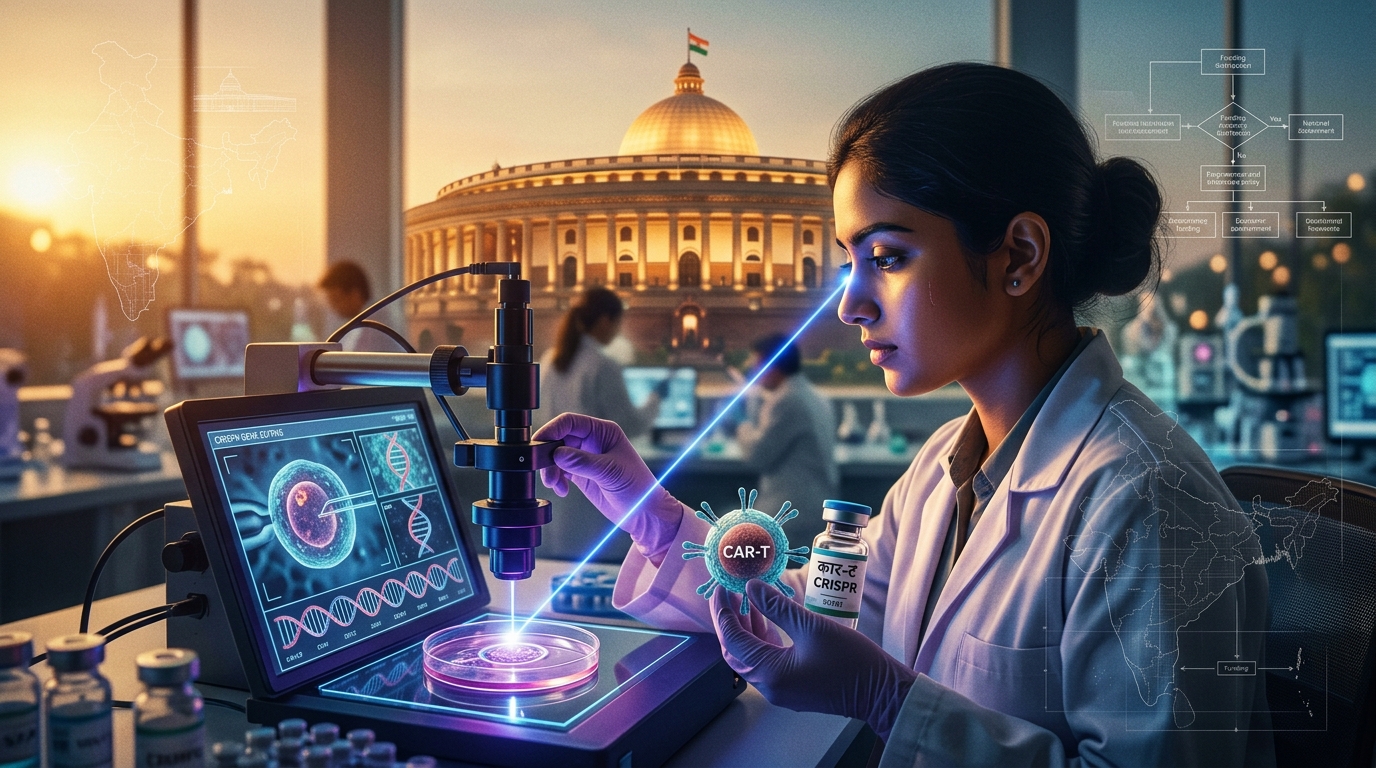
The Ministry of Science & Technology outlined India’s push for self‑reliance in CRISPR and gene‑editing through the 2024 <span class="key-term" data-definition="BioE3 (Biotechnology for Economy, Environment, and Employment) Policy — 2024 policy to make India a biomanufacturing hub (GS3: Science & Technology)">BioE3 Policy</span>, supported by <span class="key-term" data-definition="Department of Biotechnology (DBT) — Ministry of Science & Technology body that formulates biotech policies and funds research (GS3: Science & Technology)">DBT</span>, <span class="key-term" data-definition="BIRAC (Biotechnology Industry Research Assistance Council) — public sector agency under DBT that supports biotech startups (GS3: Science & Technology)">BIRAC</span>, <span class="key-term" data-definition="ICMR (Indian Council of Medical Research) — apex body for biomedical research and ethics in India (GS3: Health)">ICMR</span> and <span class="key-term" data-definition="CDSCO (Central Drugs Standard Control Organisation) — national regulatory authority for drugs and clinical trials (GS3: Health & Pharmaceuticals)">CDSCO</span>. It details regulatory guidelines, funding schemes, and recent clinical milestones such as the Phase‑I gene‑therapy trial for Hemophilia A, underscoring the relevance for UPSC aspirants in health, science, and policy domains.
In response to a Rajya Sabha query, the Ministry of Science &amp; Technology outlined the nation’s strategy to achieve self‑reliance in CRISPR ‑based therapies. The plan hinges on the BioE3 Policy , backed by the DBT , and coordinated regulatory oversight by CDSCO , ICMR and the BIRAC . Key Developments Release of the National Guidelines for Gene Therapy Product Development and Clinical Trials, 2019 by CDSCO, ICMR and DBT. First‑in‑human Phase‑I trial for Hemophilia A gene therapy, showing stable Factor VIII production; results published in the New England Journal of Medicine . BioE3‑funded academic projects targeting Hemophilia A, Thalassaemia, Hemophilia B (mRNA‑based), and CAR‑T therapies for multiple myeloma. DBT grant to Tata Institute for Genetics and Society for an indigenous mRNA‑based in‑vivo gene‑editing platform for propionic academia. Establishment of the मूलांकुर BioEnablers scheme to provide pilot‑scale manufacturing facilities. BIRAC’s programmes – BIG, SEED, LEAP, PPP – supporting biotech start‑ups, including two home‑grown anti‑CD19 CAR‑T products (Qartemi &amp; NexCAR19) now commercially available. ICMR’s grant ecosystem (First‑in‑the‑world‑challenge, Small, Intermediate, Centre for Advanced Research) and support mechanisms like “Biomedical Innovations Patent Mitra”, “MedTechMitra”, and the “Indian Clinical Trial and Education Network (INTENT)” with 85 trial sites. CSIR‑IGIB’s technology transfer to Serum Institute for commercialisation of a novel gene therapy (agreement signed Nov 2025). Important Facts & Regulatory Landscape The biosafety framework operates under the Rules for the Manufacture, Use/Import/Export and Storage of Hazardous Micro‑organisms/Genetically Engineered Organisms or Cells, 1989 , notified by the Environment (Protection) Act, 1986 . Oversight during laboratory work is provided by Institutional Biosafety Committees ( IBSCs ) and the Review Committee on Genetic Manipulation ( RCGM ), guided by the 2017 Recombinant DNA Guidelines and the 2020 IBSC Handbook. Clinical development is regulated by the New Drugs and Clinical Trials (NDCT) Rules, 2019 under the Drugs and Cosmetics Act, 1940. Human subject protection is ensured by Institutional Ethics Committees operating per the ICMR National Ethical Guidelines (2017). After successful trials, a comprehensive dossier on quality, safety and efficacy is submitted to CDSCO for marketing approval. UPSC Relevance Understanding India’s biotech policy framework is essential for GS 3 (Science & Technology) and GS 4 (Ethics) papers. The integration of research, funding, and regulation illustrates the country’s approach to strategic autonomy in health‑care, a recurring theme in UPSC questions on self‑reliance (Atmanirbhar Bharat). The involvement of multiple agencies (DBT, BIRAC, ICMR, CDSCO) showcases inter‑ministerial coordination, relevant for Polity (GS 2) and Governance. Moreover, the ethical oversight mechanisms (IBSC, IEC) tie directly to the Ethics syllabus. Way Forward Scale‑up of successful Phase‑I trials to Phase‑II/III, leveraging the BioEnablers GMP facilities. Strengthen public‑private partnerships to accelerate commercialization of affordable gene‑editing therapeutics. Expand the INTENT network beyond 85 sites to ensure geographic equity in clinical trial participation. Enhance capacity building for regulatory personnel to keep pace with rapid advances in CRISPR and CAR‑T technologies. Promote indigenous intellectual property generation through schemes like “Biomedical Innovations Patent Mitra”. Collectively, these measures aim to create a sustainable pipeline of home‑grown cell and gene therapies, reducing dependence on imports and positioning India as a global biotech hub.
  1. Home
  2. Prepare
  3. Current Affairs
  4. India’s BioE3 Policy Boosts Indigenous CRISPR Gene‑Therapy & CAR‑T Development – Regulatory Frameworks and Funding Highlights
Must Review
Login to bookmark articles
Login to mark articles as complete

Overview

India’s BioE3 drives self‑reliant CRISPR & CAR‑T therapeutics through integrated funding and regulation

Key Facts

  1. BioE3 Policy (2024) aims to make India a biomanufacturing hub for CRISPR‑based gene‑editing and CAR‑T therapies.
  2. National Guidelines for Gene Therapy Product Development and Clinical Trials, 2019 were issued jointly by CDSCO, ICMR and DBT.
  3. First‑in‑human Phase‑I trial for Hemophilia A gene therapy (2025) demonstrated stable Factor VIII production and was published in NEJM.
  4. DBT‑funded BioE3 projects target Hemophilia A, Thalassaemia, Hemophilia B (mRNA) and CAR‑T for multiple myeloma.
  5. BIRAC’s BIG, SEED, LEAP and PPP programmes supported two indigenous anti‑CD19 CAR‑T products – Qartemi and NexCAR19 – now commercially available.
  6. ‘मूलांकुर BioEnablers’ scheme provides GMP‑compliant pilot‑scale facilities for large‑scale cell and gene‑therapy manufacturing.
  7. Gene‑therapy clinical development is regulated by the NDCT Rules, 2019 (Drugs & Cosmetics Act, 1940) with biosafety oversight under the 1989 GMO Rules and Institutional Biosafety Committees.

Background & Context

The push for self‑reliance in advanced biotechnology aligns with the Atmanirbhar Bharat agenda, linking science & technology policy with health security and economic growth. Integrated funding (DBT, BIRAC) and a robust regulatory architecture (CDSCO, ICMR, NDCT Rules) illustrate inter‑ministerial coordination, a key governance theme in UPSC exams.

UPSC Syllabus Connections

Essay•Economy, Development and InequalityGS3•Developments in science and technology and their applicationsEssay•Science, Technology and SocietyPrelims_GS•Biology and HealthGS3•IT, Space, Computers, Robotics, Nano-technology, Bio-technology and IPRGS2•Issues relating to Health, Education, Human ResourcesEssay•Youth, Health and WelfarePrelims_GS•Demographics and Social SectorGS2•Government policies and interventions for developmentGS2•Development processes - role of NGOs, SHGs and stakeholders

Mains Answer Angle

GS 3 – Discuss how the BioE3 policy, coupled with regulatory reforms, can enable India to achieve strategic autonomy in CRISPR and CAR‑T therapeutics.

Full Article

Read Original on pib

Analysis

Practice Questions

GS1
Easy
Prelims MCQ

Regulatory framework for gene therapy

1 marks
4 keywords
GS3
Medium
Mains Short Answer

Regulatory framework for gene‑therapy

10 marks
5 keywords
GS3
Hard
Mains Essay

Science & Technology – Policy & Self‑reliance

25 marks
8 keywords
Related:Daily•Weekly

Loading related articles...

Loading related articles...

Tip: Click articles above to read more from the same date, or use the back button to see all articles.

Explore:Current Affairs·Editorial Analysis·Govt Schemes·Study Materials·Previous Year Questions·UPSC GPT