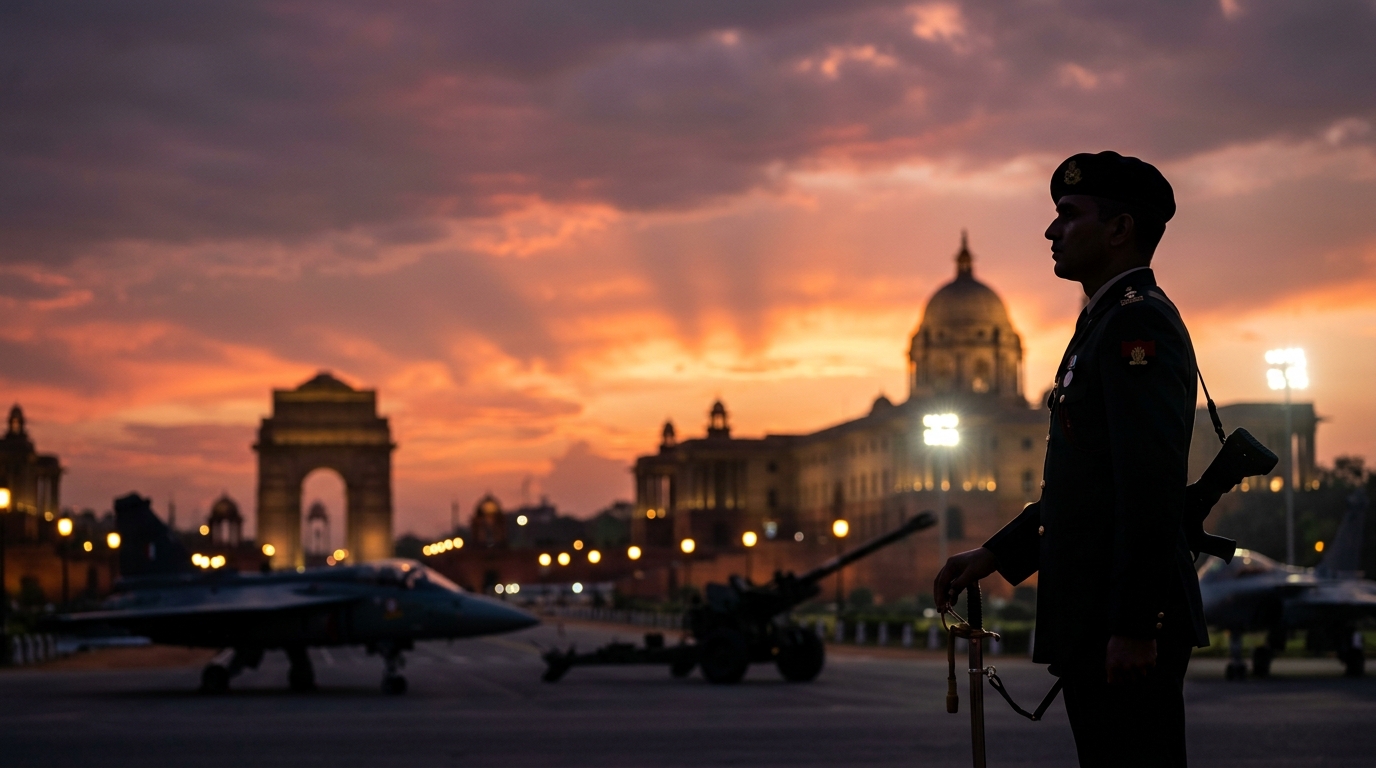
Written by: K M Seethi10 min readNew DelhiUpdated: Apr 1, 2026 02:55 PM ISTSIPRI estimates that India has about 180 nuclear warheads, slightly ahead of Pakistan’s around 170, while China’s arsenal has grown rapidly to about 600 warheads. (File)Make us preferred source on GoogleWhatsapptwitterFacebookRedditPRINTIndia’s defence strategy is shaped not only by global conflicts and rising geopolitical tensions, but also by regional realities and structural factors. Recent data from the Stockholm International Peace Research Institute (SIPRI) shows that India is the second-largest arms importer. However, efforts to gradually shift towards domestic production are underway.
This raises significant questions about India’s defence strategy: Is it aimed at strengthening deterrence without rapid expansion? How is it seeking to reduce dependence on defence imports?
India’s defence spending
The latest report of SIPRI comes at a time when the world is experiencing an unrelenting escalation in conflict. Prolonged conflicts in Ukraine and West Asia, and rivalry in the Indo-Pacific have pushed global military spending to about $2.7 trillion in 2024 – the highest increase in decades.
Many countries in both the Global North and Global South are expanding their forces, investing in advanced weapons, and modernising nuclear arsenals. India’s defence profile also reflects this broader trend, even as both regional and global pressures impact its options and strategies.
SIPRI ranks India as the second-largest arms importer, accounting for 8.3 per cent of global imports in 2020–24. India’s $86.1 billion defence spending places it among the top five globally, but more importantly, it highlights a steady – not aggressive – expansion compared to China’s far larger outlay.
In comparison, China spent about $314 billion, almost four times India’s level, while Pakistan spent about $10.2 billion, far lower in absolute terms but significant in regional balance. These figures show a perceptible gap between India and China, and a significant gap between India and Pakistan.
Must Read | How dual-use technologies shape conflicts, raise legal and ethical questions
Strengthening deterrence without rapid expansion
On the nuclear front, SIPRI estimates that India has about 180 nuclear warheads, slightly ahead of Pakistan’s around 170, while China’s arsenal has grown rapidly to about 600 warheads. China’s expansion has raised the strategic pressure in Asia. India’s response has focused on strengthening its credible deterrence, especially through longer-range missiles and a growing sea-based capability.Story continues below this ad
The defence scenario, by and large, indicates a strategy of sustained modernisation under constraint. India is steadily increasing its capabilities across land, air and sea, while also paying attention to cyber and space domains. Military spending has risen gradually, but it remains around 1.9–2 per cent of GDP, which indicates limits in fiscal space. SIPRI data reveals that India’s imports have declined modestly compared to the previous period, pointing to an effort to expand domestic production.
India’s defence strategy, therefore, reflects a difficult balancing act. It is responding to a demanding security environment dictated by China’s rise and Pakistan’s alignment with China. Delhi is strengthening deterrence without rapid expansion. It is importing key systems while building local capacity.Don't Miss | How India’s nuclear energy programme transitions from uranium to thorium
Diversifying imports
India’s dependence on foreign arms remains a major challenge in its defence profile, though its pattern has changed over time. SIPRI data shows that India continues to rely on imports for major platforms, even as domestic production expands.
The supplier base has shifted over the past decade. Russia remains India’s largest supplier, but its share has fallen over the years – from about 60–70 per cent in the early 2010s to around 36–38 per cent in 2020–24. Meanwhile, France has emerged as a major partner, accounting for about 29–33 per cent of imports. The United States accounts for around 13 per cent of India’s defence imports, while Israel accounts for about 9–10 per cent. Story continues below this ad
This shows a clear move towards diversification and points to efforts towards reducing reliance on a single source. Russia still plays a key role, especially for legacy systems and missile platforms. France has become central through combat aircraft and submarine cooperation. The United States contributes to maritime surveillance and advanced aviation systems. Israel provides drones, sensors, and precision technologies.
Also Read | War lessons for military: Procure anti-drone systems, integrate them with legacy weapon system to create effective umbrella
Growth of domestic production
The composition of imports also reveals India’s priorities. SIPRI data indicates that aircraft account for about 29 per cent, missiles about 23 per cent, armoured vehicles around 14 per cent, and naval platforms about 13 per cent of imports. This implies a focus on air power, precision strike, and maritime capability.
Over time, there has been a decline of about 4–9 per cent in import volumes compared with the previous five-year period. SIPRI links this to the growth of domestic production under policies such as Atmanirbharta. Meanwhile, dependence continues in high-technology areas such as engines, advanced electronics, and air defence systems.
India is also watching the regional security scenario. Pakistan’s imports have increased, with China supplying nearly 80 per cent of its arms. Beijing itself is largely self-reliant and exports arms, which strengthens its strategic position. Plausibly, India sits in an uncomfortable middle ground – no longer heavily dependent on a single supplier, but far from self-sufficient.Story continues below this ad
Regional and global security conditions
These dynamics underline how regional security conditions, alongside geopolitical tensions, shape India’s defence imports. SIPRI data and regional trends show that military demand grows when security risks become higher and more frequent.
The most significant factor is China. Its defence spending of over $300 billion, rapid modernisation, expansion of naval presence, and infrastructure build-up along the Line of Actual Control have created sustained pressure on India.
Pakistan is another factor. Although Pakistan’s spending is much lower, its military modernisation has been supported by China. SIPRI data underline that Pakistan’s arms imports have increased significantly, and its reliance on Chinese platforms has grown, creating a form of strategic coordination between the two countries.
Global trends also matter. SIPRI reports that global arms transfers increased by 9.2 per cent between 2021 and 2025, indicating a wider turn towards militarisation. Supply chains have become tighter due to ongoing conflicts in West Asia and Ukraine. Technology races in drones, missiles and cyber capabilities are accelerating. In such an environment, countries prefer to secure capabilities early rather than wait.Story continues below this ad
Must Read | How India’s defence spending is aligned with its regional ambition
Procurement needs for India
For India, these pressures also translate into urgent procurement needs. Systems such as Rafale aircraft, S-400 air defence, drones, and surveillance platforms address immediate gaps. Domestic production cannot always meet these needs in time. For now, imports act as a bridge between present requirements and future capability.
There is also a structural factor. India faces a two-front challenge, with long borders and maritime interests. This requires readiness across multiple domains at once. The demand for weapons is therefore not limited to one service or one theatre. It spans air defence, naval expansion, land mobility, and new domains.
In this scenario, India’s imports are driven by a mix of urgency, scale, and technological need. They indicate a response to a changing security environment rather than a simple preference for foreign systems.
Also Read | Rising water stress and inter-state river disputes
Self-reliance, diversification, and vision 2047SIPRI data noted that while India’s defence imports remain high, there is a gradual shift towards domestic production. Delhi’s defence strategy combines immediate security requirements with long-term goals of self-reliance, evident in its strategies like diversification and Defence Vision 2047. Story continues below this ad
Diversification – Diversification of suppliers not just reduces dependence on one supplier but also helps manage risks arising from global conflicts, such as supply disruptions linked to the war in Ukraine and West Asia.
The Defence Vision 2047 – The framework outlines a plan to build a multi-domain, technology-driven military. It emphasises integration across services, use of artificial intelligence, drones, cyber capabilities, and space-based systems. It also links defence production to economic goals, aiming to build a strong domestic industry.
What is clear is that immediate needs continue to influence decisions. The recent approval to procure five additional S-400 long range surface-to-air missile systems reflects this urgency. Such acquisitions are expected to address present risks while domestic capabilities are still evolving.
Hence, India’s defence profile, as reflected in SIPRI 2025, presents a country in transition. It is diversifying suppliers, building domestic industry, and investing in new technologies. SIPRI’s data hints that this trend will continue in the coming years. Imports will remain part of the system, especially for high-end technology. Domestic production will grow slowly. Ultimately, everything depends on how quickly India can close the gap between ambition and capacity.Story continues below this ad
Post read questions
How shifting global security dynamics are influencing India’s defence strategy. Discuss with reference to the recent data from the Stockholm International Peace Research Institute.
India’s $86.1 billion defence spending places it among the top five globally. But does this show a steady – not aggressive – expansion compared to China’s far larger outlay?
India’s defence strategy combines immediate security requirements with long-term goals of self-reliance, evident in its strategies like diversification and Defence Vision 2047. Illustrate.
China’s military rise has altered the strategic balance in Asia. Examine its implications for India’s defence preparedness and strategic choices. Story continues below this ad
Discuss the impact of the China–Pakistan strategic partnership on India’s security calculus.
(K.M. Seethi is the Director of Inter University Centre for Social Science Research and Extension (IUCSSRE), Mahatma Gandhi University (MGU), Kerala, and former Senior Professor of International Relations at the same university.)
Share your thoughts and ideas on UPSC Special articles with [email protected].
Click Here to read the UPSC Essentials magazine for February 2026. Subscribe to our UPSC newsletter and stay updated with the news cues from the past week.
Stay updated with the latest UPSC articles by joining our Telegram channel – IndianExpress UPSC Hub, and follow us on Instagram and X.Expand © IE Online Media Services Pvt LtdTags:Current Affairsgovernment jobsSarkari NaukriUPSCUPSC Civil ServicesUPSC Civil Services ExamUPSC EssentialsUPSC Specials
Loading page, please wait…