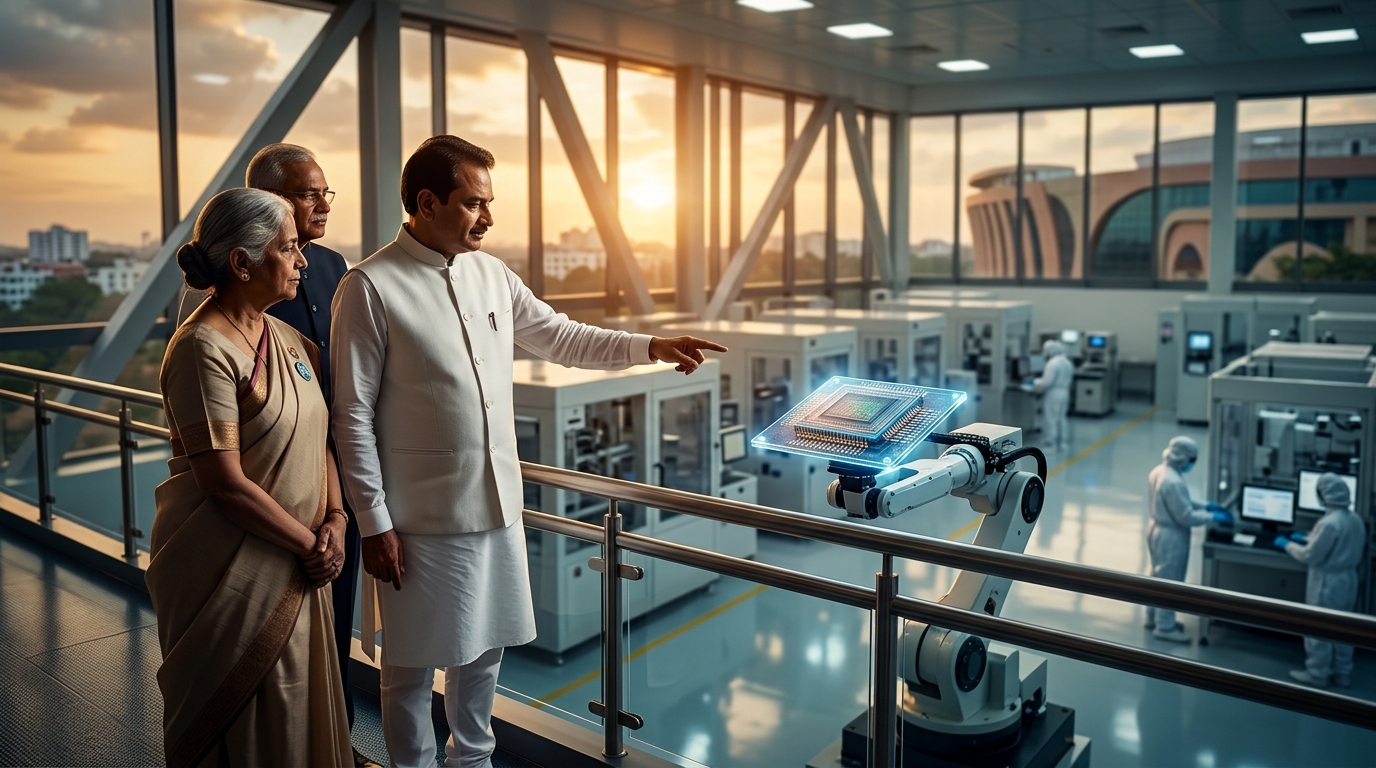
The foundation stone for India’s inaugural 3D glass semiconductor technology unit was laid in Bhubaneswar by CM Mohan Charan Majhi and Union IT Minister Ashwini Vaishnaw. The plant marks a major stride in the India Semiconductor Mission (ISM) and the broader Semicon India programme.
Key Developments
- Project executed by US‑based 3D Glass Solutions Inc via its wholly‑owned Indian arm Heterogeneous Integration Packaging Solutions Pvt Ltd.
- Funding includes a strategic investment from Intel, whose CEO Lip‑Bu Tan joined the ceremony virtually.
- The plant is expected to produce 70,000 glass panels and 50 million assembled units annually, along with about 13,000 advanced 3DHI modules.
- The project cost is Rs 1,934 crore, approved under ISM last year.
- It follows a September 2024 US‑India partnership to assess India’s semiconductor ecosystem, workforce and infrastructure needs.
Important Facts
Unlike conventional silicon substrates, glass offers lower electrical loss, superior radio‑frequency performance and better thermal stability, making it ideal for high‑frequency passive components. The Bhubaneswar facility will handle assembly and packaging of these glass‑based chips, positioning India in the global supply chain for advanced packaging services.
Semiconductors, often dubbed the “new oil”, are integral to sectors such as communications, computing, defence, healthcare and clean energy. Their design‑to‑fabrication pathway is capital‑intensive, requiring sophisticated fabs, testing and packaging infrastructure – areas that India aims to develop domestically.
Exam Relevance
- Understanding Vikram 3201 helps answer questions on indigenous technology and strategic self‑reliance.
- The ISM and Semicon India schemes illustrate how the government uses policy tools (financial incentives, design‑linked schemes) to build strategic industries – a typical GS‑3 (Economy) topic.
- The collaboration with the United States reflects India’s diplomatic and economic engagement in high‑technology sectors, relevant for GS‑2 (Polity) and GS‑3 (Economy) discussions on international partnerships.
- Key terms such as 3D glass semiconductor technology and ATMP/OSAT are likely to appear in MCQs on emerging technologies.
Way Forward
To fully leverage the plant, India must strengthen the ancillary ecosystem: skilled manpower, supply of high‑purity glass, and robust testing facilities. Continued US‑India cooperation, coupled with domestic R&D incentives, can accelerate the transition from assembly‑only to full‑scale fab capabilities. Monitoring the performance of this plant will provide insights into the effectiveness of ISM’s policy framework and guide future investments in the semiconductor sector.