Overview
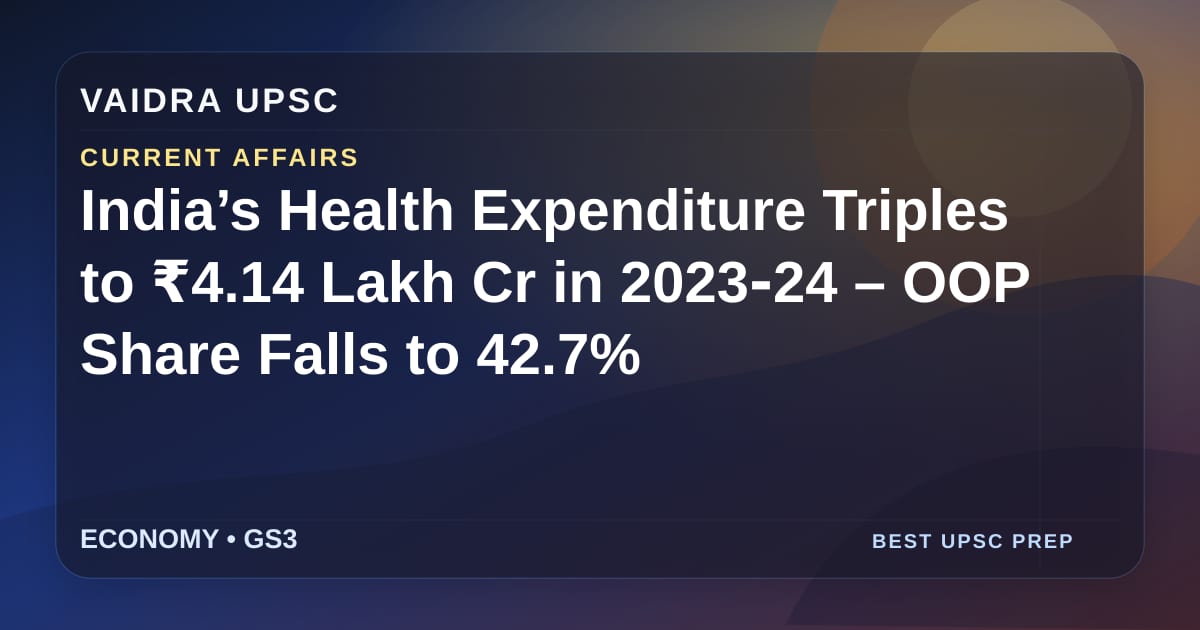
The Union Health Ministry’s latest National Health Accounts (NHA) shows that total health outlay rose from ₹1.30 lakh crore in 2013‑14 to ₹4.14 lakh crore in 2023‑24. During the same period, the share of household out‑of‑pocket spending dropped from 64.2% to 42.7%.
Key Developments
- Public health financing grew by 14.9 percentage points, raising the government’s share of total health expenditure.
- Per‑capita government health spending increased from ₹1,042 to ₹2,959, nearly a three‑fold rise.
- Social‑security health spending rose from 6% to 11% of total health outlay.
- Private health‑insurance share climbed from 3.4% to 10.2%.
- Expenditure on primary healthcare reached about ₹1.53 lakh crore in 2023‑24.
Important Facts
The decline in OOP spending continued from 43.4% in 2022‑23 to 42.7% in 2023‑24, reflecting the expanding role of government‑supported services. Major schemes contributing to this trend include:
- Ayushman Bharat‑PMJAY
- Ayushman Arogya Mandirs
- Pradhan Mantri National Dialysis Programme
- Pradhan Mantri Bhartiya Janaushadhi Pariyojana and AMRIT pharmacies for affordable medicines.
Exam Relevance
Understanding the shift in health financing is crucial for GS III (Economy & Development). The data illustrate how fiscal policy, social security, and insurance mechanisms interact to improve financial protection – a core topic in the health‑sector sub‑section of the Indian Economy. Candidates should link these trends to the broader goals of Universal Health Coverage and the Sustainable Development Goals (SDGs).
Way Forward
To sustain the downward OOP trend, the government may need to:
- Increase the budgetary allocation for public health financing beyond the current level.
- Strengthen the regulatory framework for private insurers to ensure wider coverage and affordability.
- Expand primary‑care networks, especially in rural and underserved areas, to reduce dependence on costly tertiary care.
- Monitor the impact of existing schemes through robust data systems like the NHA.
Continued focus on these areas will help India move closer to a financially protective, accessible health system.