Loading page, please wait…
HomeCurrent AffairsEditorialsGovt SchemesLearning ResourcesUPSC SyllabusPricingAboutBest UPSC AIUPSC AI ToolAI for UPSCUPSC ChatGPT

© 2026 Vaidra. All rights reserved.

PrivacyTerms
Vaidra Logo
Vaidra

Top 4 items + smart groups

UPSC GPT
New
Current Affairs
Daily Solutions
Daily Puzzle
Mains Evaluator

Version 2.0.0 • Built with ❤️ for UPSC aspirants

Iranian Delegation Meets Pakistan Officials as US Team Arrives for Ceasefire Talks | GS2 UPSC Current Affairs April 2026
Iranian Delegation Meets Pakistan Officials as US Team Arrives for Ceasefire Talks
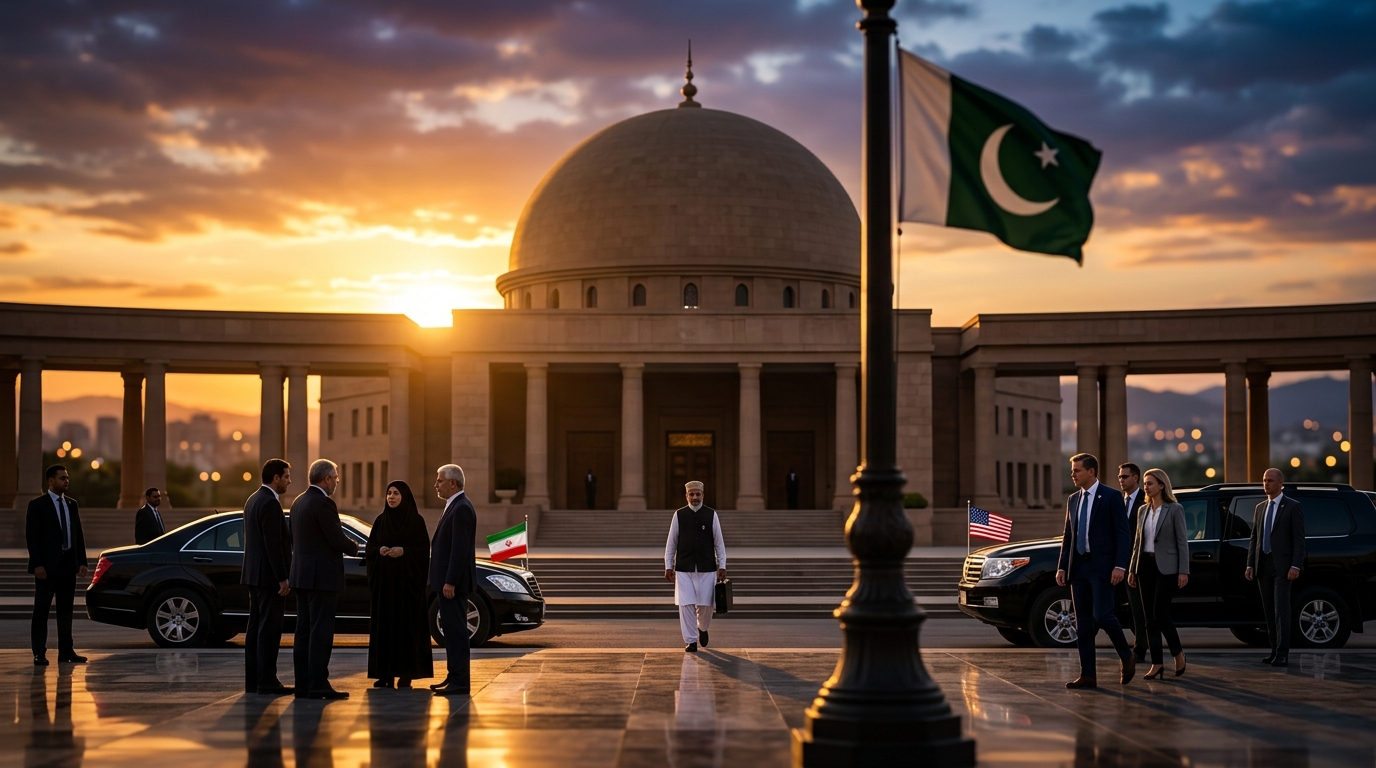
On 11 April 2026, an Iranian delegation led by the Speaker of the Iranian Parliament arrived in Islamabad and met Pakistani officials, followed by a U.S. team headed by Vice President J.D. Vance. The talks aim to turn a recent two‑week ceasefire into a permanent peace arrangement, building on a U.S.‑proposed 15‑point plan and highlighting Pakistan’s mediating role, a topic of relevance for UPSC aspirants studying international diplomacy and regional security.
In the early hours of Saturday, 11 April 2026 , a high‑level Iranian delegation led by Mohammad‑Bagher Ghalibaf , the Speaker of the Iranian Parliament , landed in Islamabad. They were received by Field Marshal Asim Munir and Foreign Minister Mohammed Ishaq Dar . Shortly after, the U.S. negotiating team arrived, headed by Vice President J.D. Vance , special envoy Steve Witkoff and former senior adviser Jared Kushner . The talks aim to cement a permanent ceasefire after a two‑week pause declared the previous week. Key Developments Iranian delegation meets Pakistani senior officials on 11 April 2026. U.S. team, including the Vice President, arrives in Islamabad for direct talks. Both sides seek to convert the temporary ceasefire into a lasting arrangement. The United States had earlier shared a 15‑point plan with Tehran, as reported on 24 March 2026. Pakistan’s Gen. Asim Munir is said to have handed the plan to Iran, maintaining contacts with the IRGC . Important Facts The 15‑point plan was transmitted more than three weeks after the United States and Israel began bombing Iran. The plan’s delivery was facilitated by Pakistan, highlighting Islamabad’s role as a regional mediator. The backdrop to these talks includes the recent assassination of Supreme Leader Ayatollah Ali Khamenei by a joint U.S.–Israeli strike, which has intensified Iran’s internal security dynamics and the prominence of the IRGC . UPSC Relevance These developments touch upon several UPSC themes: (i) India’s foreign policy and its strategic partnership with Pakistan in conflict mediation; (ii) the role of regional powers in de‑escalating South‑West Asian crises; (iii) the impact of high‑level diplomatic engagements on global security architecture , especially concerning nuclear‑armed states; and (iv) the functioning of parliamentary leadership and military‑civil relations in Iran, exemplified by the involvement of the Speaker and the Field Marshal . Way Forward For a durable peace, both the United States and Iran will need to address core issues such as sanctions, nuclear safeguards, and regional proxy conflicts. Pakistan’s continued facilitation could evolve into a formal mediation framework, while India may monitor the process to safeguard its own strategic interests in the region. UPSC aspirants should track subsequent diplomatic communiqués and any parliamentary debates in India and Pakistan that reference these talks.
  1. Home
  2. Prepare
  3. Current Affairs
  4. Iranian Delegation Meets Pakistan Officials as US Team Arrives for Ceasefire Talks
Login to bookmark articles
Login to mark articles as complete

Overview

gs.gs275% UPSC Relevance

Pakistan mediates US‑Iran ceasefire talks, reshaping regional security dynamics

Key Facts

  1. 11 April 2026: Iranian parliamentary delegation led by Speaker Mohammad‑Bagher Ghalibaf arrived in Islamabad.
  2. U.S. negotiating team arrived the same day, headed by Vice President J.D. Vance, envoy Steve Witkoff and former adviser Jared Kushner.
  3. Both delegations aim to convert the two‑week pause into a permanent ceasefire between the United States and Iran.
  4. The U.S. had shared a 15‑point ceasefire plan with Tehran on 24 March 2026, conveyed via Pakistan’s Gen. Asim Munir.
  5. Pakistan’s Field Marshal Asim Munir handed the plan to Iran, maintaining contacts with the Islamic Revolutionary Guard Corps (IRGC).
  6. The talks follow the joint U.S.–Israeli strike that killed Supreme Leader Ayatollah Ali Khamenei, intensifying regional security concerns.

Background & Context

The negotiations sit at the intersection of South‑West Asian security, nuclear non‑proliferation and the role of regional powers as mediators. For UPSC, they illustrate how parliamentary leadership, civil‑military relations in Iran and Pakistan’s diplomatic posture influence India’s foreign‑policy calculus and the broader global security architecture.

UPSC Syllabus Connections

Prelims_GS•Constitution and Political System

Mains Answer Angle

GS2 – Discuss the implications of Pakistan’s mediation in US‑Iran ceasefire talks for India’s strategic interests and regional stability. The answer can examine diplomatic, security and constitutional dimensions of mediation.

Full Article

<p>In the early hours of <strong>Saturday, 11 April 2026</strong>, a high‑level Iranian delegation led by <strong>Mohammad‑Bagher Ghalibaf</strong>, the <span class="key-term" data-definition="Iranian Parliament (Majlis) — the unicameral legislative body of Iran, responsible for law‑making and oversight (GS2: Polity)">Speaker of the Iranian Parliament</span>, landed in Islamabad. They were received by <strong>Field Marshal Asim Munir</strong> and <strong>Foreign Minister Mohammed Ishaq Dar</strong>. Shortly after, the U.S. negotiating team arrived, headed by <strong>Vice President J.D. Vance</strong>, special envoy <strong>Steve Witkoff</strong> and former senior adviser <strong>Jared Kushner</strong>. The talks aim to cement a permanent <span class="key-term" data-definition="Ceasefire — a mutually agreed suspension of hostilities, often used as a step toward conflict resolution (GS4: Ethics, GS2: Polity)">ceasefire</span> after a two‑week pause declared the previous week.</p> <h3>Key Developments</h3> <ul> <li>Iranian delegation meets Pakistani senior officials on 11&#160;April&#160;2026.</li> <li>U.S. team, including the Vice President, arrives in Islamabad for direct talks.</li> <li>Both sides seek to convert the temporary ceasefire into a lasting arrangement.</li> <li>The United States had earlier shared a <span class="key-term" data-definition="15‑point plan — a diplomatic proposal outlining steps for ending the war between the United States and Iran (GS2: Polity)">15‑point plan</span> with Tehran, as reported on 24&#160;March&#160;2026.</li> <li>Pakistan’s <strong>Gen. Asim Munir</strong> is said to have handed the plan to Iran, maintaining contacts with the <span class="key-term" data-definition="Islamic Revolutionary Guard Corps (IRGC) — a powerful paramilitary force that influences Iran’s security and foreign policy (GS2: Polity)">IRGC</span>.</li> </ul> <h3>Important Facts</h3> <p>The 15‑point plan was transmitted more than three weeks after the United States and <strong>Israel</strong> began bombing Iran. The plan’s delivery was facilitated by Pakistan, highlighting Islamabad’s role as a regional mediator. The backdrop to these talks includes the recent assassination of <span class="key-term" data-definition="Supreme Leader Ayatollah Ali Khamenei — the highest authority in Iran’s political system (GS2: Polity)">Supreme Leader Ayatollah Ali Khamenei</span> by a joint U.S.–Israeli strike, which has intensified Iran’s internal security dynamics and the prominence of the <span class="key-term" data-definition="Islamic Revolutionary Guard Corps (IRGC) — a powerful paramilitary force that influences Iran’s security and foreign policy (GS2: Polity)">IRGC</span>.</p> <h3>UPSC Relevance</h3> <p>These developments touch upon several UPSC themes: (i) <strong>India’s foreign policy</strong> and its strategic partnership with Pakistan in conflict mediation; (ii) the role of <strong>regional powers</strong> in de‑escalating South‑West Asian crises; (iii) the impact of high‑level diplomatic engagements on <strong>global security architecture</strong>, especially concerning nuclear‑armed states; and (iv) the functioning of parliamentary leadership and military‑civil relations in Iran, exemplified by the involvement of the <span class="key-term" data-definition="Speaker of the Iranian Parliament — the presiding officer of Iran’s legislative body, influencing foreign‑policy discourse (GS2: Polity)">Speaker</span> and the <span class="key-term" data-definition="Field Marshal — the highest rank in the Pakistan Army, often involved in strategic decision‑making (GS2: Polity)">Field Marshal</span>.</p> <h3>Way Forward</h3> <p>For a durable peace, both the United States and Iran will need to address core issues such as sanctions, nuclear safeguards, and regional proxy conflicts. Pakistan’s continued facilitation could evolve into a formal mediation framework, while India may monitor the process to safeguard its own strategic interests in the region. UPSC aspirants should track subsequent diplomatic communiqués and any parliamentary debates in India and Pakistan that reference these talks.</p>
Read Original on hindu

Analysis

Practice Questions

GS2
Medium
Prelims MCQ

US‑Iran diplomatic initiatives

1 marks
3 keywords
GS2
Easy
Mains Short Answer

Regional mediation and India’s strategic interests

10 marks
4 keywords
GS2
Hard
Mains Essay

Global security architecture and parliamentary‑military relations

25 marks
5 keywords
Related:Daily•Weekly

Loading related articles...

Loading related articles...

Tip: Click articles above to read more from the same date, or use the back button to see all articles.

Quick Reference

Key Insight

Pakistan mediates US‑Iran ceasefire talks, reshaping regional security dynamics

Key Facts

  1. 11 April 2026: Iranian parliamentary delegation led by Speaker Mohammad‑Bagher Ghalibaf arrived in Islamabad.
  2. U.S. negotiating team arrived the same day, headed by Vice President J.D. Vance, envoy Steve Witkoff and former adviser Jared Kushner.
  3. Both delegations aim to convert the two‑week pause into a permanent ceasefire between the United States and Iran.
  4. The U.S. had shared a 15‑point ceasefire plan with Tehran on 24 March 2026, conveyed via Pakistan’s Gen. Asim Munir.
  5. Pakistan’s Field Marshal Asim Munir handed the plan to Iran, maintaining contacts with the Islamic Revolutionary Guard Corps (IRGC).
  6. The talks follow the joint U.S.–Israeli strike that killed Supreme Leader Ayatollah Ali Khamenei, intensifying regional security concerns.

Background

The negotiations sit at the intersection of South‑West Asian security, nuclear non‑proliferation and the role of regional powers as mediators. For UPSC, they illustrate how parliamentary leadership, civil‑military relations in Iran and Pakistan’s diplomatic posture influence India’s foreign‑policy calculus and the broader global security architecture.

UPSC Syllabus

  • Prelims_GS — Constitution and Political System

Mains Angle

GS2 – Discuss the implications of Pakistan’s mediation in US‑Iran ceasefire talks for India’s strategic interests and regional stability. The answer can examine diplomatic, security and constitutional dimensions of mediation.

Explore:Current Affairs·Editorial Analysis·Govt Schemes·Study Materials·Previous Year Questions·UPSC GPT