Iranian Missile Strikes on Dimona & Arad and US Ultimatum over Strait of Hormuz – Implications for UPSC — UPSC Current Affairs | March 22, 2026
Iranian Missile Strikes on Dimona & Arad and US Ultimatum over Strait of Hormuz – Implications for UPSC
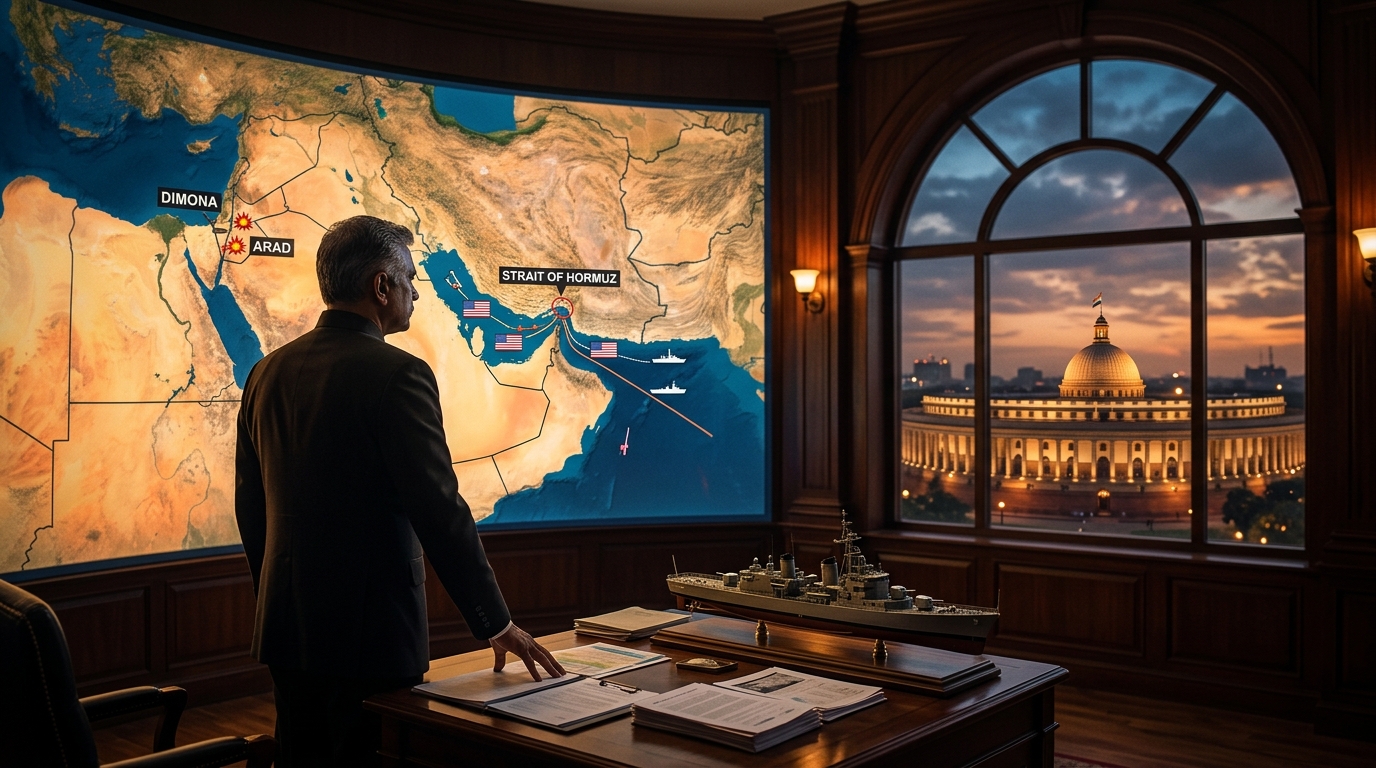
Iran launched missile strikes on the Israeli towns of Dimona and Arad, near Israel’s nuclear research centre, while also targeting the U.K.-U.S. base on Diego Garcia. In response, President <strong>Donald Trump</strong> issued a 48‑hour ultimatum to Iran to reopen the <span class="key-term" data-definition="Strait of Hormuz — a narrow maritime passage linking the Persian Gulf with the Gulf of Oman; vital for global oil shipments and a strategic flashpoint in South‑West Asia (GS3: Economy, International Relations)">Strait of Hormuz</span>, threatening to destroy Iranian power plants, escalating the conflict into a new, potentially nuclear‑escalation phase.
On 21 March 2026 , Iran fired missiles that hit the Israeli towns of Dimona and Arad . The attacks occurred shortly after Iran’s strike on the Natanz enrichment site. Simultaneously, Iran attempted a missile strike on the U.K.–U.S. Diego Garcia base, suggesting an expanded missile range. Key Developments (Bullet Points) Iranian missiles hit Dimona and Arad , causing extensive building damage and at least 64 injuries . Israel’s air‑defence systems failed to intercept the missiles, marking the first penetration near its nuclear centre. President Donald Trump posted a 48‑hour ultimatum demanding Iran reopen the Strait of Hormuz or face attacks on Iranian power plants. Iran warned any strike on its energy assets would trigger retaliation against U.S. and Israeli infrastructure. U.S. Central Command reported degradation of Iran’s anti‑ship missile capability after precision bombings. International bodies, including the IAEA , confirmed no radiation leak from Dimona. Important Facts • Dimona lies ~20 km west of Israel’s nuclear research centre; Arad is ~35 km north. • Iran’s missile strike on Natanz preceded the Israeli attacks, indicating a tit‑for‑tat escalation. • The attempted strike on Diego Garcia suggests Iran may be employing a two‑stage ICBM or repurposing space launch vehicles. UPSC Relevance The episode touches upon multiple GS papers: • GS‑2 (Polity & International Relations) – State behaviour, nuclear non‑proliferation, and the role of strategic waterways. • GS‑3 (Economy & Security) – Impact of Hormuz disruptions on global oil prices, energy security, and defence procurement. • GS‑4 (Ethics & Integrity) – Decision‑making under crisis, use of nuclear‑related threats, and international law concerning maritime chokepoints. Way Forward Diplomatic channels must be intensified to de‑escalate the Hormuz crisis, possibly via the UN Security Council. India and other oil‑importing nations should diversify energy sources to mitigate supply shocks. Strengthen regional missile‑defence cooperation, especially for vulnerable chokepoints. Monitor IAEA reports for any nuclear safety breaches, ensuring compliance with the Non‑Proliferation Treaty. For UPSC aspirants, understanding the intertwining of strategic geography, nuclear politics, and energy economics is crucial for answering questions on contemporary security challenges.
Must Review
Login to bookmark articles
Login to mark articles as complete
Overview
Iran‑Israel missile exchange threatens nuclear sites and global oil flow, testing diplomatic resolve
Key Facts
21 Mar 2026: Iran launched missiles that struck Dimona (near Israel’s nuclear research centre) and Arad, injuring at least 64 people.
Israel’s air‑defence systems failed to intercept the missiles – the first known penetration near the Dimona nuclear facility.
22 Mar 2026: US President Donald Trump gave Iran a 48‑hour ultimatum to reopen the Strait of Hormuz or face attacks on its power plants.
Iran’s earlier missile strike on the Natanz uranium‑enrichment plant preceded the Israeli attacks, indicating a tit‑for‑tat escalation.
US Central Command reported that precision bombings have degraded Iran’s anti‑ship missile capability.
The IAEA confirmed there was no radiation leak from Dimona after the missile impact.
Iran attempted a missile strike on the British‑US Diego Garcia base, signalling a possible ICBM‑level reach.
Background & Context
The episode intertwines nuclear non‑proliferation, strategic maritime chokepoints and energy security – core themes of GS‑2 (International Relations) and GS‑3 (Economy & Security). It underscores how regional missile exchanges can disrupt global oil supplies via the Strait of Hormuz and raise concerns over the safety of nuclear installations.
UPSC Syllabus Connections
Essay•International Relations and GeopoliticsPrelims_GS•Constitution and Political SystemPrelims_GS•Physics and Chemistry in Everyday LifeEssay•Media, Communication and InformationPrelims_GS•International Current AffairsGS3•Cyber security and communication networks in internal securityEssay•Democracy, Governance and Public AdministrationGS1•World Wars and redrawal of national boundariesEssay•Science, Technology and SocietyEssay•Youth, Health and Welfare
Mains Answer Angle
In a GS‑2 answer, candidates can evaluate the geopolitical fallout of the Iran‑Israel missile exchange and the US ultimatum, linking it to regional stability, nuclear diplomacy and global energy markets.