Loading page, please wait…
HomeCurrent AffairsEditorialsGovt SchemesLearning ResourcesUPSC SyllabusPricingAboutBest UPSC AIUPSC AI ToolAI for UPSCUPSC ChatGPT

© 2026 Vaidra. All rights reserved.

PrivacyTerms
Vaidra Logo
Vaidra

Top 4 items + smart groups

UPSC GPT
New
Current Affairs
Daily Solutions
Daily Puzzle
Mains Evaluator

Version 2.0.0 • Built with ❤️ for UPSC aspirants

ISRO Completes Second Integrated Air Drop Test (IADT‑02) for Gaganyaan Mission – Key Milestone for India’s First Crewed Spaceflight | GS3 UPSC Current Affairs April 2026
ISRO Completes Second Integrated Air Drop Test (IADT‑02) for Gaganyaan Mission – Key Milestone for India’s First Crewed Spaceflight
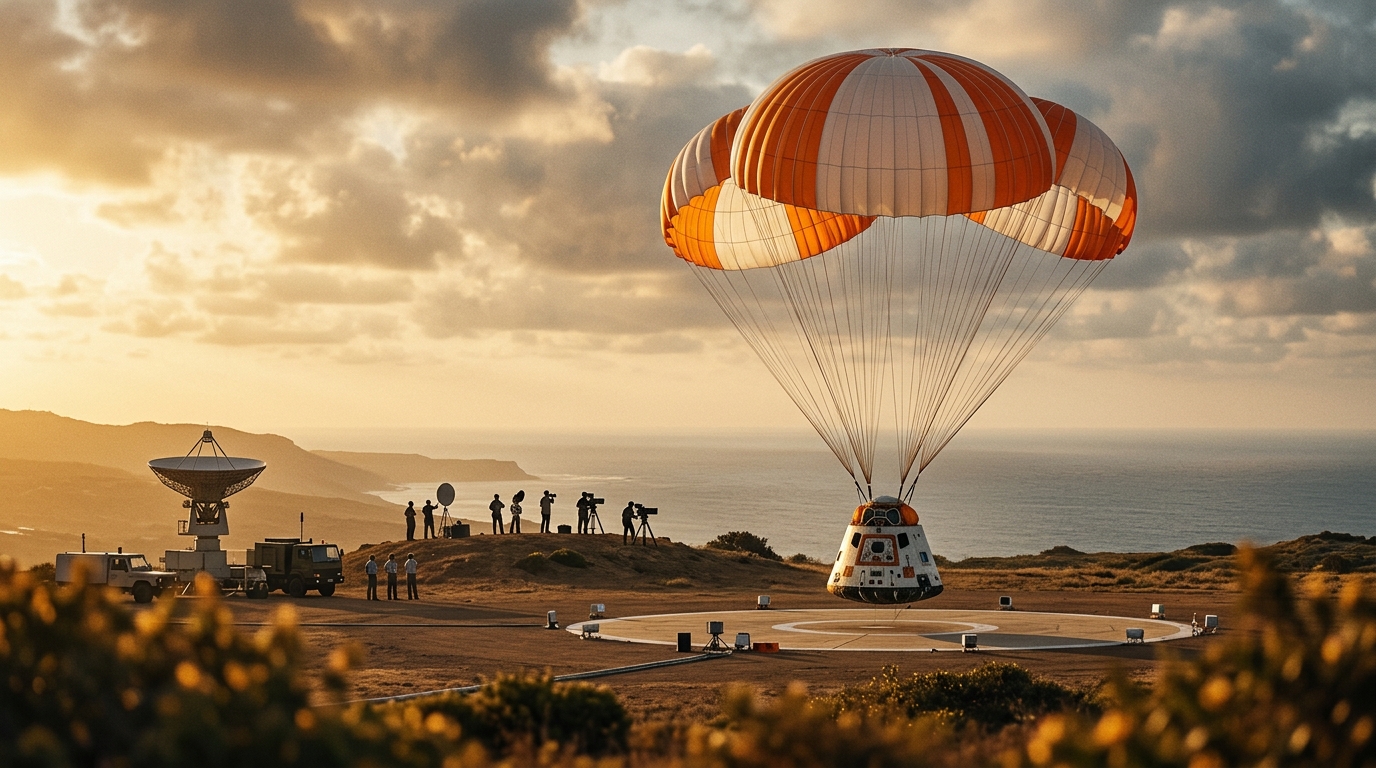
ISRO successfully conducted the second Integrated Air Drop Test (IADT‑02) on 10 April 2026 at the Satish Dhawan Space Centre, validating the parachute‑based deceleration system for the Gaganyaan crew module. The test, involving the Indian Air Force, Navy and DRDO, marks a critical milestone toward India’s first crewed spaceflight slated for 2027, highlighting the nation’s advancing space technology and inter‑agency coordination.
Overview The IADT‑02 was successfully carried out on 10 April 2026 at the Satish Dhawan Space Centre , Sriharikota. The test is part of the Gaganyaan programme, which targets its first human flight in 2027. Key Developments A simulated Crew Module weighing 5.7 tonnes was lifted by an Indian Air Force Chinook helicopter to an altitude of about 3 km and released over the sea. During descent, 10 parachutes of four types were deployed in a pre‑programmed sequence, gradually reducing the velocity of the module. The module was recovered by the Indian Navy in coordination with ISRO, confirming the reliability of the parachute‑based deceleration system . The test demonstrated seamless cooperation among ISRO, the DRDO , the Indian Navy and the Indian Air Force. Important Facts Date: 10 April 2026 Location: Satish Dhawan Space Centre , Sriharikota Test Objective: Validate the parachute‑based deceleration and recovery mechanisms for the crew module ahead of the crewed flight. Mass of simulated module: 5.7 tonnes (same as the actual crew module for the first uncrewed Gaganyaan mission, G1). Parachute configuration: 10 parachutes, four distinct types, deployed sequentially. Stakeholder participation: ISRO, Indian Air Force , Indian Navy, DRDO . UPSC Relevance The successful IADT‑02 underscores India’s growing capabilities in space technology , a key topic under GS‑3 (Science & Technology). It also illustrates inter‑agency coordination (ISRO, IAF, Navy, DRDO), relevant for GS‑2 (Polity) questions on institutional collaboration and national security. The test’s outcome directly impacts the timeline of the Gaganyaan crewed mission, reflecting India’s strategic intent in the global space race. Way Forward Proceed to the final integrated flight test of the crew module, incorporating data from IADT‑02. Complete the certification of all parachute systems and recovery protocols before the scheduled crewed launch in 2027. Strengthen joint operational frameworks among ISRO, the armed forces and DRDO to ensure mission safety and reliability. Leverage the successful test to showcase India’s indigenous space capabilities in diplomatic engagements and international collaborations.
  1. Home
  2. Prepare
  3. Current Affairs
  4. ISRO Completes Second Integrated Air Drop Test (IADT‑02) for Gaganyaan Mission – Key Milestone for India’s First Crewed Spaceflight
Must Review
Login to bookmark articles
Login to mark articles as complete

Overview

gs.gs380% UPSC Relevance

IADT‑02 clears a critical safety hurdle, boosting India’s 2027 crewed spaceflight ambition.

Key Facts

  1. IADT‑02 was conducted on 10 April 2026 at Satish Dhawan Space Centre, Sriharikota.
  2. A 5.7‑tonne simulated crew module was lifted to ~3 km by an Indian Air Force Chinook helicopter before being released.
  3. The descent employed 10 parachutes of four distinct types in a programmed sequence to achieve safe splash‑down.
  4. Recovery of the module was executed by the Indian Navy in coordination with ISRO and DRDO.
  5. The test validates the parachute‑based deceleration and recovery system for Gaganyaan’s crew module ahead of the 2027 crewed flight.
  6. Stakeholders: ISRO, Indian Air Force, Indian Navy, Defence Research & Development Organisation.

Background & Context

The Integrated Air Drop Test (IADT) is a ground‑based demonstration of the crew module’s re‑entry safety system, a critical component of the Gaganyaan programme – India’s first indigenous crewed orbital mission. Successful validation underscores India’s growing self‑reliance in space technology (GS‑3) and showcases inter‑agency coordination among civilian and defence establishments (GS‑2).

UPSC Syllabus Connections

Prelims_GS•Science and Technology ApplicationsEssay•Science, Technology and SocietyGS3•Developments in science and technology and their applicationsGS3•Various security forces and agenciesGS1•Poverty and Developmental Issues

Mains Answer Angle

In a Mains answer, discuss how IADT‑02 reflects India’s strategic push for indigenous human spaceflight and the role of inter‑institutional collaboration in achieving technological self‑sufficiency. (GS‑3 – Science & Technology; GS‑2 – Polity & Governance).

Full Article

<h3>Overview</h3> <p>The <span class="key-term" data-definition="Integrated Air Drop Test (IADT) — a ground‑based demonstration of the parachute and recovery system for the crew module, essential for validating re‑entry safety (GS3: Science & Technology)">IADT‑02</span> was successfully carried out on <strong>10 April 2026</strong> at the <span class="key-term" data-definition="Satish Dhawan Space Centre — ISRO’s primary launch site at Sriharikota, named after former ISRO chairman, hosting satellite launches and test missions (GS3: Science & Technology)">Satish Dhawan Space Centre</span>, Sriharikota. The test is part of the <span class="key-term" data-definition="Gaganyaan — India’s indigenous crewed spaceflight programme aiming for a crewed orbital mission, a flagship of the nation’s space ambitions (GS3: Science & Technology)">Gaganyaan</span> programme, which targets its first human flight in 2027.</p> <h3>Key Developments</h3> <ul> <li>A simulated <span class="key-term" data-definition="Crew Module — the pressurised capsule that houses astronauts during launch, re‑entry and landing, analogous to a spacecraft’s ‘capsule’ (GS3: Science & Technology)">Crew Module</span> weighing <strong>5.7 tonnes</strong> was lifted by an <span class="key-term" data-definition="Indian Air Force (IAF) — the aerial warfare branch of the Indian Armed Forces, providing logistical support such as heavy‑lift helicopters (GS2: Polity)">Indian Air Force</span> <strong>Chinook</strong> helicopter to an altitude of about <strong>3 km</strong> and released over the sea.</li> <li>During descent, <strong>10 parachutes of four types</strong> were deployed in a pre‑programmed sequence, gradually reducing the velocity of the module.</li> <li>The module was recovered by the <strong>Indian Navy</strong> in coordination with ISRO, confirming the reliability of the <span class="key-term" data-definition="Parachute‑based deceleration system — a set of sequentially deployed parachutes that reduce the descent speed of the crew module for safe splash‑down (GS3: Science & Technology)">parachute‑based deceleration system</span>.</li> <li>The test demonstrated seamless cooperation among ISRO, the <span class="key-term" data-definition="Defence Research & Development Organisation (DRDO) — India’s premier agency for research and development in defence technologies, collaborating on space‑related projects (GS2: Polity)">DRDO</span>, the Indian Navy and the Indian Air Force.</li> </ul> <h3>Important Facts</h3> <ul> <li><strong>Date:</strong> 10 April 2026</li> <li><strong>Location:</strong> <span class="key-term" data-definition="Satish Dhawan Space Centre — ISRO’s primary launch site at Sriharikota, named after former ISRO chairman, hosting satellite launches and test missions (GS3: Science & Technology)">Satish Dhawan Space Centre</span>, Sriharikota</li> <li><strong>Test Objective:</strong> Validate the parachute‑based deceleration and recovery mechanisms for the crew module ahead of the crewed flight.</li> <li><strong>Mass of simulated module:</strong> 5.7 tonnes (same as the actual crew module for the first uncrewed Gaganyaan mission, G1).</li> <li><strong>Parachute configuration:</strong> 10 parachutes, four distinct types, deployed sequentially.</li> <li><strong>Stakeholder participation:</strong> ISRO, <span class="key-term" data-definition="Indian Air Force (IAF) — the aerial warfare branch of the Indian Armed Forces, providing logistical support such as heavy‑lift helicopters (GS2: Polity)">Indian Air Force</span>, Indian Navy, <span class="key-term" data-definition="Defence Research & Development Organisation (DRDO) — India’s premier agency for research and development in defence technologies, collaborating on space‑related projects (GS2: Polity)">DRDO</span>.</li> </ul> <h3>UPSC Relevance</h3> <p>The successful <span class="key-term" data-definition="Integrated Air Drop Test (IADT) — a ground‑based demonstration of the parachute and recovery system for the crew module, essential for validating re‑entry safety (GS3: Science & Technology)">IADT‑02</span> underscores India’s growing capabilities in <strong>space technology</strong>, a key topic under GS‑3 (Science & Technology). It also illustrates inter‑agency coordination (ISRO, IAF, Navy, DRDO), relevant for GS‑2 (Polity) questions on institutional collaboration and national security. The test’s outcome directly impacts the timeline of the <span class="key-term" data-definition="Gaganyaan — India’s indigenous crewed spaceflight programme aiming for a crewed orbital mission, a flagship of the nation’s space ambitions (GS3: Science & Technology)">Gaganyaan</span> crewed mission, reflecting India’s strategic intent in the global space race.</p> <h3>Way Forward</h3> <ul> <li>Proceed to the final integrated flight test of the crew module, incorporating data from IADT‑02.</li> <li>Complete the certification of all parachute systems and recovery protocols before the scheduled crewed launch in 2027.</li> <li>Strengthen joint operational frameworks among ISRO, the armed forces and DRDO to ensure mission safety and reliability.</li> <li>Leverage the successful test to showcase India’s indigenous space capabilities in diplomatic engagements and international collaborations.</li> </ul>
Read Original on hindu

Analysis

Practice Questions

GS3
Easy
Prelims MCQ

Space technology validation

1 marks
4 keywords
GS2
Medium
Mains Short Answer

Institutional coordination in defence and space programmes

10 marks
3 keywords
GS3
Hard
Mains Essay

Science & Technology – Indigenous space capability and its broader impact

25 marks
5 keywords
Related:Daily•Weekly

Loading related articles...

Loading related articles...

Tip: Click articles above to read more from the same date, or use the back button to see all articles.

Quick Reference

Key Insight

IADT‑02 clears a critical safety hurdle, boosting India’s 2027 crewed spaceflight ambition.

Key Facts

  1. IADT‑02 was conducted on 10 April 2026 at Satish Dhawan Space Centre, Sriharikota.
  2. A 5.7‑tonne simulated crew module was lifted to ~3 km by an Indian Air Force Chinook helicopter before being released.
  3. The descent employed 10 parachutes of four distinct types in a programmed sequence to achieve safe splash‑down.
  4. Recovery of the module was executed by the Indian Navy in coordination with ISRO and DRDO.
  5. The test validates the parachute‑based deceleration and recovery system for Gaganyaan’s crew module ahead of the 2027 crewed flight.
  6. Stakeholders: ISRO, Indian Air Force, Indian Navy, Defence Research & Development Organisation.

Background

The Integrated Air Drop Test (IADT) is a ground‑based demonstration of the crew module’s re‑entry safety system, a critical component of the Gaganyaan programme – India’s first indigenous crewed orbital mission. Successful validation underscores India’s growing self‑reliance in space technology (GS‑3) and showcases inter‑agency coordination among civilian and defence establishments (GS‑2).

UPSC Syllabus

  • Prelims_GS — Science and Technology Applications
  • Essay — Science, Technology and Society
  • GS3 — Developments in science and technology and their applications
  • GS3 — Various security forces and agencies
  • GS1 — Poverty and Developmental Issues

Mains Angle

In a Mains answer, discuss how IADT‑02 reflects India’s strategic push for indigenous human spaceflight and the role of inter‑institutional collaboration in achieving technological self‑sufficiency. (GS‑3 – Science & Technology; GS‑2 – Polity & Governance).

Explore:Current Affairs·Editorial Analysis·Govt Schemes·Study Materials·Previous Year Questions·UPSC GPT