Loading page, please wait…
HomeCurrent AffairsEditorialsGovt SchemesLearning ResourcesUPSC SyllabusPricingAboutBest UPSC AIUPSC AI ToolAI for UPSCUPSC ChatGPT

© 2026 Vaidra. All rights reserved.

PrivacyTerms
Vaidra Logo
Vaidra

Top 4 items + smart groups

UPSC GPT
New
Current Affairs
Daily Solutions
Daily Puzzle
Mains Evaluator

Version 2.0.0 • Built with ❤️ for UPSC aspirants

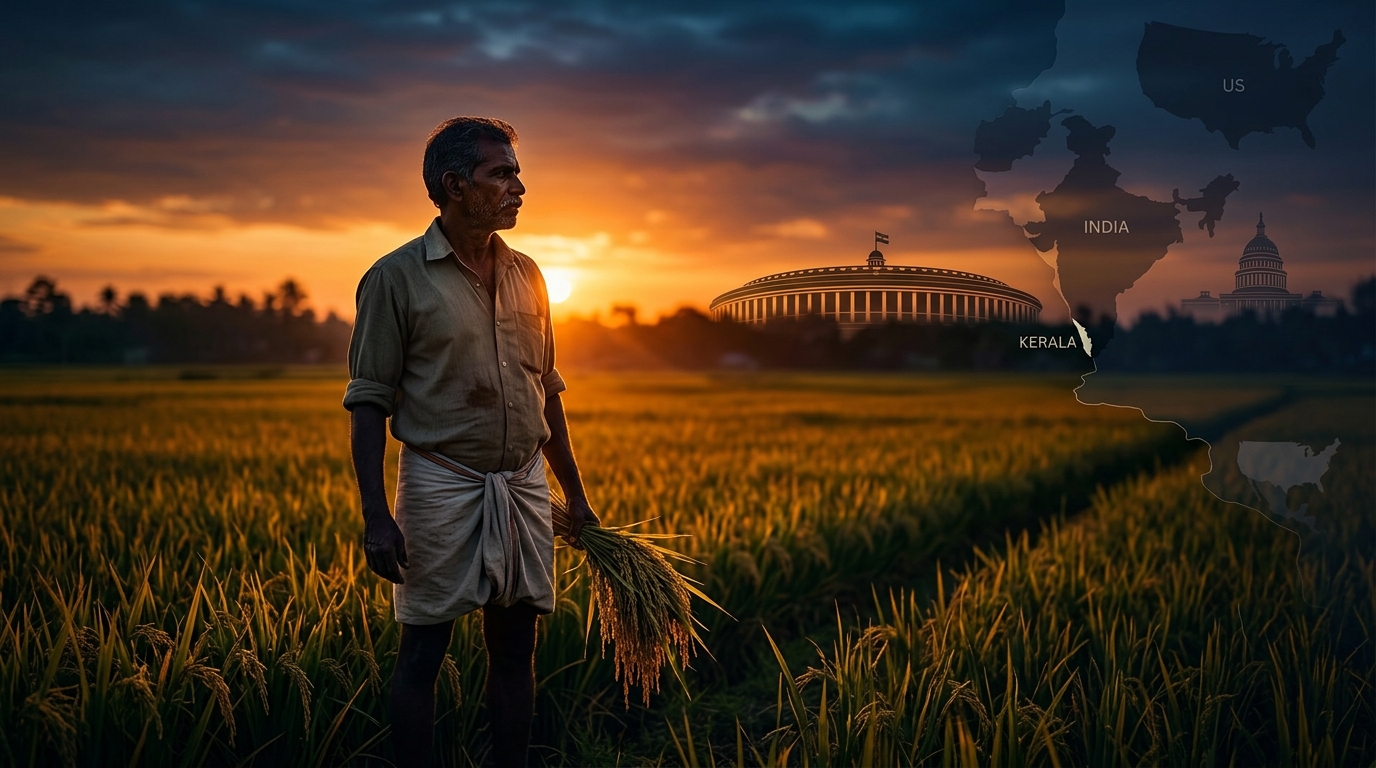
Kerala’s Paddy Bonus Row: CM Vijayan Challenges Centre’s Demand Amid Indo‑US Trade Deal

Kerala’s Paddy Bonus Row: CM Vijayan Challenges Centre’s Demand Amid Indo‑US Trade Deal
Kerala’s CM Pinarayi Vijayan has asked the Union to drop its demand to end the state’s extra paddy bonus of ₹6.31 kg⁻¹, calling the Centre’s storage‑cost argument a challenge to farmers and linking the issue to the Indo‑U.S. trade deal and payment backlogs.
Overview On 8 February 2026 , Chief Minister Pinarayi Vijayan of Kerala publicly demanded that the Union Government withdraw its request to discontinue the additional bonus paid to paddy farmers. The controversy stems from a letter sent by the Union Finance Expenditure Secretary to the Kerala Chief Secretary, urging the state to stop the extra incentive of ₹6.31 per kg that Kerala pays over the central Minimum Support Price (MSP) . The CM framed the Centre’s stance as a challenge to farmers and linked it to the recent Indo‑U.S. trade deal and existing payment backlogs. Key Developments Development 1: The Union Finance Expenditure Secretary wrote to Kerala’s Chief Secretary asking the state to discontinue the additional paddy bonus, arguing that higher production would increase storage costs for the public exchequer. Development 2: CM Vijayan rebutted the Centre’s justification, labeling it a "strange justification" and asserting that it amounts to a "challenge to the farmers" and an adversarial attitude towards agriculture. Development 3: Vijayan questioned whether the demand was a direct outcome of opening Indian markets to American farm products under the recent Indo‑U.S. trade agreement and highlighted the Centre’s backlog in disbursing its share of aid to paddy farmers. Important Facts Fact 1: Kerala’s state‑level bonus for paddy is ₹6.31 per kilogram above the central MSP, reflecting a policy to support farmer incomes. Fact 2: The controversy was reported on 08 February 2026 at 06:05 pm IST , indicating the timeliness of the centre‑state fiscal dispute. UPSC Relevance This issue intersects multiple sections of the UPSC syllabus. In GS Paper II (Polity & Governance) , it exemplifies centre‑state relations, fiscal federalism, and the role of the Finance Ministry in agricultural policy. In GS Paper III (Economics & Agriculture) , it touches upon agricultural price support mechanisms, food security, and the impact of international trade agreements on domestic agrarian sectors. The case also offers material for optional subjects such as Public Administration (policy implementation) and Agricultural Economics (price incentives and market liberalisation). Potential question angles include: the constitutional provisions governing agricultural subsidies, the economic rationale behind MSP and state bonuses, and the implications of the Indo‑U.S. trade deal on Indian agriculture. Way Forward For a sustainable resolution, the Centre could consider a collaborative framework that balances fiscal prudence with farmer welfare—perhaps by sharing storage cost burdens or by integrating the state bonus into a broader national agri‑incentive scheme. Simultaneously, transparent accounting of aid disbursements and a clear assessment of the Indo‑U.S. trade deal’s impact on domestic paddy markets would mitigate misunderstandings. A policy dialogue involving the Ministry of Agriculture, the Finance Ministry, and state governments is essential to align objectives and preserve agricultural stability.
  1. Home
  2. Prepare
  3. Current Affairs
  4. Kerala’s Paddy Bonus Row: CM Vijayan Challenges Centre’s Demand Amid Indo‑US Trade Deal
Must Review
Login to bookmark articles
Login to mark articles as complete

Overview

gs.gs278% UPSC Relevance

Full Article

<h2>Overview</h2> <p>On <strong>8 February 2026</strong>, <strong>Chief Minister Pinarayi Vijayan</strong> of <strong>Kerala</strong> publicly demanded that the <strong>Union Government</strong> withdraw its request to discontinue the additional bonus paid to paddy farmers. The controversy stems from a letter sent by the Union Finance Expenditure Secretary to the Kerala Chief Secretary, urging the state to stop the extra incentive of <strong>₹6.31 per kg</strong> that Kerala pays over the central <strong>Minimum Support Price (MSP)</strong>. The CM framed the Centre’s stance as a challenge to farmers and linked it to the recent <strong>Indo‑U.S. trade deal</strong> and existing payment backlogs.</p> <h3>Key Developments</h3> <ul> <li><strong>Development 1:</strong> The Union Finance Expenditure Secretary wrote to Kerala’s Chief Secretary asking the state to discontinue the additional paddy bonus, arguing that higher production would increase storage costs for the public exchequer.</li> <li><strong>Development 2:</strong> CM Vijayan rebutted the Centre’s justification, labeling it a "strange justification" and asserting that it amounts to a "challenge to the farmers" and an adversarial attitude towards agriculture.</li> <li><strong>Development 3:</strong> Vijayan questioned whether the demand was a direct outcome of opening Indian markets to American farm products under the recent Indo‑U.S. trade agreement and highlighted the Centre’s backlog in disbursing its share of aid to paddy farmers.</li> </ul> <h3>Important Facts</h3> <ul> <li><strong>Fact 1:</strong> Kerala’s state‑level bonus for paddy is <strong>₹6.31 per kilogram</strong> above the central MSP, reflecting a policy to support farmer incomes.</li> <li><strong>Fact 2:</strong> The controversy was reported on <strong>08 February 2026</strong> at <strong>06:05 pm IST</strong>, indicating the timeliness of the centre‑state fiscal dispute.</li> </ul> <h3>UPSC Relevance</h3> <p>This issue intersects multiple sections of the UPSC syllabus. In <strong>GS Paper II (Polity & Governance)</strong>, it exemplifies centre‑state relations, fiscal federalism, and the role of the Finance Ministry in agricultural policy. In <strong>GS Paper III (Economics & Agriculture)</strong>, it touches upon agricultural price support mechanisms, food security, and the impact of international trade agreements on domestic agrarian sectors. The case also offers material for optional subjects such as <strong>Public Administration</strong> (policy implementation) and <strong>Agricultural Economics</strong> (price incentives and market liberalisation). Potential question angles include: the constitutional provisions governing agricultural subsidies, the economic rationale behind MSP and state bonuses, and the implications of the Indo‑U.S. trade deal on Indian agriculture.</p> <h3>Way Forward</h3> <p>For a sustainable resolution, the Centre could consider a collaborative framework that balances fiscal prudence with farmer welfare—perhaps by sharing storage cost burdens or by integrating the state bonus into a broader national agri‑incentive scheme. Simultaneously, transparent accounting of aid disbursements and a clear assessment of the Indo‑U.S. trade deal’s impact on domestic paddy markets would mitigate misunderstandings. A policy dialogue involving the Ministry of Agriculture, the Finance Ministry, and state governments is essential to align objectives and preserve agricultural stability.</p>
Read Original

Kerala’s Paddy Bonus Clash Highlights Centre‑State Fiscal Federalism amid Trade Liberalisation

Key Facts

  1. Kerala pays an extra ₹6.31 per kilogram over the central Minimum Support Price (MSP) to paddy farmers.
  2. On 8 February 2026, the Union Finance Expenditure Secretary wrote to Kerala’s Chief Secretary urging the state to stop the bonus.
  3. CM Pinarayi Vijayan rejected the Centre’s demand, calling it a "challenge to farmers" and linking it to the Indo‑U.S. trade deal.
  4. The Centre’s justification is that higher paddy production will raise storage costs for the exchequer.
  5. The dispute raises issues of fiscal federalism, agricultural subsidies and the impact of international trade agreements on domestic agriculture.
  6. The Centre has a backlog in disbursing its share of aid to paddy farmers, as highlighted by the Kerala government.

Background & Context

The row pits the Union's fiscal prudence against a state’s welfare commitment, testing the limits of centre‑state financial relations under India’s federal structure. It also illustrates how a trade agreement (Indo‑U.S.) can reverberate in domestic agricultural pricing and subsidy policies, a key intersection of polity and economics for UPSC.

UPSC Syllabus Connections

GS2•Government policies and interventions for developmentGS2•Functions and responsibilities of Union and StatesGS2•Effect of policies of developed and developing countries on India

Mains Answer Angle

GS2 – Centre‑State Relations; GS3 – Agricultural Economics. Candidates can discuss fiscal federalism, the constitutional basis for subsidies and the trade‑policy implications of the Indo‑U.S. deal.

Analysis

Practice Questions

GS2
Easy
Prelims MCQ

Fiscal Federalism / Agricultural Subsidies

1 marks
4 keywords
GS2
Medium
Mains Short Answer

Centre‑State financial relations

10 marks
4 keywords
GS2
Hard
Mains Essay

International trade agreements and domestic agriculture

25 marks
5 keywords
Related:Daily•Weekly

Loading related articles...

Loading related articles...

Tip: Click articles above to read more from the same date, or use the back button to see all articles.

Quick Reference

Key Insight

Kerala’s Paddy Bonus Clash Highlights Centre‑State Fiscal Federalism amid Trade Liberalisation

Key Facts

  1. Kerala pays an extra ₹6.31 per kilogram over the central Minimum Support Price (MSP) to paddy farmers.
  2. On 8 February 2026, the Union Finance Expenditure Secretary wrote to Kerala’s Chief Secretary urging the state to stop the bonus.
  3. CM Pinarayi Vijayan rejected the Centre’s demand, calling it a "challenge to farmers" and linking it to the Indo‑U.S. trade deal.
  4. The Centre’s justification is that higher paddy production will raise storage costs for the exchequer.
  5. The dispute raises issues of fiscal federalism, agricultural subsidies and the impact of international trade agreements on domestic agriculture.
  6. The Centre has a backlog in disbursing its share of aid to paddy farmers, as highlighted by the Kerala government.

Background

The row pits the Union's fiscal prudence against a state’s welfare commitment, testing the limits of centre‑state financial relations under India’s federal structure. It also illustrates how a trade agreement (Indo‑U.S.) can reverberate in domestic agricultural pricing and subsidy policies, a key intersection of polity and economics for UPSC.

UPSC Syllabus

  • GS2 — Government policies and interventions for development
  • GS2 — Functions and responsibilities of Union and States
  • GS2 — Effect of policies of developed and developing countries on India

Mains Angle

GS2 – Centre‑State Relations; GS3 – Agricultural Economics. Candidates can discuss fiscal federalism, the constitutional basis for subsidies and the trade‑policy implications of the Indo‑U.S. deal.

Explore:Current Affairs·Editorial Analysis·Govt Schemes·Study Materials·Previous Year Questions·UPSC GPT

Related Topics

  • 📚Subject TopicIndia can significantly enhance Africa’s food security
  • 📚Subject TopicWhat are Deccan High-Level Principles on Food Security and Nutrition 2023?
  • 📚Subject TopicWhat are Devolution High-Level Principles on Food Security and Nutrition 2023?
  • 📰Current Affairs‘Double‑Engine Sarkar’ Debate: Fiscal Federalism, Governor’s Role & Need for Reform
Kerala’s Paddy Bonus Row: CM Vijayan Chall... | UPSC Current Affairs