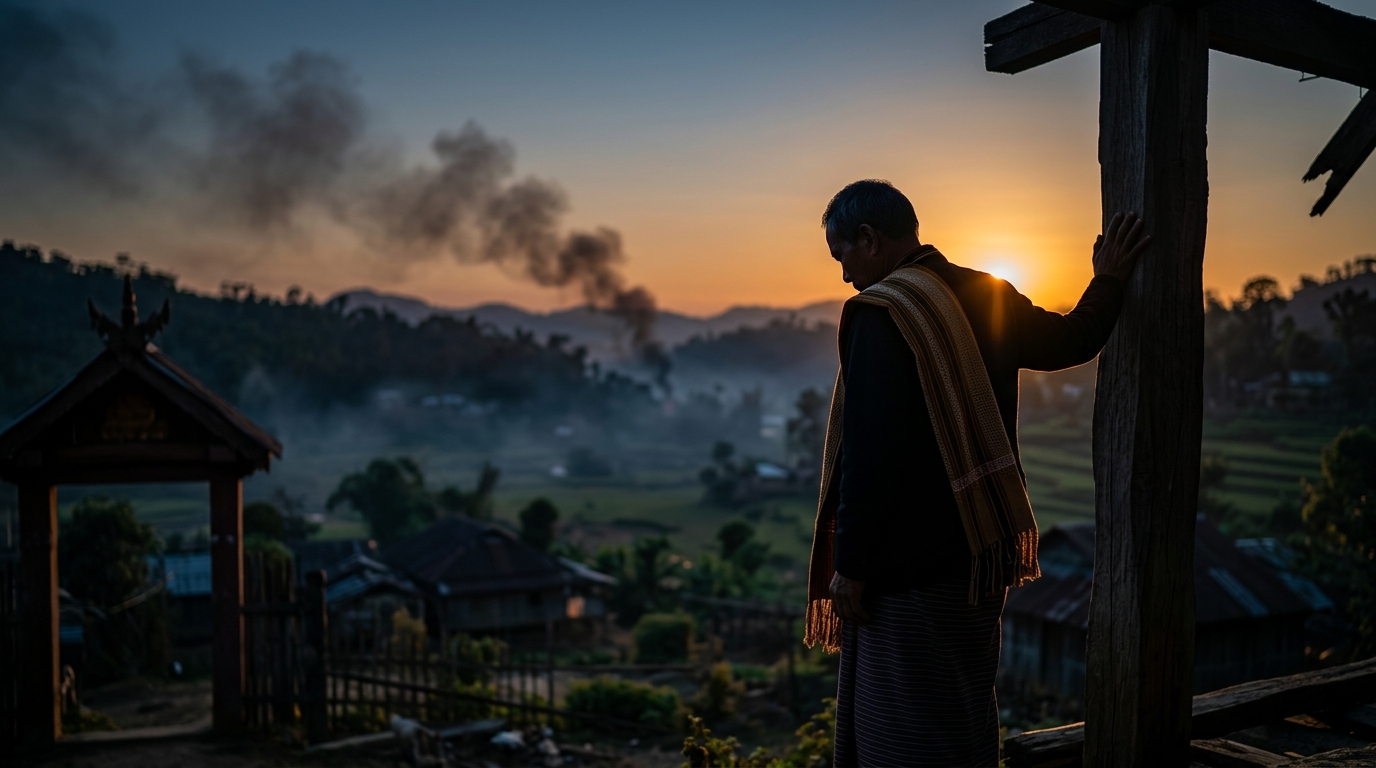
<p><span class="key-term" data-definition="Manipur — A northeastern Indian state plagued by recurring ethnic clashes between Meitei and Kuki communities (GS2: Polity, GS4: Ethics)">Manipur</span> has slipped back into violent confrontations after a bomb blast on 7 April that killed a five‑year‑old boy and an infant girl in Bishnupur district. The incident revived accusations against a <span class="key-term" data-definition="Kuki extremist organisation — Alleged militant groups linked to the Kuki community; their involvement is often denied by mainstream Kuki bodies (GS2: Polity)">Kuki extremist organisation</span>, sparking fresh protests, retaliatory attacks and a surge of rumours across the valley.</p>
<h3>Key Developments</h3>
<ul>
<li>Bomb blast on 7 April 2026 in Bishnupur district kills two children.</li>
<li>Alleged involvement of a Kuki extremist group is denied by mainstream Kuki organisations, leading to widespread protests.</li>
<li>Violence escalates with reports of arson, stone‑throwing and further casualties in both Meitei‑dominant and Kuki‑dominant areas.</li>
<li>The <span class="key-term" data-definition="Bharatiya Janata Party (BJP) — India’s ruling party at the centre, currently holding power in most states and influencing Union‑level policy (GS2: Polity)">BJP</span> installed <strong>Yumnam Khemchand Singh</strong> as Chief Minister after a spell of <span class="key-term" data-definition="President’s Rule — Constitutional provision (Article 356) where the central government assumes control of a state’s administration due to breakdown of constitutional machinery (GS2: Polity)">President’s Rule</span>.</li>
<li>Union‑level response remains limited; the <span class="key-term" data-definition="Home Ministry — Central ministry responsible for internal security, law and order, and coordination with state police forces (GS2: Polity)">Home Ministry</span> has not launched a comprehensive peace‑building mission.</li>
</ul>
<h3>Important Facts</h3>
<p>The new state government, led by <span class="key-term" data-definition="Yumnam Khemchand Singh — Chief Minister of Manipur since 2026, a moderate figure attempting to rise above ethnic politics (GS2: Polity)">Yumnam Khemchand Singh</span>, is perceived as a nominal attempt by the <span class="key-term" data-definition="Bharatiya Janata Party (BJP) — India’s ruling party at the centre, currently holding power in most states and influencing Union‑level policy (GS2: Polity)">BJP</span> to project a moderate image before upcoming elections. However, the administration’s engagement with <span class="key-term" data-definition="civil society — Non‑governmental organisations, community leaders and NGOs that can mediate conflict and promote peace (GS4: Ethics)">civil society</span> remains superficial, and hard‑line elements on both sides continue to wield influence.</p>
<p>Security agencies, including the state police and central paramilitary forces, have been deployed but lack a clear mandate to curb extremist activities. The absence of a “carrot‑and‑stick” strategy—simultaneously rewarding peace advocates and penalising perpetrators—has allowed the cycle of retaliation to persist.</p>
<h3>UPSC Relevance</h3>
<p>Understanding the <span class="key-term" data-definition="Manipur — A northeastern Indian state plagued by recurring ethnic clashes between Meitei and Kuki communities (GS2: Polity, GS4: Ethics)">Manipur</span> crisis is vital for GS‑2 (Polity) as it illustrates the challenges of federalism, centre‑state relations, and the use of <span class="key-term" data-definition="President’s Rule — Constitutional provision (Article 356) where the central government assumes control of a state’s administration due to breakdown of constitutional machinery (GS2: Polity)">President’s Rule</span>. The episode also underscores the role of the <span class="key-term" data-definition="Home Ministry — Central ministry responsible for internal security, law and order, and coordination with state police forces (GS2: Polity)">Home Ministry</span> in conflict management, a frequent GS‑2 question. Moreover, the interplay of ethnic identity, misinformation and the responsibilities of <span class="key-term" data-definition="civil society — Non‑governmental organisations, community leaders and NGOs that can mediate conflict and promote peace (GS4: Ethics)">civil society</span> ties into GS‑4 (Ethics) topics on communal harmony and governance ethics.</p>
<h3>Way Forward</h3>
<ul>
<li>Adopt a balanced "carrot‑and‑stick" approach: empower moderate community leaders, provide incentives for peace initiatives, and enforce strict action against extremist groups.</li>
<li>Mobilise the <span class="key-term" data-definition="Home Ministry — Central ministry responsible for internal security, law and order, and coordination with state police forces (GS2: Polity)">Home Ministry</span> to lead a coordinated peace‑building mission involving all political parties, tribal councils and NGOs.</li>
<li>Strengthen the capacity of <span class="key-term" data-definition="security agencies — State police and central paramilitary forces tasked with maintaining law and order (GS2: Polity)">security agencies</span> to act decisively against bombings and other violent acts, while ensuring respect for human rights.</li>
<li>Launch a robust information‑management cell to counter disinformation, rumours and hate speech that fuel ethnic polarisation.</li>
<li>Encourage the <span class="key-term" data-definition="Bharatiya Janata Party (BJP) — India’s ruling party at the centre, currently holding power in most states and influencing Union‑level policy (GS2: Polity)">BJP</span> to involve opposition leaders in dialogue, thereby reducing political monopolisation of hard‑line narratives.</li>
</ul>
<p>Without these measures, <span class="key-term" data-definition="Manipur — A northeastern Indian state plagued by recurring ethnic clashes between Meitei and Kuki communities (GS2: Polity, GS4: Ethics)">Manipur</span> is likely to remain trapped in a cycle of violence, undermining both regional stability and the broader goal of national integration.</p>