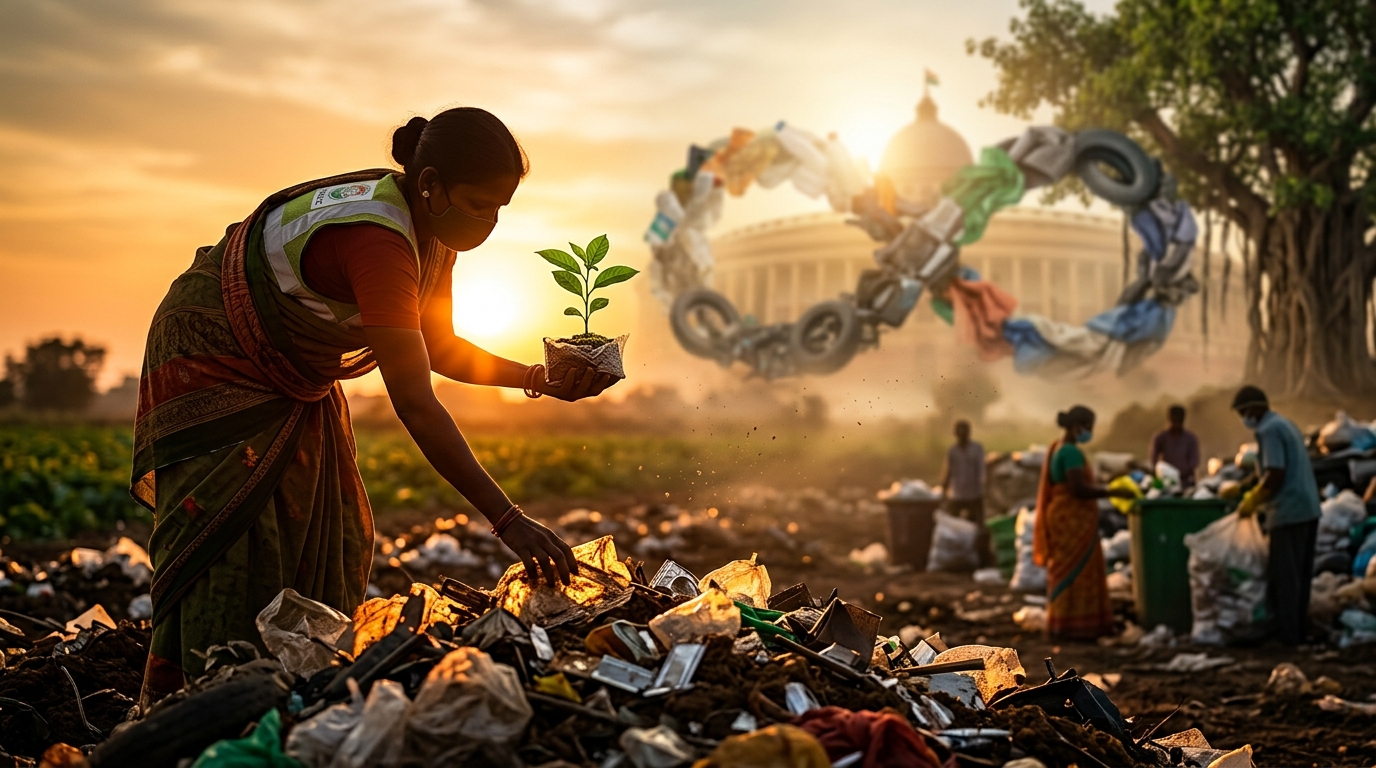
Overview of Circular Economy Initiatives (2022‑2025)
The Circular Economy has become a cornerstone of India’s environmental policy. Under this paradigm, the Ministry of Environment, Forest and Climate Change (MoEF&CC) has issued a series of Waste Management Rules covering plastic, battery, e‑waste, tyres, used oil, end‑of‑life vehicles, construction‑demolition waste, non‑ferrous scrap and solid waste.
Key Legislative Milestones
- 2022‑2025: Introduction of EPR rules for waste tyres (July 2022), batteries (Aug 2022, amended Oct 2023 & Mar 2024), e‑waste (Nov 2022, amended Jan 2023 & July 2023), plastic (amended Apr 2023), used oil (Sept 2023), end‑of‑life vehicles (Jan 2025), construction‑demolition waste (Apr 2025) and non‑ferrous scrap (July 2025).
- Online EPR portals now operational for plastic packaging, e‑waste, battery waste, waste tyres and used oil, enabling registration, compliance tracking and certificate generation.
Implementation Status (as of 05‑Mar‑2026)
Across all waste streams, 4,574 recyclers have registered, collectively recycling 417.57 lakh MT of waste and generating 341.93 lakh MT of EPR certificates. Breakdown:
- Plastic: 2,986 recyclers; 196.97 lakh MT recycled and certified.
- Battery: 520 recyclers; 69.37 lakh MT recycled; 16.14 lakh MT certified.
- Tyre: 579 recyclers; 122.29 lakh MT recycled; 116.94 lakh MT certified.
- E‑waste: 386 recyclers; 28.75 lakh MT recycled; 11.86 lakh MT certified.
- Used Oil: 103 recyclers; 0.19 lakh MT recycled; 0.02 lakh MT certified.
Strategic Support from NITI Aayog and States
In January 2026, NITI Aayog released three reports on enhancing circular economy in end‑of‑life vehicles, waste tyres and e‑waste/lithium‑ion batteries, recommending infrastructure upgrades, sector formalisation and stronger EPR enforcement. The 4th National Conference of Chief Secretaries (Dec 2024) placed Circular Economy as a sub‑theme, prompting all states/UTs to align policies.
States such as Bihar, Odisha, Arunachal Pradesh, Punjab, Madhya Pradesh, Himachal Pradesh, Uttar Pradesh, Meghalaya and Chhattisgarh have embedded circular‑economy provisions in their Industrial Policy Resolutions and launched capital‑subsidy and investment‑promotion schemes for recycling enterprises.
Complementary National Initiatives
- National Critical Mineral Mission (NCMM) (launched Oct 2025): a critical‑mineral recycling incentive of ₹1,500 crore to build capacity for extracting these metals from spent Li‑ion batteries and e‑waste.
- Mission LiFE: a citizen‑led campaign promoting sustainable lifestyles, waste segregation, e‑waste management and reduction of single‑use plastics.
- Voluntary Vehicle‑Fleet Modernisation Programme (V‑VMP) and Registered Vehicle Scrapping Facilities (RVSFs): incentives (₹2,000 crore under SASCI 2025‑26) to scrap unfit vehicles and recycle components scientifically.
- MoEF&CC‑CSIR MoU (Dec 2024) for technology transfer to establish state‑of‑the‑art recycling infrastructure.
- MEIT‑Y’s project to formalise the informal e‑waste sector through MSME‑backed recycling clusters.
Exam Relevance
Understanding the EPR framework is essential for GS III (Environment & Ecology) and GS II (Governance) questions on waste management, public‑private partnership models, and the role of central‑state coordination. The data on registered recyclers and certified waste volumes illustrate policy implementation metrics, a typical analytical angle in answer writing.
Way Forward
To deepen the circular economy, aspirants should focus on:
- Strengthening monitoring mechanisms for EPR compliance and expanding the scope to additional product categories.
- Scaling up financial incentives for informal sector integration and technology up‑gradation.
- Enhancing inter‑ministerial coordination, especially between MoEF&CC, Ministry of Mines, MEIT‑Y and NITI Aayog, to create a unified recycling value chain.
- Promoting research and domestic manufacturing of recycling equipment to reduce import dependence.
Collectively, these steps aim to achieve resource efficiency, job creation across the recycling value chain and reduced environmental degradation—core objectives of India’s sustainable development agenda.